Search icon CANCEL
Subscription
0
Cart icon
Your Cart (0 item)
Close icon
You have no products in your basket yet
Save more on your purchases! discount-offer-chevron-icon
Savings automatically calculated. No voucher code required.
Arrow left icon
Explore Products
Best Sellers
New Releases
Books
Videos
Audiobooks
Learning Hub
Newsletter Hub
Free Learning
Arrow right icon
timer SALE ENDS IN
0 Days
:
00 Hours
:
00 Minutes
:
00 Seconds
Arrow up icon
GO TO TOP
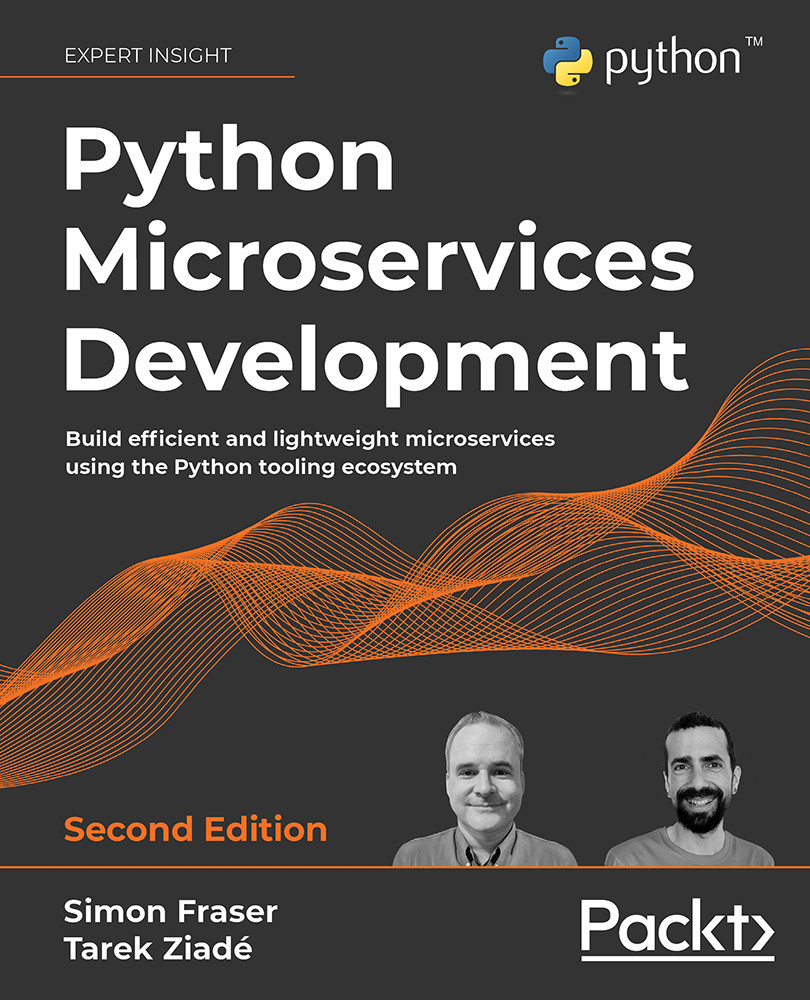
Python Microservices Development

You're reading from   Python Microservices Development Build efficient and lightweight microservices using the Python tooling ecosystem

Arrow left icon
Product type Paperback
Published in Sep 2021
Publisher Packt
ISBN-13 9781801076302
Length 310 pages
Edition 2nd Edition
Languages
Arrow right icon
Authors (2):
Arrow left icon
Simon Fraser Simon Fraser
Author Profile Icon Simon Fraser
Simon Fraser
Tarek Ziadé Tarek Ziadé
Author Profile Icon Tarek Ziadé
Tarek Ziadé
Arrow right icon
View More author details
Toc

Table of Contents (14) Chapters Close

Preface 1. Understanding Microservices 2. Discovering Quart FREE CHAPTER 3. Coding, Testing, and Documentation: the Virtuous Cycle 4. Designing Jeeves 5. Splitting the Monolith 6. Interacting with Other Services 7. Securing Your Services 8. Making a Dashboard 9. Packaging and Running Python 10. Deploying on AWS 11. What's Next? 12. Other Books You May Enjoy
13. Index

Summary

The Jeeves bot is a typical web app that interacts with a database and a few backend services. The only unusual feature is that it receives most of its workload from one endpoint. Building this application with a monolithic architecture has allowed us to quickly iterate over several choices and get a prototype that works well during development and low-volume usage.

From our discussions about the actions, it should be clear that there are good candidates for migration to a microservice. If we run this bot for dozens or hundreds of Slack workspaces, then we may find that one component is used much more than others, or has reliability issues that are difficult to address in the current architecture. How should the application scale up? What happens when an external service it relies upon is encountering errors? What happens if one of our own components—our database or message broker—goes down?

In the next chapter, we will look at these issues: how to change...

lock icon The rest of the chapter is locked
Visually different images
CONTINUE READING
83
Tech Concepts
36
Programming languages
73
Tech Tools
Icon Unlimited access to the largest independent learning library in tech of over 8,000 expert-authored tech books and videos.
Icon Innovative learning tools, including AI book assistants, code context explainers, and text-to-speech.
Icon 50+ new titles added per month and exclusive early access to books as they are being written.
Python Microservices Development
Register for a free Packt account to unlock a world of extra content!
A free Packt account unlocks extra newsletters, articles, discounted offers, and much more. Start advancing your knowledge today.
Unlock this book and the full library FREE for 7 days
Get unlimited access to 7000+ expert-authored eBooks and videos courses covering every tech area you can think of
Renews at €18.99/month. Cancel anytime
Modal Close icon
Modal Close icon