Search icon CANCEL
Subscription
0
Cart icon
Your Cart (0 item)
Close icon
You have no products in your basket yet
Save more on your purchases! discount-offer-chevron-icon
Savings automatically calculated. No voucher code required.
Arrow left icon
Explore Products
Best Sellers
New Releases
Books
Videos
Audiobooks
Learning Hub
Newsletter Hub
Free Learning
Arrow right icon
timer SALE ENDS IN
0 Days
:
00 Hours
:
00 Minutes
:
00 Seconds
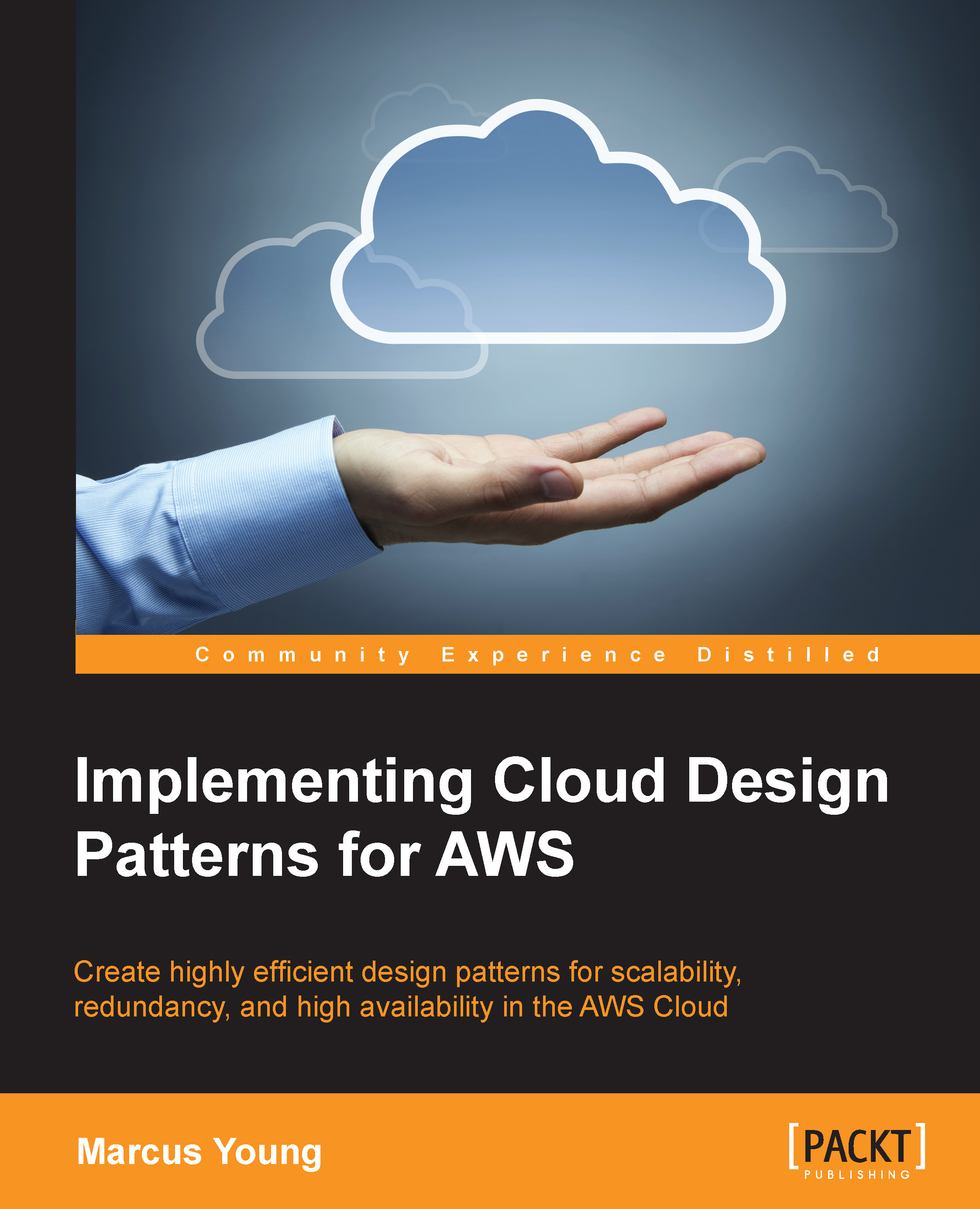
Implementing Cloud Design Patterns for AWS

Implementing Cloud Design Patterns for AWS: Create highly efficient design patterns for scalability, redundancy, and high availability in the AWS Cloud

Arrow left icon
Profile Icon Marcus Young
Arrow right icon
$19.99 per month
Full star icon Full star icon Half star icon Empty star icon Empty star icon 2.8 (5 Ratings)
Paperback Apr 2015 228 pages 1st Edition
eBook
$9.99 $39.99
Paperback
$48.99
Subscription
Free Trial
Renews at $19.99p/m
Arrow left icon
Profile Icon Marcus Young
Arrow right icon
$19.99 per month
Full star icon Full star icon Half star icon Empty star icon Empty star icon 2.8 (5 Ratings)
Paperback Apr 2015 228 pages 1st Edition
eBook
$9.99 $39.99
Paperback
$48.99
Subscription
Free Trial
Renews at $19.99p/m
eBook
$9.99 $39.99
Paperback
$48.99
Subscription
Free Trial
Renews at $19.99p/m

What do you get with a Packt Subscription?

Free for first 7 days. $19.99 p/m after that. Cancel any time!
Product feature icon Unlimited ad-free access to the largest independent learning library in tech. Access this title and thousands more!
Product feature icon 50+ new titles added per month, including many first-to-market concepts and exclusive early access to books as they are being written.
Product feature icon Innovative learning tools, including AI book assistants, code context explainers, and text-to-speech.
Product feature icon Thousands of reference materials covering every tech concept you need to stay up to date.
Subscribe now
View plans & pricing
Table of content icon View table of contents Preview book icon Preview Book

Implementing Cloud Design Patterns for AWS

Chapter 1. Introduction

The paradigm for development of applications has shifted in many ways over the years. Instead of just developing pure applications, aimed at specific system configurations, the trend has moved towards web applications. These applications present a very different set of challenges not just for the developers, but also for the people who manage the systems that host them. The reaction to this need to build, test, and manage such web applications has been to develop an abstraction on top of the hardware that allows for the ability to bring up entire virtualized environments quickly and consistently.

Throughout these chapters, you will learn basic design principles for applications and known issues. These may not be completely compatible with all application types but should serve as a basic toolkit for bigger design patterns. It is also very important to note that AWS adds new services all the time, some of which by default solve these design patterns at the time of writing. If your software or services handle sensitive data and have in-flight or at-rest requirements, be very careful to read how each individual AWS-provided service handles data.

The topics that are covered in this chapter are:

  • Introduction to AWS
  • Cloud computing service models
  • Benefits of moving to the Cloud
  • Problems encountered with AWS

Introduction to AWS

Amazon Web Services (AWS) is a very large suite of Cloud services provided by Amazon. AWS provides, at a base level, virtual machines and the services surrounding them. Many Cloud-based virtual machine services such as Google Compute Engine, DigitalOcean, Rackspace, Windows Azure, and so on provide the ability to bring up a machine from a supported base operating system image or snapshot, and it's up to the user to customize it further.

Amazon has made itself one of the leaders for Cloud-hosting by providing not just virtual machines, but configurable services and software implementations of hardware found in data centers. For most large-scale systems, the move to Cloud infrastructure brings to the table a huge set of questions on how to handle issues such as load balancing, content delivery networks, failover, and replication. The AWS suite can handle the same issues that a physical data center can, usually for a fraction of the cost. They can get rid of some of the red tape that comes with a data center such as requesting provisioning, repairs, and scheduling downtime.

Amazon is constantly offering new services to tackle new and unique problems encountered with Cloud infrastructure. However, this book may not cover every service offered by Amazon. The services that this book will cover include:

  • Computing and networking
    • Elastic Cloud Compute (EC2) virtual machines
    • Route 53 DNS provides local and global DNS look-ups
    • Virtual Private Cloud (VPC) isolated Cloud networks provide internal networks
    • Elastic Load Balancers (ELB) automatically distribute traffic across EC2 instances
    • Auto Scaling Groups (ASG) provide a way to scale instances up and down based on schedules or metrics gathered via CloudWatch from the EC2 instances attached to them
  • Database
    • SimpleDB is a highly scalable NoSQL database
    • Relational Database Service (RDS) is a scalable SQL database apart from MySQL, Oracle, PostgreSQL, or SQL Server
    • ElastiCache is an in-memory cache on top of Redis or MemCached
  • Storage and content delivery
    • Simple Storage Service (S3) is a distributed storage network that crosses data center boundaries with built-in redundancy
    • CloudFront is a CDN that distributes content based on latency or location
  • Application services
    • Simple Queue Service (SQS) is a fast, reliable, scalable, and fully managed message queuing service
  • Deployment and management
    • CloudFormation is a service that allows the provisioning and updating of AWS resources through templates, usually JSON
  • Logging
    • CloudWatch can monitor, display, and alert on instance metrics and logs

Tip

For information on other services provided by AWS that are not relevant to the information in this book visit http://aws.amazon.com/products/.

Cloud computing service models

AWS falls under the category of Cloud computing called Infrastructure as a Service. In Cloud computing there are three service models:

  • Infrastructure as a Service (IaaS)
  • Platform as a Service (PaaS)
  • Software as a Service (SaaS)

Infrastructure as a Service

IaaS can be described as a service that provides virtual abstractions for hardware, servers, and networking components. The service provider owns all the equipment and is responsible for its housing, running, and maintenance. In this case, AWS provides APIs, SDKs, and a UI for creating and modifying virtual machines, their network components, routers, gateways, subnets, load balancers, and much more. Where a user with a physical data center would incur charges for the hardware, shelving, and access, this is removed by IaaS with a payment model that is per-hour (or per-use) type.

Platform as a Service

While AWS itself is an IaaS provider, it contains a product named ElasticBeanstalk, which falls under the PaaS category for Cloud models. PaaS is described as the delivery of a computing platform, typically an operating system, programming language execution environment, database, or web server. With ElasticBeanStalk, a user can easily turn a code into a running environment without having to worry about any of the pieces underneath such as setting up and maintaining the database, web server, or code runtime versions. It also allows it to be scaled without having to do anything other than define scale policies through the configuration.

Software as a Service

AWS also provides a marketplace where a user can purchase official and third-party operating system images that provide configurable services such as databases, web applications, and more. This type of service falls under the SaaS model. The best interpretation for the SaaS model is on-demand software, meaning that the user need only configure the software to use and interact with it. The draw to SaaS is that there is no need to learn how to configure and deploy the software to get it working in a larger stack and generally the charges are per usage-hour.

The AWS suite is both impressive and unique in that it doesn't fall under any one of the Cloud service models as described previously. Until AWS made its name, the need to virtualize an entire environment or stack was usually not an easy task and consisted of a collection of different providers, each solving a specific part of the deployment puzzle. The cost of using many different providers to create a virtual stack might not be cheaper than the initial hardware cost for moving equipment into a data center. Besides the cost of the providers themselves, having multiple providers also created the problem of scaling in one area and notifying another of the changes. While making applications more resilient and scalable, this Frankenstein method usually did not simplify the problem as a whole.

Benefits of moving to the Cloud

There are many different answers to why moving to a Cloud-hosted environment might be beneficial but it depends on the end user. The shift may suit small teams but for mid-sized teams the effort saved begins to outweigh the cost. I start at mid-sized because this is the size that usually includes the two teams that benefit the most:

  • The developers and testers
  • Operations

For a developer, the biggest benefit of Cloud providers is the ability to throw away entire environments. In a traditional developer setting, the developers usually develop their code locally, have access to a shared physical server, or have access to a virtual server of some type. Issues that usually arise out of these setups are that it's hard to enforce consistency and the servers can become stale over time. If each developer works locally, inconsistency can arise very quickly. Different versions of the core language or software could be used and might behave differently from machine to machine. One developer might use Windows and prefer registry look-ups while another developer may use Mac and prefer environment variables.

If the developers share a core server for development, other issues may arise such as permissions or possibly trying to modify services independent of each other causing race conditions. No matter what problems exist, known or unknown, they could be solved by always starting from the same base operating system state. The leading software for solving this issue is Vagrant. Vagrant provides the ability to spin up and destroy a virtual machine from a configuration file along with a configuration management suite such as Puppet, Chef, Docker, or Ansible. Vagrant itself is agnostic to the Cloud hosting tool in the sense that it does not require AWS. It can spin up instances at AWS given the credentials, but it can also spin up virtual machines locally from VirtualBox and VMWare.

Vagrant gives back consistency to the developers in the sense that it takes a base box (in AWS terms this is an Amazon Machine Image or AMI) and configures it via one of the configuration suites or shell to create a running virtual machine every time it is needed. If all the developers share the same configuration file then all of them are mostly guaranteed to work against the same environment. That environment can be destroyed just as easily as it was created, giving the resources back and incurring no charges until needed again.

The bringing up and destroying of the instances becomes a small invisible piece of their workflow. By virtue of enforcing a strategy like this on a team, a lot of issues can be found and resolved before they make their way up the chain to the testing or production environments.

Note

More information on Vagrant can be found at http://www.vagrantup.com.

The other team I mentioned that benefits from moving to the Cloud is the operations team. This team differs greatly in responsibility from company to company but it is safe to assume that the team is heavily involved with monitoring the applications and systems for issues and possible optimizations. AWS provides enough infrastructure for monitoring and acting on metrics and an entire book could be dedicated to the topic. However, I'll focus only on auto scaling groups and CloudWatch.

For AWS, an auto scaling group defines scaling policies for instances based on schedules, custom metrics, or base metrics such as disk usage, CPU utilization, memory usage, and so on. An auto scaling group can act on these thresholds and scale up or down depending on how they are configured. In a non-Cloud environment this same setup takes quite a bit of effort and depends on the software whereas, it's a core concept to AWS.

Auto scaling groups also automatically register instances with a load balancer and shift them into a round robin distribution. For an operations team, the benefit of moving to Amazon might justify itself only to alleviate all the work involved in duplicating this functionality elsewhere, allowing the team to focus on creating deeper and more meaningful system health checks.

Throw-away environments can also be beneficial to the operations teams. A sibling product to Vagrant, very recently released, is Terraform. Terraform, like Vagrant, is agnostic to the hosting environment but does not solely spin up virtual instances. Terraform is similar to CloudFormation in the sense that its goal is to take a central configuration file, which describes all the resources it needs. It then maps them into a dependency graph, optimizes, and creates an entire stack. A common example for Terraform would be to create a production environment from a few virtual machines, load balancers, Route53 DNS entries, and set auto scaling policies. This flexibility would be nearly impossible in traditional hardware settings and provides an on-demand mentality not just for the base application, but also for the entire infrastructure, leading to a more agile core.

Note

More information on Terraform can be found at http://www.terraform.io.

Common problems encountered at AWS

The previous sections have tried to make light of issues found in traditional settings, which might make moving to a Cloud infrastructure seem like a logical choice with no ramifications. But this is not true. While Cloud infrastructure aims to resolve many problems, it does bring up new issues to the user.

Underlying hardware failures

Some issues can be avoided while others may not. Some examples of issues that may not be avoided, other than user error, are underlying hardware issues that propagate themselves to the user. Hardware has a fail rate and can be guaranteed to fail at some point while the benefit of IaaS is that, even though the hardware is abstracted away, it is still a relevant topic to anyone using it.
AWS has a Service Level Agreement (SLA) policy for each service, which guarantees that at their end you will meet a certain percentage of uptime. This implies a certain amount of downtime for scheduled maintenance and repairs of the hardware underneath.

As an AWS user this means you can expect an e-mail at some point during usage warning about instances being stopped and the need to restart manually. While this is no different from a physical environment where the user schedules their own downtime, it does mean that instances can misbehave when the hardware is starting to fail. Most of the replication and failover is handled underneath but if the application is real-time and is stopped, it does mean that you, as a user, should have policies in place to handle this situation.

Over-provisioning

Another issue with having virtual machines in the Cloud is over-provisioning. An instance type is selected when an instance is launched that corresponds to the virtualized hardware required for it. Without taking measures to ensure that replication or scaling happens on multiple data centers, there is a very real risk that when a new instance is needed, the hardware will not be immediately available. If scaling policies are in effect that specify your application should scale out to a certain number of instances, but all of those instances are in a data center nearing its maximum capacity, the scaling policy will fail. This failure negates having a scaling policy in place if it cannot always scale to the size required.

Under-provisioning

A topic that is rarely talked about but is very common is under-provisioning and it is the opposite of over-provisioning. We will start with an example: say we purchase a server for hosting a database and purchase the smallest instance type possible. Let's assume that for the next few days this is the only machine running in a specific rack in the AWS data center. We are promised the resources of the instance we purchased but as the hardware is free, it gives us a boost in performance that we get accustomed to unknowingly.

After a few days, the hardware that has been provisioned for other customers, now gives us the resources we were promised and not the extra boost we got for free in the background. While monitoring we now see a performance degradation! While this database was originally able to perform so many transactions per second it now does much less. The problem here is that we grew accustomed to the processing power that technically was not ours and now our database does not perform the way we expected it to.

Perhaps the promised amount is not suitable but it is live and has customer data within it. To resolve this, we must terminate the instance and change the instance type to something more powerful, which could have downstream effects or even full downtime to the customer. This is the danger of under-provisioning and it is extremely hard to trace. Not knowing what kind of a performance we should actually get (as promised in the SLA) causes us to possibly affect the customer, which is never ideal.

Replication

The previous examples are extreme and rarely encountered. For example, in a traditional hosting environment where there are multiple applications behind a load balancer, replication is not trivial. Replication of this application server requires registration with the load balancer and is usually done manually or requires configuration each time. AWS-provided ELBs are a first-class entity just like the virtual machines themselves. The registration between this is abstracted and can be done with the click of a button or automatically through auto scaling groups and start-up scripts.

Redundancy

Apart from replication, redundancy is another hot topic. Most database clustering takes redundancy into effect but requires special configuration and initial setup. The RDS allows replication to be specified at the time of setup and guarantees redundancy and uptime as per its SLA. Their Multi-AZ specification guarantees that the replication crosses availability zones and provides automatic failover. Besides replication, special software or configuration is needed to store offsite backups. With S3, an instance may synchronize with an S3 bucket. S3 is itself a redundant storage that crosses data center sites and can be done via an AWS CLI or their provided API. S3 is also a first-class entity so permissions can be provided transparently to virtual machines.

The previous database example hints towards a set of issues deemed high availability. The purpose of high availability is to mitigate redundancy through a load balancer, proxy, or crossing availability zones. This is a part of risk management and disaster recovery. The last thing an operations team would want is to have their database go down and be replicated to New Orleans during Hurricane Katrina. This is an extreme and incredibly rare example but the risk exists. The reason that disaster recovery exists and will always exist is the simple fact that accidents happen and have happened when ill-prepared.

Improving the end user experience

Another set of problems to be solved is optimization to the end user. Optimization in this case is proxying through cache servers so that high workloads can be handled without spinning up more instances. In a scaling policy, high bandwidth would lead to more instances, which incur cost and startup time. Caching static content, where possible, can help mitigate high bandwidth peaks. Other ways to optimize without caching might be to use Content Delivery Networks (CDNs) such as the AWS-provided CloudFront service, which automatically choose servers geographically close to the user.

Monitoring and log-gathering

The last set of problems to discuss in small detail is operational in nature. Most applications generate logs and large software stacks with many disparate logs. Third-party software such as Loggly and Splunk exist to aggregate and search log collections but AWS has services dedicated to this as well. The preferred way is to upload logs to CloudWatch. CloudWatch allows you to directly search and create alerts on the data within logs. Since CloudWatch is a first-class AWS service, they provide an SLA similar to the instance itself and the storage is scalable.

These are only some of the issues that someone shifting into AWS might encounter or need to fortify their infrastructure against. Reading through the chapters of this book will serve as a beginner's guide of sorts to help create a resilient infrastructure against these issues and others.

Summary

Throughout this brief introduction to AWS, we learned not only the background and industry shift into virtualized infrastructure, but also where AWS fits in with some competitors. We not only discussed the kinds of problems AWS solves, but also the kinds of problems that can be encountered in Cloud infrastructure. There are countless unique processes to be solved with this dynamic paravirtual environment. Picking up consistent patterns throughout this book will help to strengthen applications of many forms against these issues. In the next chapter, we will go over some basic design patterns. It is one of the easier topics and covers data backups through instance snapshots, replication through machine imaging, scaling instance types, dynamic scaling through CloudWatch, and increasing the disk size when needed. These patterns help solve common provisioning issues for single instances.

Left arrow icon Right arrow icon

Description

This book is aimed at architects, solution providers, and those of the DevOps community who are looking to implement repeatable patterns for deploying and maintaining services in the Amazon cloud infrastructure. Prior experience using AWS is required as the book focuses more on the patterns and not on the basics of using AWS.

Who is this book for?

This book is aimed at architects, solution providers, and those of the DevOps community who are looking to implement repeatable patterns for deploying and maintaining services in the Amazon cloud infrastructure. Prior experience using AWS is required as the book focuses more on the patterns and not on the basics of using AWS.

What you will learn

  • Create and maintain server backups
  • Implement scaling policies on schedules, influxes in traffic, and deep health checks
  • Provision servers and data that persist through termination
  • Make complete use of high availability storage and redundancy storage
  • Design content delivery networks to improve user experience
  • Optimize databases through caching and sharding
  • Monitor and queue data for processing

Product Details

Country selected
Publication date, Length, Edition, Language, ISBN-13
Publication date : Apr 29, 2015
Length: 228 pages
Edition : 1st
Language : English
ISBN-13 : 9781782177340
Vendor :
Amazon
Tools :

What do you get with a Packt Subscription?

Free for first 7 days. $19.99 p/m after that. Cancel any time!
Product feature icon Unlimited ad-free access to the largest independent learning library in tech. Access this title and thousands more!
Product feature icon 50+ new titles added per month, including many first-to-market concepts and exclusive early access to books as they are being written.
Product feature icon Innovative learning tools, including AI book assistants, code context explainers, and text-to-speech.
Product feature icon Thousands of reference materials covering every tech concept you need to stay up to date.
Subscribe now
View plans & pricing

Product Details

Publication date : Apr 29, 2015
Length: 228 pages
Edition : 1st
Language : English
ISBN-13 : 9781782177340
Vendor :
Amazon
Tools :

Packt Subscriptions

See our plans and pricing
Modal Close icon
$19.99 billed monthly
Feature tick icon Unlimited access to Packt's library of 7,000+ practical books and videos
Feature tick icon Constantly refreshed with 50+ new titles a month
Feature tick icon Exclusive Early access to books as they're written
Feature tick icon Solve problems while you work with advanced search and reference features
Feature tick icon Offline reading on the mobile app
Feature tick icon Simple pricing, no contract
$199.99 billed annually
Feature tick icon Unlimited access to Packt's library of 7,000+ practical books and videos
Feature tick icon Constantly refreshed with 50+ new titles a month
Feature tick icon Exclusive Early access to books as they're written
Feature tick icon Solve problems while you work with advanced search and reference features
Feature tick icon Offline reading on the mobile app
Feature tick icon Choose a DRM-free eBook or Video every month to keep
Feature tick icon PLUS own as many other DRM-free eBooks or Videos as you like for just $5 each
Feature tick icon Exclusive print discounts
$279.99 billed in 18 months
Feature tick icon Unlimited access to Packt's library of 7,000+ practical books and videos
Feature tick icon Constantly refreshed with 50+ new titles a month
Feature tick icon Exclusive Early access to books as they're written
Feature tick icon Solve problems while you work with advanced search and reference features
Feature tick icon Offline reading on the mobile app
Feature tick icon Choose a DRM-free eBook or Video every month to keep
Feature tick icon PLUS own as many other DRM-free eBooks or Videos as you like for just $5 each
Feature tick icon Exclusive print discounts

Frequently bought together


Stars icon
Total $ 152.97
Learning AWS
$54.99
AWS Administration ??? The  Definitive Guide
$48.99
Implementing Cloud Design Patterns for AWS
$48.99
Total $ 152.97 Stars icon

Table of Contents

12 Chapters
1. Introduction Chevron down icon Chevron up icon
2. Basic Patterns Chevron down icon Chevron up icon
3. Patterns for High Availability Chevron down icon Chevron up icon
4. Patterns for Processing Static Data Chevron down icon Chevron up icon
5. Patterns for Processing Dynamic Data Chevron down icon Chevron up icon
6. Patterns for Uploading Data Chevron down icon Chevron up icon
7. Patterns for Databases Chevron down icon Chevron up icon
8. Patterns for Data Processing Chevron down icon Chevron up icon
9. Patterns for Operation and Maintenance Chevron down icon Chevron up icon
10. Patterns for Networking Chevron down icon Chevron up icon
11. Throw-away Environments Chevron down icon Chevron up icon
Index Chevron down icon Chevron up icon

Customer reviews

Rating distribution
Full star icon Full star icon Half star icon Empty star icon Empty star icon 2.8
(5 Ratings)
5 star 20%
4 star 0%
3 star 40%
2 star 20%
1 star 20%
Krzysztof Satola Sep 02, 2015
Full star icon Full star icon Full star icon Full star icon Full star icon 5
ShortA great reference guide filled with detailed implementation design examples in the do-it-yourself fashion, showing best practices to cloud applications design. Can serve as a basic toolkit for building more complex designs as well as practical guide to AWS operations. Complements nicely AWS Cloud Design Patterns (CDP).FullThis book is aimed at architects, solution providers, and DevOps interested in repeatable implementation patterns for deploying and maintaining services in the Amazon Cloud infrastructure. The beginning of the Implementing Cloud Design Patterns for AWS covers general cloud-related introductory topics, cloud computing service models, benefits of moving to the cloud, and some specific concerns related to AWS (i.e. over- and under-provisioning). The rest of the book is focused on different patterns in high availability, data processing, operations and maintenance, networking, and dynamic infrastructure.I like the way the content of this book is organized. The author introduces some atom patterns (i.e. Stamp pattern) and then reuses them while explaining more complicated scenarios (i.e. Multi-server pattern). He starts with the very basic topics to finish with the more complex ones: microservices, DevOps and infrastructure as code, temporary development environments or continous integration. I wish the latter topics were described in greater detail. Maybe this would happen in the next release of this useful book?The structure of the book is based on AWS Cloud Design Patterns (CDP), a collection of solutions and design ideas for using AWS cloud technology to solve common systems design problems. I find it as an implementation guide for the patters defined on the CDP website. All use cases are shown in a consistent way with step-by-step instructions of how to simulate/accomplish them using AWS Management Console or third party tools like Vagrant or Varnish. Readers will need some basic AWS knowledge though to better understand what is happening in the background while performing these hands-on exercises. As the book complements the CDP, I would recommend readers to start with the pattern descriptions on the CDP website and then refer to the book, to see how to implement specific patterns. Both, the book and the website, play very nice together and can become a valuable asset in a cloud architect’s library.I like the author’s recommendations and caution points which can be found throughout the book. In my opinion the are very valid and represent quite pragmatic approach to topics being discused. The book consists of screenshots, short comments and command-line or code snippets, very concise and straight to the point.The book could be also used by readers not very interested in the cloud design but just wanting to get some guidance on how to play with some AWS-based services (instantiating EC2 images, configuring ELBs, working with S3 and so on). Links to specific sections of AWS documentation available in the book may also help with deeper understanding of how services described in the book actually work.As the move to cloud infrastructure brings to the table a huge set of questions on how to handle issues such as load balancing, content delivery networks, failover, and replication, this book can definitely help to tackle all of them one by one.
Amazon Verified review Amazon
I.F. Jun 25, 2015
Full star icon Full star icon Full star icon Empty star icon Empty star icon 3
Very essential and yet effective. A perfect introduction to the Amazon AWS service
Amazon Verified review Amazon
david Aug 14, 2015
Full star icon Full star icon Full star icon Empty star icon Empty star icon 3
It covers all deployment patterns on AWS: Networking, Maintenance, Monitoring, DB, Backup, Data, etc .. in a very practical way with easily implementable simple examples. It is an interesting guide that offers ideas for deploying applications on Amazon AWS.Also in the final chapters refers to the interaction with other applications to integrate with AWS CI: Packer, Vagrant, etc ...Recommended to have an overview of what Amazon AWS can offer and provides different deployment patterns.
Amazon Verified review Amazon
FireTV is unreliable as HELL ! Jun 19, 2017
Full star icon Full star icon Empty star icon Empty star icon Empty star icon 2
By definition a design pattern is a tried and tested production grade solution, this book is just a collection of basic ideas which describe how a handful of AWS features work, it is full of caveats saying how the solution would not work in the real world.All in it's not worth much, the free AWS white papers contain better information, this is not even a 'complete' beginners guide.
Amazon Verified review Amazon
Dirk Estievenart Dec 08, 2015
Full star icon Empty star icon Empty star icon Empty star icon Empty star icon 1
I bought the Kindle edition.- The table of contents is not working on Kindle, so each time you need to jump to another chapter, you'll have to scroll back to the beginning of the book. This is quite annoying for a tech book!- The book is difficult to read and navigate overall.- All the examples are written in bash which is OK for sysadmin tasks, but this will hardly be the way you'll implement your applications.- The patterns are obvious and any developer with some experience can figure them out by thinking 5 minutes.- Worst of all, this book hardly handles any AWS service!! Kinesis? SNS? DynamoDB? Elasticache? Lambda?I'd expect from a book about patterns for AWS to use ElastiCache instead of setting up a Redis yourself.Don't waste your money on this.
Amazon Verified review Amazon
Get free access to Packt library with over 7500+ books and video courses for 7 days!
Start Free Trial

FAQs

What is included in a Packt subscription? Chevron down icon Chevron up icon

A subscription provides you with full access to view all Packt and licnesed content online, this includes exclusive access to Early Access titles. Depending on the tier chosen you can also earn credits and discounts to use for owning content

How can I cancel my subscription? Chevron down icon Chevron up icon

To cancel your subscription with us simply go to the account page - found in the top right of the page or at https://subscription.packtpub.com/my-account/subscription - From here you will see the ‘cancel subscription’ button in the grey box with your subscription information in.

What are credits? Chevron down icon Chevron up icon

Credits can be earned from reading 40 section of any title within the payment cycle - a month starting from the day of subscription payment. You also earn a Credit every month if you subscribe to our annual or 18 month plans. Credits can be used to buy books DRM free, the same way that you would pay for a book. Your credits can be found in the subscription homepage - subscription.packtpub.com - clicking on ‘the my’ library dropdown and selecting ‘credits’.

What happens if an Early Access Course is cancelled? Chevron down icon Chevron up icon

Projects are rarely cancelled, but sometimes it's unavoidable. If an Early Access course is cancelled or excessively delayed, you can exchange your purchase for another course. For further details, please contact us here.

Where can I send feedback about an Early Access title? Chevron down icon Chevron up icon

If you have any feedback about the product you're reading, or Early Access in general, then please fill out a contact form here and we'll make sure the feedback gets to the right team. 

Can I download the code files for Early Access titles? Chevron down icon Chevron up icon

We try to ensure that all books in Early Access have code available to use, download, and fork on GitHub. This helps us be more agile in the development of the book, and helps keep the often changing code base of new versions and new technologies as up to date as possible. Unfortunately, however, there will be rare cases when it is not possible for us to have downloadable code samples available until publication.

When we publish the book, the code files will also be available to download from the Packt website.

How accurate is the publication date? Chevron down icon Chevron up icon

The publication date is as accurate as we can be at any point in the project. Unfortunately, delays can happen. Often those delays are out of our control, such as changes to the technology code base or delays in the tech release. We do our best to give you an accurate estimate of the publication date at any given time, and as more chapters are delivered, the more accurate the delivery date will become.

How will I know when new chapters are ready? Chevron down icon Chevron up icon

We'll let you know every time there has been an update to a course that you've bought in Early Access. You'll get an email to let you know there has been a new chapter, or a change to a previous chapter. The new chapters are automatically added to your account, so you can also check back there any time you're ready and download or read them online.

I am a Packt subscriber, do I get Early Access? Chevron down icon Chevron up icon

Yes, all Early Access content is fully available through your subscription. You will need to have a paid for or active trial subscription in order to access all titles.

How is Early Access delivered? Chevron down icon Chevron up icon

Early Access is currently only available as a PDF or through our online reader. As we make changes or add new chapters, the files in your Packt account will be updated so you can download them again or view them online immediately.

How do I buy Early Access content? Chevron down icon Chevron up icon

Early Access is a way of us getting our content to you quicker, but the method of buying the Early Access course is still the same. Just find the course you want to buy, go through the check-out steps, and you’ll get a confirmation email from us with information and a link to the relevant Early Access courses.

What is Early Access? Chevron down icon Chevron up icon

Keeping up to date with the latest technology is difficult; new versions, new frameworks, new techniques. This feature gives you a head-start to our content, as it's being created. With Early Access you'll receive each chapter as it's written, and get regular updates throughout the product's development, as well as the final course as soon as it's ready.We created Early Access as a means of giving you the information you need, as soon as it's available. As we go through the process of developing a course, 99% of it can be ready but we can't publish until that last 1% falls in to place. Early Access helps to unlock the potential of our content early, to help you start your learning when you need it most. You not only get access to every chapter as it's delivered, edited, and updated, but you'll also get the finalized, DRM-free product to download in any format you want when it's published. As a member of Packt, you'll also be eligible for our exclusive offers, including a free course every day, and discounts on new and popular titles.

Modal Close icon
Modal Close icon