Search icon CANCEL
Subscription
0
Cart icon
Your Cart (0 item)
Close icon
You have no products in your basket yet
Save more on your purchases! discount-offer-chevron-icon
Savings automatically calculated. No voucher code required.
Arrow left icon
Explore Products
Best Sellers
New Releases
Books
Videos
Audiobooks
Learning Hub
Newsletter Hub
Free Learning
Arrow right icon
timer SALE ENDS IN
0 Days
:
00 Hours
:
00 Minutes
:
00 Seconds
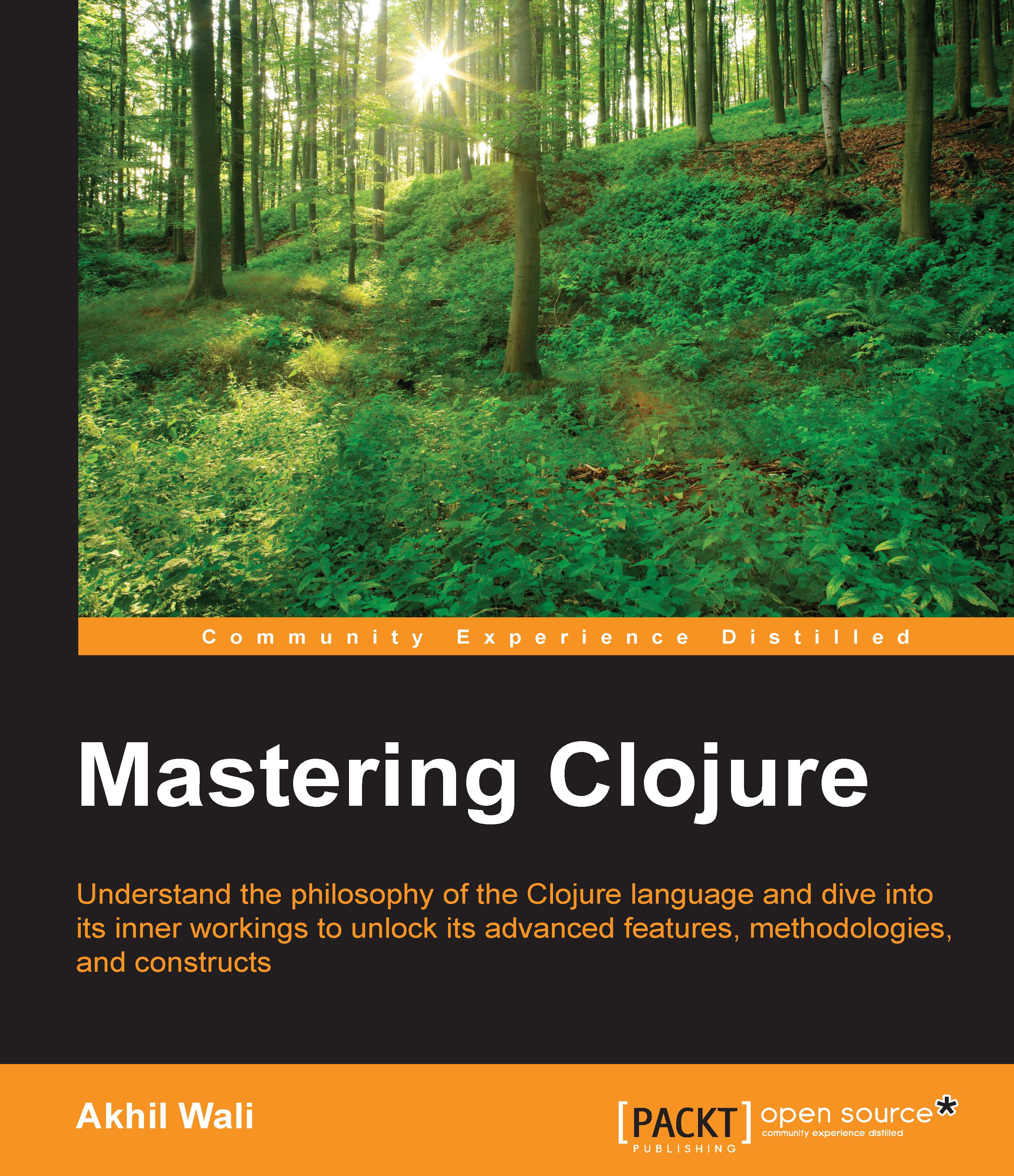
Mastering Clojure
Mastering Clojure

Mastering Clojure: Understand the philosophy of the Clojure language and dive into its inner workings to unlock its advanced features, methodologies, and constructs
eBook
$9.99 $43.99
Paperback
$54.99
Subscription
Free Trial
Renews at $19.99p/m

What do you get with a Packt Subscription?

Free for first 7 days. $19.99 p/m after that. Cancel any time!
Product feature icon Unlimited ad-free access to the largest independent learning library in tech. Access this title and thousands more!
Product feature icon 50+ new titles added per month, including many first-to-market concepts and exclusive early access to books as they are being written.
Product feature icon Innovative learning tools, including AI book assistants, code context explainers, and text-to-speech.
Product feature icon Thousands of reference materials covering every tech concept you need to stay up to date.
Subscribe now
View plans & pricing
Table of content icon View table of contents Preview book icon Preview Book

Mastering Clojure

Chapter 2. Orchestrating Concurrency and Parallelism

Let's now examine how concurrent and parallel programming are supported in Clojure. The term concurrent programming refers to managing more than one task at the same time. Parallel programming or parallelism, on the other hand, deals with executing multiple tasks at the same time. The distinction between these two terms is that concurrency is about how we structure and synchronize multiple tasks, and parallelism is more about running multiple tasks in parallel over multiple cores. The main advantages of using concurrency and parallelism can be elaborated as follows:

  • Concurrent programs can perform multiple tasks simultaneously. For example, a desktop application can have a single task for handling user interaction and another task for handling I/O and network communication. A single processor can be shared among several tasks. Processor utilization is thus more effective in concurrent programs.
  • Parallel programs take advantage...

Managing concurrent tasks

Clojure has a couple of handy constructs that allow us to define concurrent tasks. A thread is the most elementary abstraction of a task that runs in the background. In the formal sense, a thread is simply a sequence of instructions that can be scheduled for execution. A task that runs in the background of a program is said to execute on a separate thread. Threads will be scheduled for execution on a specific processor by the underlying operating system. Most modern operating systems allow a process to have several threads of execution. The technique of managing multiple threads in a single process is termed as multithreading.

While Clojure does support the use of threads, concurrent tasks can be modeled in more elegant ways using other constructs. Let's explore the different ways in which we can define concurrent tasks.

Note

The following examples can be found in src/m_clj/c2/concurrent.clj of the book's source code.

Using delays

A delay can be used to define...

Managing state

A program can be divided into several parts which can execute concurrently. It is often necessary to share data or state among these concurrently running tasks. Thus, we arrive at the notion of having multiple observers for some data. If the data gets modified, we must ensure that the changes are visible to all observers. For example, suppose there are two threads that read data from a common variable. This data gets modified by one thread, and the change must be propagated to the other thread as soon as possible to avoid inconsistencies.

Programming languages that support mutability handle this problem by locking over a monitor, as we demonstrated with the locking form, and maintaining local copies of the data. In such languages, a variable is just a container for data. Whenever a concurrent task accesses a variable that is shared with other tasks, it copies the data from the variable. This is done in order to prevent unwanted overwriting of the variable by other tasks while...

Executing tasks in parallel

The simultaneous execution of several computations is termed as parallelism. The use of parallelism tends to increase the overall performance of a computation, since the computation can be partitioned to execute on several cores or processors. Clojure has a couple of functions that can be used for the parallelization of a particular computation or task, and we will briefly examine them in this section.

Note

The following examples can be found in src/m_clj/c2/parallel.clj of the book's source code.

Suppose we have a function that pauses the current thread for some time and then returns a computed value, as depicted in Example 2.17:

(defn square-slowly [x]
  (Thread/sleep 2000)
  (* x x))

Example 2.17: A function that pauses the current thread

The function square-slowly in Example 2.17 requires a single argument x. This function pauses the current thread for two seconds and returns the square of its argument x. If the function square-slowly is invoked over a collection...

Summary

We have explored various constructs that can be used to create concurrent and parallel tasks in Clojure. You learned to handle shared mutable state through the use of reference types, namely vars, refs, atoms and agents. As we described earlier, the dining philosophers problem can be easily implemented using refs and agents. You also studied how tasks can be executed in parallel. Lastly, we explored the claypoole library, which allows us to control the amount of parallelism used for a given computation.

In the next chapter, we will continue our exploration of parallelism in Clojure through the use of reducers.

Left arrow icon Right arrow icon
Download code icon Download Code

Key benefits

  • Learn to handle data using sequences, reducers, and transducers in Clojure
  • Explore the lesser known and more advanced features, constructs, and methodologies of the Clojure language and its ecosystem, such as asynchronous channels, actors, logic programming, and reactive programming
  • Sharpen your Clojure skills through illustrative and comprehensive examples

Description

Clojure is a general-purpose language from the Lisp family with an emphasis on functional programming. It has some interesting concepts and features such as immutability, gradual typing, thread-safe concurrency primitives, and macro-based metaprogramming, which makes it a great choice to create modern, performant, and scalable applications. Mastering Clojure gives you an insight into the nitty-gritty details and more advanced features of the Clojure programming language to create more scalable, maintainable, and elegant applications. You’ll start off by learning the details of sequences, concurrency primitives, and macros. Packed with a lot of examples, you’ll get a walkthrough on orchestrating concurrency and parallelism, which will help you understand Clojure reducers, and we’ll walk through composing transducers so you know about functional composition and process transformation inside out. We also explain how reducers and transducers can be used to handle data in a more performant manner. Later on, we describe how Clojure also supports other programming paradigms such as pure functional programming and logic programming. Furthermore, you’ll level up your skills by taking advantage of Clojure's powerful macro system. Parallel, asynchronous, and reactive programming techniques are also described in detail. Lastly, we’ll show you how to test and troubleshoot your code to speed up your development cycles and allow you to deploy the code faster.

Who is this book for?

If you’re looking to learn more about the core libraries and dive deep into the Clojure language, then this book is ideal for you. Prior knowledge of the Clojure language is required.

What you will learn

  • * Maximize the impact of parallelization, functional composition, and process transformation by composing reducers and transducers
  • * Process and manipulate data using sequences, reducers, and transducers in Clojure
  • * Modify and add features to the Clojure language using macros
  • * Explore the features of category theory and custom data sources for logic programming in Clojure
  • * Orchestrate parallelism and concurrency using built-in primitives as well as community libraries in Clojure
  • * Handle data with asynchronous and reactive programming methodologies and leverage it using the core.async library
  • * Test your code with unit tests, specs, and type checks to write testable code
  • * Troubleshoot and style your Clojure code to make it more maintainable

Product Details

Country selected
Publication date, Length, Edition, Language, ISBN-13
Publication date : Mar 28, 2016
Length: 266 pages
Edition : 1st
Language : English
ISBN-13 : 9781785889745
Category :
Languages :

What do you get with a Packt Subscription?

Free for first 7 days. $19.99 p/m after that. Cancel any time!
Product feature icon Unlimited ad-free access to the largest independent learning library in tech. Access this title and thousands more!
Product feature icon 50+ new titles added per month, including many first-to-market concepts and exclusive early access to books as they are being written.
Product feature icon Innovative learning tools, including AI book assistants, code context explainers, and text-to-speech.
Product feature icon Thousands of reference materials covering every tech concept you need to stay up to date.
Subscribe now
View plans & pricing

Product Details

Publication date : Mar 28, 2016
Length: 266 pages
Edition : 1st
Language : English
ISBN-13 : 9781785889745
Category :
Languages :

Packt Subscriptions

See our plans and pricing
Modal Close icon
$19.99 billed monthly
Feature tick icon Unlimited access to Packt's library of 7,000+ practical books and videos
Feature tick icon Constantly refreshed with 50+ new titles a month
Feature tick icon Exclusive Early access to books as they're written
Feature tick icon Solve problems while you work with advanced search and reference features
Feature tick icon Offline reading on the mobile app
Feature tick icon Simple pricing, no contract
$199.99 billed annually
Feature tick icon Unlimited access to Packt's library of 7,000+ practical books and videos
Feature tick icon Constantly refreshed with 50+ new titles a month
Feature tick icon Exclusive Early access to books as they're written
Feature tick icon Solve problems while you work with advanced search and reference features
Feature tick icon Offline reading on the mobile app
Feature tick icon Choose a DRM-free eBook or Video every month to keep
Feature tick icon PLUS own as many other DRM-free eBooks or Videos as you like for just $5 each
Feature tick icon Exclusive print discounts
$279.99 billed in 18 months
Feature tick icon Unlimited access to Packt's library of 7,000+ practical books and videos
Feature tick icon Constantly refreshed with 50+ new titles a month
Feature tick icon Exclusive Early access to books as they're written
Feature tick icon Solve problems while you work with advanced search and reference features
Feature tick icon Offline reading on the mobile app
Feature tick icon Choose a DRM-free eBook or Video every month to keep
Feature tick icon PLUS own as many other DRM-free eBooks or Videos as you like for just $5 each
Feature tick icon Exclusive print discounts

Frequently bought together


Stars icon
Total $ 153.97
Mastering Clojure
$54.99
Learning ClojureScript
$43.99
Clojure Programming Cookbook
$54.99
Total $ 153.97 Stars icon

Table of Contents

13 Chapters
1. Working with Sequences and Patterns Chevron down icon Chevron up icon
2. Orchestrating Concurrency and Parallelism Chevron down icon Chevron up icon
3. Parallelization Using Reducers Chevron down icon Chevron up icon
4. Metaprogramming with Macros Chevron down icon Chevron up icon
5. Composing Transducers Chevron down icon Chevron up icon
6. Exploring Category Theory Chevron down icon Chevron up icon
7. Programming with Logic Chevron down icon Chevron up icon
8. Leveraging Asynchronous Tasks Chevron down icon Chevron up icon
9. Reactive Programming Chevron down icon Chevron up icon
10. Testing Your Code Chevron down icon Chevron up icon
11. Troubleshooting and Best Practices Chevron down icon Chevron up icon
A. References Chevron down icon Chevron up icon
Index Chevron down icon Chevron up icon

Customer reviews

Rating distribution
Full star icon Full star icon Full star icon Half star icon Empty star icon 3.5
(2 Ratings)
5 star 50%
4 star 0%
3 star 0%
2 star 50%
1 star 0%
saokat ali Jun 06, 2016
Full star icon Full star icon Full star icon Full star icon Full star icon 5
This is a well written book about Clojure and its ecosystem. There's no other book that explains reducers, transducers, core.async and core.logic with the level of detail as described in this book. All code examples are well explained and give the reader a good idea of what real world Clojure code looks like.
Amazon Verified review Amazon
el Feb 04, 2017
Full star icon Full star icon Empty star icon Empty star icon Empty star icon 2
Topics are very interesting; but the book is very dry. Examples are ill conceived and leave you wondering for a while. You can get the same amount of information by reading product tutorials. There are better advanced Clojure books around.
Amazon Verified review Amazon
Get free access to Packt library with over 7500+ books and video courses for 7 days!
Start Free Trial

FAQs

What is included in a Packt subscription? Chevron down icon Chevron up icon

A subscription provides you with full access to view all Packt and licnesed content online, this includes exclusive access to Early Access titles. Depending on the tier chosen you can also earn credits and discounts to use for owning content

How can I cancel my subscription? Chevron down icon Chevron up icon

To cancel your subscription with us simply go to the account page - found in the top right of the page or at https://subscription.packtpub.com/my-account/subscription - From here you will see the ‘cancel subscription’ button in the grey box with your subscription information in.

What are credits? Chevron down icon Chevron up icon

Credits can be earned from reading 40 section of any title within the payment cycle - a month starting from the day of subscription payment. You also earn a Credit every month if you subscribe to our annual or 18 month plans. Credits can be used to buy books DRM free, the same way that you would pay for a book. Your credits can be found in the subscription homepage - subscription.packtpub.com - clicking on ‘the my’ library dropdown and selecting ‘credits’.

What happens if an Early Access Course is cancelled? Chevron down icon Chevron up icon

Projects are rarely cancelled, but sometimes it's unavoidable. If an Early Access course is cancelled or excessively delayed, you can exchange your purchase for another course. For further details, please contact us here.

Where can I send feedback about an Early Access title? Chevron down icon Chevron up icon

If you have any feedback about the product you're reading, or Early Access in general, then please fill out a contact form here and we'll make sure the feedback gets to the right team. 

Can I download the code files for Early Access titles? Chevron down icon Chevron up icon

We try to ensure that all books in Early Access have code available to use, download, and fork on GitHub. This helps us be more agile in the development of the book, and helps keep the often changing code base of new versions and new technologies as up to date as possible. Unfortunately, however, there will be rare cases when it is not possible for us to have downloadable code samples available until publication.

When we publish the book, the code files will also be available to download from the Packt website.

How accurate is the publication date? Chevron down icon Chevron up icon

The publication date is as accurate as we can be at any point in the project. Unfortunately, delays can happen. Often those delays are out of our control, such as changes to the technology code base or delays in the tech release. We do our best to give you an accurate estimate of the publication date at any given time, and as more chapters are delivered, the more accurate the delivery date will become.

How will I know when new chapters are ready? Chevron down icon Chevron up icon

We'll let you know every time there has been an update to a course that you've bought in Early Access. You'll get an email to let you know there has been a new chapter, or a change to a previous chapter. The new chapters are automatically added to your account, so you can also check back there any time you're ready and download or read them online.

I am a Packt subscriber, do I get Early Access? Chevron down icon Chevron up icon

Yes, all Early Access content is fully available through your subscription. You will need to have a paid for or active trial subscription in order to access all titles.

How is Early Access delivered? Chevron down icon Chevron up icon

Early Access is currently only available as a PDF or through our online reader. As we make changes or add new chapters, the files in your Packt account will be updated so you can download them again or view them online immediately.

How do I buy Early Access content? Chevron down icon Chevron up icon

Early Access is a way of us getting our content to you quicker, but the method of buying the Early Access course is still the same. Just find the course you want to buy, go through the check-out steps, and you’ll get a confirmation email from us with information and a link to the relevant Early Access courses.

What is Early Access? Chevron down icon Chevron up icon

Keeping up to date with the latest technology is difficult; new versions, new frameworks, new techniques. This feature gives you a head-start to our content, as it's being created. With Early Access you'll receive each chapter as it's written, and get regular updates throughout the product's development, as well as the final course as soon as it's ready.We created Early Access as a means of giving you the information you need, as soon as it's available. As we go through the process of developing a course, 99% of it can be ready but we can't publish until that last 1% falls in to place. Early Access helps to unlock the potential of our content early, to help you start your learning when you need it most. You not only get access to every chapter as it's delivered, edited, and updated, but you'll also get the finalized, DRM-free product to download in any format you want when it's published. As a member of Packt, you'll also be eligible for our exclusive offers, including a free course every day, and discounts on new and popular titles.

Modal Close icon
Modal Close icon