Search icon CANCEL
Subscription
0
Cart icon
Your Cart (0 item)
Close icon
You have no products in your basket yet
Save more on your purchases! discount-offer-chevron-icon
Savings automatically calculated. No voucher code required.
Arrow left icon
Explore Products
Best Sellers
New Releases
Books
Videos
Audiobooks
Learning Hub
Newsletter Hub
Free Learning
Arrow right icon
timer SALE ENDS IN
0 Days
:
00 Hours
:
00 Minutes
:
00 Seconds
Arrow up icon
GO TO TOP
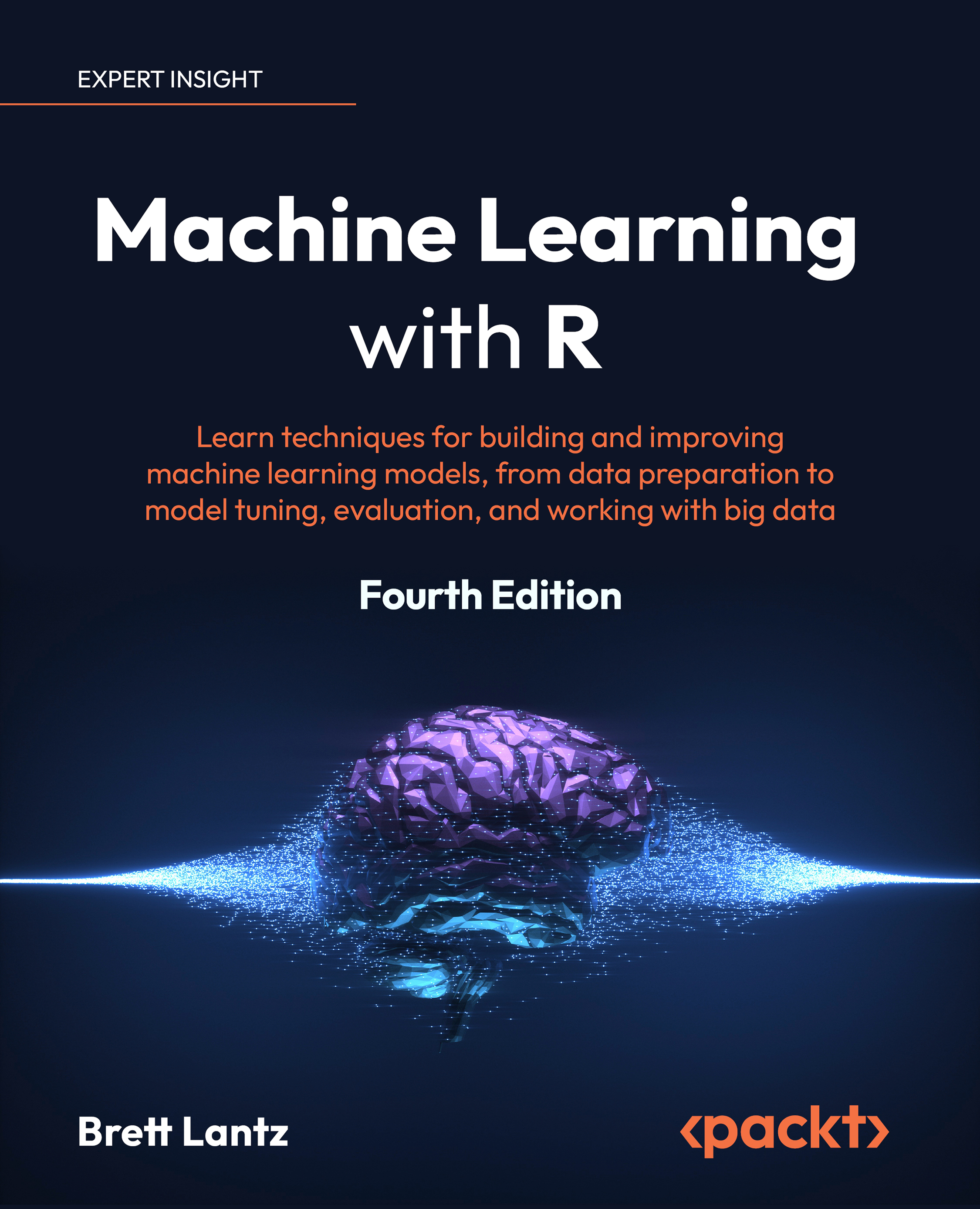
Machine Learning with R

You're reading from   Machine Learning with R Learn techniques for building and improving machine learning models, from data preparation to model tuning, evaluation, and working with big data

Arrow left icon
Product type Paperback
Published in May 2023
Publisher Packt
ISBN-13 9781801071321
Length 762 pages
Edition 4th Edition
Languages
Tools
Concepts
Arrow right icon
Author (1):
Arrow left icon
Brett Lantz Brett Lantz
Author Profile Icon Brett Lantz
Brett Lantz
Arrow right icon
View More author details
Toc

Table of Contents (19) Chapters Close

Preface 1. Thinking Computationally 2. Abstraction in Detail FREE CHAPTER 3. Algorithmic Thinking and Complexity 4. Understanding the Machine 5. Data Structures 6. Reusing Your Code and Modularity 7. Outlining the Challenge 8. Building a Simple Command-Line Interface 9. Reading Data from Different Formats 10. Finding Information in Text 11. Clustering Data 12. Reflecting on What We Have Built 13. The Problems of Scale 14. Dealing with GPUs and Specialized Hardware 15. Profiling Your Code 16. Unlock Your Exclusive Benefits 17. Other Books You May Enjoy 18. Index

Data Structures

In order to solve problems, we need to work with data. At a basic level, this involves interacting with single values either on the stack or on the heap (and managing their lifetime). The next level is storing and interacting with many values of a given type. For this, the standard library provides several different containers with different characteristics. The basic container type is a vector, which stores values in contiguous (linear) memory and has very good traversal performance. Alternatively, one can use linked lists, which provide some flexibility for insertion and deletion at the cost of traversal performance. At the highest level, we have special-purpose containers such as sets and maps.

The goal of this chapter is to highlight some of the nuances of working with different kinds of data storage and high-level container classes so one can choose the most appropriate container for specific tasks and understand the performance implications of these choices...


lock icon The rest of the chapter is locked
Visually different images
CONTINUE READING
83
Tech Concepts
36
Programming languages
73
Tech Tools
Icon Unlimited access to the largest independent learning library in tech of over 8,000 expert-authored tech books and videos.
Icon Innovative learning tools, including AI book assistants, code context explainers, and text-to-speech.
Icon 50+ new titles added per month and exclusive early access to books as they are being written.
Machine Learning with R
Register for a free Packt account to unlock a world of extra content!
A free Packt account unlocks extra newsletters, articles, discounted offers, and much more. Start advancing your knowledge today.
Unlock this book and the full library FREE for 7 days
Get unlimited access to 7000+ expert-authored eBooks and videos courses covering every tech area you can think of
Renews at $19.99/month. Cancel anytime
Modal Close icon
Modal Close icon