Search icon CANCEL
Subscription
0
Cart icon
Your Cart (0 item)
Close icon
You have no products in your basket yet
Save more on your purchases! discount-offer-chevron-icon
Savings automatically calculated. No voucher code required.
Arrow left icon
Explore Products
Best Sellers
New Releases
Books
Videos
Audiobooks
Learning Hub
Newsletter Hub
Free Learning
Arrow right icon
timer SALE ENDS IN
0 Days
:
00 Hours
:
00 Minutes
:
00 Seconds
Arrow up icon
GO TO TOP
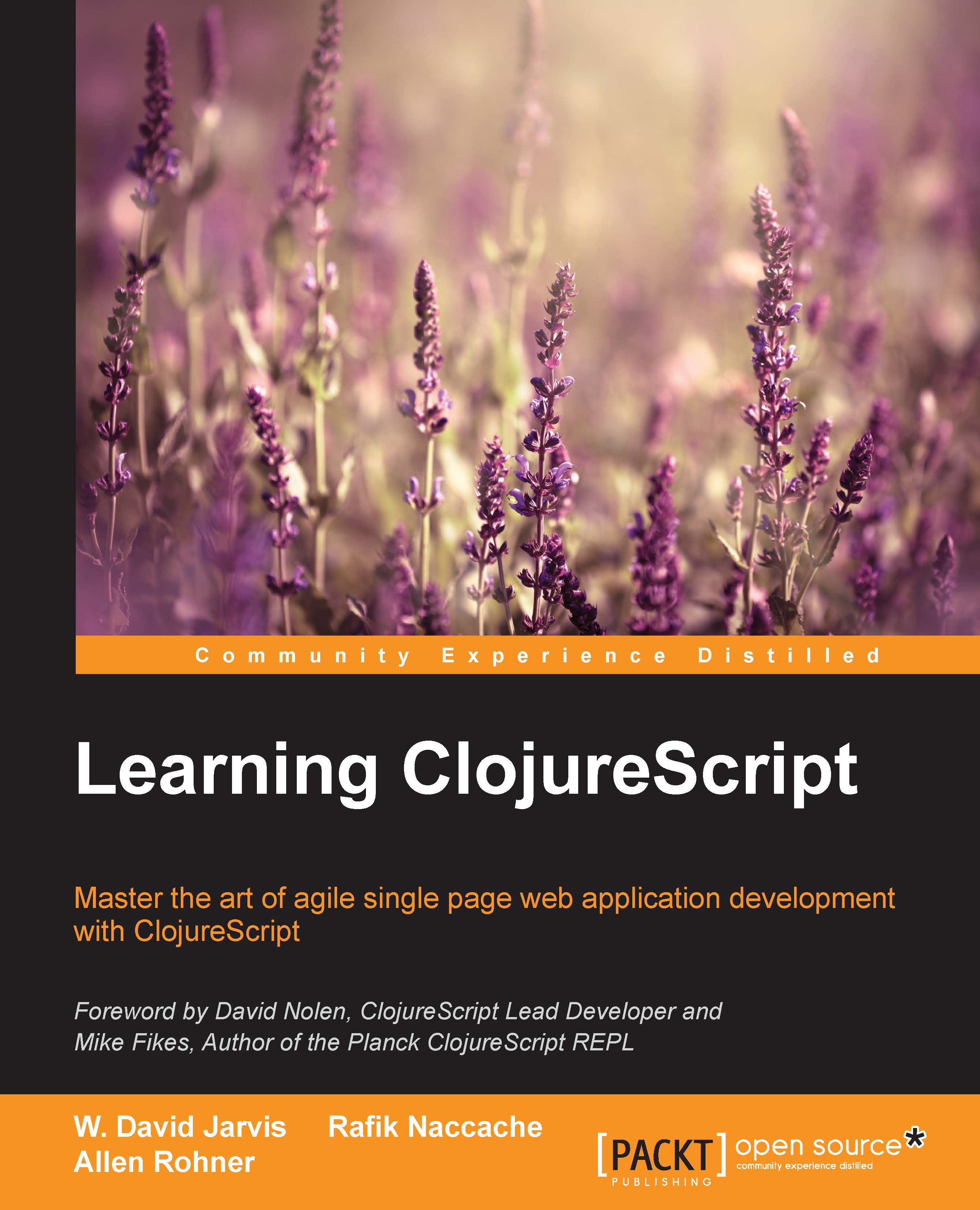
Learning ClojureScript

You're reading from   Learning ClojureScript Master the art of agile single page web application development with ClojureScript

Arrow left icon
Product type Paperback
Published in Jun 2016
Publisher
ISBN-13 9781785887635
Length 320 pages
Edition 1st Edition
Languages
Arrow right icon
Authors (2):
Arrow left icon
Allen Rohner Allen Rohner
Author Profile Icon Allen Rohner
Allen Rohner
 Jarvis Jarvis
Author Profile Icon Jarvis
Jarvis
Arrow right icon
View More author details
Toc

Table of Contents (9) Chapters Close

Preface 1. Getting Ready for ClojureScript Development FREE CHAPTER 2. ClojureScript Language Fundamentals 3. Advanced ClojureScript Concepts 4. Web Applications Basics with ClojureScript 5. Building Single Page Applications 6. Building Richer Web Applications 7. Going Further with ClojureScript 8. Bundling ClojureScript for Production

Summary

This concludes our section on getting started with ClojureScript development. We introduced you to the ClojureScript compiler, demonstrating how it runs on the JVM and leverages the Google Closure Library to optimize compiled JavaScript and provide namespace functionality.

We learned how the ClojureScript compiler can be used to build ClojureScript programs into JavaScript artifacts, how to access these artifacts and, finally, how to interact with them via a REPL targeting different JavaScript environments.

We covered how to use Piggieback in order to expose a JavaScript-enabled nREPL session, how to push the compiled JavaScript via websockets to the browser thanks to Weasel, and how to target Node.js using this setup.

After that, we saw how we could use Figwheel to get a single self-contained Leiningen plugin for developing with the browser. We also learned how to target Node.js using Figwheel.

Finally, we saw how one can use one of these setups with an integrated development environment based on CIDER or inf-clojure.

Now that you have your computer configured for ClojureScript development, lets tackle the language properly. In the next chapter, we'll dig into the core of the ClojureScript language.

Visually different images
CONTINUE READING
83
Tech Concepts
36
Programming languages
73
Tech Tools
Icon Unlimited access to the largest independent learning library in tech of over 8,000 expert-authored tech books and videos.
Icon Innovative learning tools, including AI book assistants, code context explainers, and text-to-speech.
Icon 50+ new titles added per month and exclusive early access to books as they are being written.
Learning ClojureScript
You have been reading a chapter from
Learning ClojureScript
Published in: Jun 2016
Publisher:
ISBN-13: 9781785887635
Register for a free Packt account to unlock a world of extra content!
A free Packt account unlocks extra newsletters, articles, discounted offers, and much more. Start advancing your knowledge today.
Unlock this book and the full library FREE for 7 days
Get unlimited access to 7000+ expert-authored eBooks and videos courses covering every tech area you can think of
Renews at $19.99/month. Cancel anytime
Modal Close icon
Modal Close icon