Search icon CANCEL
Subscription
0
Cart icon
Your Cart (0 item)
Close icon
You have no products in your basket yet
Save more on your purchases! discount-offer-chevron-icon
Savings automatically calculated. No voucher code required.
Arrow left icon
Explore Products
Best Sellers
New Releases
Books
Videos
Audiobooks
Learning Hub
Newsletter Hub
Free Learning
Arrow right icon
timer SALE ENDS IN
0 Days
:
00 Hours
:
00 Minutes
:
00 Seconds
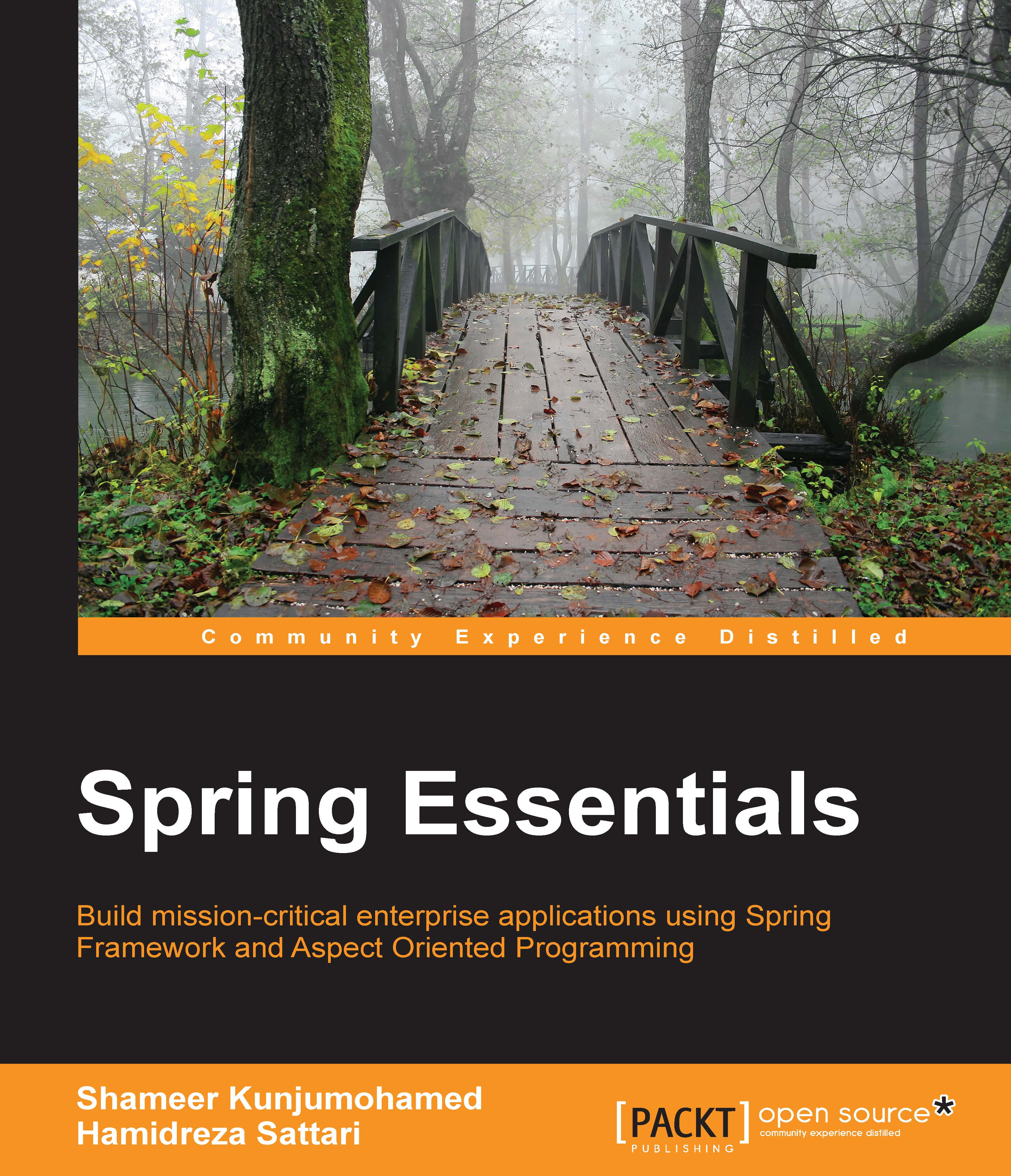
Spring Essentials
Spring Essentials

Spring Essentials: Build mission-critical enterprise applications using Spring Framework and Aspect Oriented Programming

Arrow left icon
Profile Icon Shameer Kunjumohamed Profile Icon Hamidreza Sattari
Arrow right icon
$48.99
Full star icon Full star icon Half star icon Empty star icon Empty star icon 2.5 (2 Ratings)
Paperback Feb 2016 260 pages 1st Edition
eBook
$9.99 $39.99
Paperback
$48.99
Subscription
Free Trial
Renews at $19.99p/m
Arrow left icon
Profile Icon Shameer Kunjumohamed Profile Icon Hamidreza Sattari
Arrow right icon
$48.99
Full star icon Full star icon Half star icon Empty star icon Empty star icon 2.5 (2 Ratings)
Paperback Feb 2016 260 pages 1st Edition
eBook
$9.99 $39.99
Paperback
$48.99
Subscription
Free Trial
Renews at $19.99p/m
eBook
$9.99 $39.99
Paperback
$48.99
Subscription
Free Trial
Renews at $19.99p/m

What do you get with Print?

Product feature icon Instant access to your digital copy whilst your Print order is Shipped
Product feature icon Paperback book shipped to your preferred address
Product feature icon Redeem a companion digital copy on all Print orders
Product feature icon Access this title in our online reader with advanced features
Product feature icon DRM FREE - Read whenever, wherever and however you want
Modal Close icon
Payment Processing...
tick Completed

Shipping Address

Billing Address

Shipping Methods
Table of content icon View table of contents Preview book icon Preview Book

Spring Essentials

Chapter 2. Building the Web Layer with Spring Web MVC

Web application development is a major focus area for enterprise systems. In this age of cloud and big data, web applications are under a tremendous load of an ever-increasing number of concurrent users accessing them from multiple devices such as mobiles and tablets, as well as traditional desktop web browsers. Modern web applications have to address a newer set of nonfunctional requirements, such as scalability, performance, productivity, responsiveness, and multi-device support.

Spring MVC is a web framework from Spring, perfectly built from the ground up to address the concerns of modern web applications. A lightweight and high-performance web framework, Spring MVC is designed to be highly productive from day one, flexible, and adaptable with a wide variety of view technologies. Sitting on top of the mighty Spring Framework, it integrates well with all Java EE technologies and other open source frameworks. Just like any...

Features of Spring MVC

Spring MVC bundles a compelling set of features and advantages over rival web technologies. Knowledge of these will help you decide on choosing Spring MVC for your requirements. The following list covers most of them:

  • Simple configuration and native integration with Spring Framework, leveraging the powerful features of Spring and other open source libraries
  • Built on top of Java web technologies such as Servlets, JSP, and JSTL and can be deployed into any standard Servlet container, such as Tomcat
  • Implemented based on the Model-View-Controller (MVC) architecture pattern, with clear separation of concerns using simple annotations and namespace XML tags
  • Explicit support for convention over configuration for MVC components
  • Supports a big set of view technologies, such as JSP, Thymeleaf, Handlebars, Velocity, FreeMarker, PDF, Excel, and JasperReports
  • Declarative input validation, data binding, and exception handling
  • Flexible URL mapping with automatic request and response transformation...

The Model-View-Controller pattern

MVC is a well-established architectural pattern popularly used for building interactive web and desktop applications. There are numerous frameworks implementing this pattern in most software platforms. MVC divides the application into three core elements that actually represent layers, separates concerns between these three core elements, and defines how they communicate with each other.

The Model-View-Controller pattern

Model represents data, View displays the Model, and Controller handles user actions. Model can be any data, including that stored in a database. It usually represents a collection of domain objects with clearly defined relationships to each other. A Model can be displayed in multiple views depending on how the application is designed.

Controller acts as an intermediary between View and Model. It often has a set of handlers for each event generated by the view as the user interacts with it. Controller delegates user actions to appropriate handlers and then finally redirects...

Your first Spring MVC application

Let's jump to creating a very simple Spring MVC web application. For the purpose of learning, we will develop the web version of Taskify, the task management system we started in Chapter 1, Getting Started with Spring Core. The samples in this chapter use Spring Tool Suite (STS) as the IDE, but you can use your favorite IDE, such as IntelliJ and NetBeans. Almost all Java IDEs support Spring development; most of them have plugins to manage Spring projects and artifacts.

To begin with, follow these steps; then, we will explore the code:

  1. Open STS or Eclipse → create a new project → type a project name → select a template, either Spring MVC Project or Simple Spring Web Maven → specify the top-level package name → finish. Your project structure will be generated.
  2. Make sure your pom.xml file contains Maven dependencies for the spring-context, spring-mvc, servlet-api, jsp-api, and jstl libraries. Note that jsp-api and jstl...

Setting up a Spring MVC application

Let's figure out how a Spring MVC web application is configured by analyzing the application artifacts listed in the previous section, Your first Spring MVC application. It contains all the necessary artifacts for building a Spring MVC web app.

The project structure of a Spring MVC application

The easiest way to create the project structure and the necessary artifacts is using STS to create a Spring MVC project, as described in the previous section. Alternatively, you may use one of the Maven archetypes available in various repositories online. STS uses such a bundled archetype. Here is the typical project structure of a Spring MVC application as viewed in STS:

The project structure of a Spring MVC application

This structure represents a single-WAR web application where all the services and data access components are collocated with the web controllers. In the case of bigger applications, many such components could be part of a different JAR library project, to be shared between multiple web apps and...

The architecture and components of Spring MVC

Having gone through your first Spring MVC application, it is now time to look at Spring MVC applications from an architectural perspective:

The architecture and components of Spring MVC

Spring MVC components

As the name implies, Spring MVC follows the renowned MVC architectural pattern. This pattern ensures the separation of concerns by dividing responsibilities into three major roles:

  • Model: This represents data and business logic
  • View: This represents presentation
  • Controller: This processes client requests and delegates them to the view for rendering back to the client

The Model we are talking about here is not necessarily persistent data (a data model) as such; rather, it represents the information passed back and forth between the client and different layers of the server application, which form the building blocks of any system.

Besides the Model, View, and Controller components, DispatcherServlet too plays a crucial role in the Spring MVC architecture. It acts as the Front Controller, a...

Features of Spring MVC


Spring MVC bundles a compelling set of features and advantages over rival web technologies. Knowledge of these will help you decide on choosing Spring MVC for your requirements. The following list covers most of them:

  • Simple configuration and native integration with Spring Framework, leveraging the powerful features of Spring and other open source libraries

  • Built on top of Java web technologies such as Servlets, JSP, and JSTL and can be deployed into any standard Servlet container, such as Tomcat

  • Implemented based on the Model-View-Controller (MVC) architecture pattern, with clear separation of concerns using simple annotations and namespace XML tags

  • Explicit support for convention over configuration for MVC components

  • Supports a big set of view technologies, such as JSP, Thymeleaf, Handlebars, Velocity, FreeMarker, PDF, Excel, and JasperReports

  • Declarative input validation, data binding, and exception handling

  • Flexible URL mapping with automatic request and response transformation...

The Model-View-Controller pattern


MVC is a well-established architectural pattern popularly used for building interactive web and desktop applications. There are numerous frameworks implementing this pattern in most software platforms. MVC divides the application into three core elements that actually represent layers, separates concerns between these three core elements, and defines how they communicate with each other.

Model represents data, View displays the Model, and Controller handles user actions. Model can be any data, including that stored in a database. It usually represents a collection of domain objects with clearly defined relationships to each other. A Model can be displayed in multiple views depending on how the application is designed.

Controller acts as an intermediary between View and Model. It often has a set of handlers for each event generated by the view as the user interacts with it. Controller delegates user actions to appropriate handlers and then finally redirects...

Your first Spring MVC application


Let's jump to creating a very simple Spring MVC web application. For the purpose of learning, we will develop the web version of Taskify, the task management system we started in Chapter 1, Getting Started with Spring Core. The samples in this chapter use Spring Tool Suite (STS) as the IDE, but you can use your favorite IDE, such as IntelliJ and NetBeans. Almost all Java IDEs support Spring development; most of them have plugins to manage Spring projects and artifacts.

To begin with, follow these steps; then, we will explore the code:

  1. Open STS or Eclipse → create a new project → type a project name → select a template, either Spring MVC Project or Simple Spring Web Maven → specify the top-level package name → finish. Your project structure will be generated.

  2. Make sure your pom.xml file contains Maven dependencies for the spring-context, spring-mvc, servlet-api, jsp-api, and jstl libraries. Note that jsp-api and jstl are required only if you are using JSP as...

Setting up a Spring MVC application


Let's figure out how a Spring MVC web application is configured by analyzing the application artifacts listed in the previous section, Your first Spring MVC application. It contains all the necessary artifacts for building a Spring MVC web app.

The project structure of a Spring MVC application

The easiest way to create the project structure and the necessary artifacts is using STS to create a Spring MVC project, as described in the previous section. Alternatively, you may use one of the Maven archetypes available in various repositories online. STS uses such a bundled archetype. Here is the typical project structure of a Spring MVC application as viewed in STS:

This structure represents a single-WAR web application where all the services and data access components are collocated with the web controllers. In the case of bigger applications, many such components could be part of a different JAR library project, to be shared between multiple web apps and then...

The architecture and components of Spring MVC


Having gone through your first Spring MVC application, it is now time to look at Spring MVC applications from an architectural perspective:

Spring MVC components

As the name implies, Spring MVC follows the renowned MVC architectural pattern. This pattern ensures the separation of concerns by dividing responsibilities into three major roles:

  • Model: This represents data and business logic

  • View: This represents presentation

  • Controller: This processes client requests and delegates them to the view for rendering back to the client

The Model we are talking about here is not necessarily persistent data (a data model) as such; rather, it represents the information passed back and forth between the client and different layers of the server application, which form the building blocks of any system.

Besides the Model, View, and Controller components, DispatcherServlet too plays a crucial role in the Spring MVC architecture. It acts as the Front Controller,...

DispatcherServlet explained


DispatcherServlet is the gateway to any Spring MVC application. Inherited from javax.servlet.http.HttpServlet, it is typically configured declaratively in the web.xml file. While you can have multiple definitions of DispatcherServlet with unique URL patterns, most Spring MVC applications only have single DispatcherServlet with the context-root URL(/), that is, all requests coming to that domain will be handled by DispatcherServlet.

Starting from Servlet 3.0, in addition to declarative configuration in the web.xml file, DispatcherServlet can be configured programmatically by implementing or extending either of these three support classes provided by Spring:

  • The WebAppInitializer interface

  • The AbstractDispatcherServletInitializer abstract class

  • The AbstractAnnotationConfigDispatcherServletInitializer abstract class

The following code listing demonstrates how to implement a WebAppInitializer directly in your application:

public class ApplicationInitializer implements...

Controllers in detail


Controllers, with their methods annotated with @RequestMapping, handle web requests. They accept input data in multiple forms and transform them into Model attributes to be consumed by views that are displayed back to the client. They connect the user to service-layer beans, where your application behavior is defined.

A Controller in Spring MVC has the following signature:

public interface Controller {

   ModelAndView handleRequest(HttpServletRequest request, HttpServletResponse response) throws Exception;
}

A Controller is designed as an interface, allowing you to create any kind of implementation. Starting from Spring version 2.5, you can turn any class into a Controller just by annotating it with @Controller. It relieves you from implementing any specific interface or extending a framework-specific class:

@Controller
public class HomeController {

   @RequestMapping(value = "/", method = RequestMethod.GET)
   public String home(Model model) {
      logger.info("Welcome...

Asynchronous request processing in Spring MVC


In an age of APIs, AJAX clients, and devices, web servers are under exponentially growing traffic. Figuring out ways to make servers more scalable is an ongoing challenge for server vendors. The traditional one thread per HTTP connection strategy does not scale well for a bigger number of concurrent user access. In this model, every request blocks a thread from the thread pool allocated by the Servlet container until the request is completely processed (the examples shown so far follow this model). When AJAX clients—where a single screen frequently fires multiple concurrent connection requests—join the traditional, blocking I/O model of web servers with long-running processes, servers easily get exhausted due to the thread starvation problem, since no free thread is available in the pool. This makes the application unavailable on increased load.

Asynchronous HTTP request processing is a technique that utilizes the non-blocking I/O capability of...

Working with views


Spring MVC provides a very flexible view resolution mechanism that is fully decoupled from the other elements of the MVC framework. It does not force you to use a particular view technology; rather, it makes it easier to use your own favorite technology. It even allows you to mix and match multiple technologies at the view tier. Spring MVC provides out-of-the-box support for JPS, XSLT, and Velocity views.

Resolving views

In a typical Spring MVC application, the developer chooses a view technology of his choice and accordingly uses a ViewResolver that resolves views built using that technology.

The component responsible for resolving views in a Spring MVC application is org.springframework.web.servlet.ViewResolver. It maps logical view names with physical view resources and the chosen view technology.

All request-handling methods of controllers must resolve a logical view name by either returning a view name, a view object, or a ModelAndView object. The org.springframework...

Spring and Spring form tag libraries


Spring bundles a set of tags for the easier authoring of plain JSP pages and JSP forms, defined in spring.tld and spring-form.tld respectively. spring.tld describes general-purpose JSP tags commonly used in JSP pages, listed in the following table:

Spring tag

Description

<spring:bind/>

This allows the data binding of an attribute given in the bind path of a locally declared bean or a Model attribute and provides a BindStatus object to the enclosed body content.

<spring:escapeBody/>

This applies HTML escaping and JavaScript escaping for the body.

<spring:hasBindErrors/>

This provides an error instance if there are bind errors.

<spring:htmlEscape/>

This sets an HTML escape value for the current JSP page.

<spring:message/>

This displays a message for a given code, usually resolved from a resource bundle.

<spring:nestedPath/>

This sets a nested path of ModelAttribute to the <spring:bind/>...

Composing a form in JSP


Spring forms can be composed in JSP pages using the <spring> and <form> tags. For the purpose of illustration, let's take a look at a JSP form that uses both the Spring and form tag libraries along with JSTL. The following is a stripped-down version of views/task/new.jsp:

<%@ taglib uri="http://java.sun.com/jsp/jstl/core" prefix="c"%>
<%@ taglib prefix="spring" uri="http://www.springframework.org/tags"%>
<%@ taglib prefix="form" uri="http://www.springframework.org/tags/form"%>
...
<form:form action="new" method="post" commandName="task">
  <spring:bind path="name">
    <div class="form-group${status.error ? ' has-error' : ''}">
      <label for="txtTaskName">Task-name</label>
      <form:input path="name" class="form-control" id="txtTaskName" placeholder="Task Name" />
      <form:errors path="name" cssClass="control-label" />
    </div>
  </spring:bind>
  <div class="form-group...
Left arrow icon Right arrow icon

Key benefits

  • Step into more advanced features of aspect-oriented programming and API components to build enterprise grade systems
  • Build lightning-fast web applications and REST APIs using Spring MVC and its asynchronous processing capabilities with the view technologies of your choice
  • Explore simplified but powerful data access techniques including JPA (Java Persistence Architecture) repositories and NoSQL data access

Description

Spring is an open source Java application development framework to build and deploy systems and applications that run on the JVM. It is the industry standard and the most popular framework among Java developers with over two-thirds of developers using it. Spring Essentials makes learning Spring so much quicker and easier with the help of illustrations and practical examples. Starting from the core concepts of features such as inversion of Control Container and BeanFactory, we move on to a detailed look at aspect-oriented programming. We cover the breadth and depth of Spring MVC, the WebSocket technology, Spring Data, and Spring Security with various authentication and authorization mechanisms. Packed with real-world examples, you’ll get an insight into utilizing the power of Spring Expression Language in your applications for higher maintainability. You’ll also develop full-duplex real-time communication channels using WebSocket and integrate Spring with web technologies such as JSF, Struts 2, and Tapestry. At the tail end, you will build a modern SPA using EmberJS at the front end and a Spring MVC-based API at the back end.By the end of the book, you will be able to develop your own dull-fledged applications with Spring.

Who is this book for?

If you are a Java developer who is looking to master Enterprise Java Development using Spring Framework, then this book is ideal for you. Prior understanding of core Java programming and a high-level understanding of Spring Framework is recommended. Having sound knowledge of servlet-based web development in Java and basic Database concepts would be an advantage but not a requirement.

What you will learn

  • * Set up and build standalone and web-based projects using Spring Framework with Maven or Gradle
  • * Get familiar with JSP Form processing using Spring and Form Tag Library
  • * Develop RESTful API applications for XML and JSON data transfers with non-blocking asynchronous capabilities
  • * Explore Spring's comprehensive transaction support for declarative Transaction Management and its integration with Spring's data access abstractions
  • * Investigate Spring Data access mechanisms with Spring Data Repositories, a simple and consistent data-access abstraction
  • * Construct real-time applications using WebSocket with a SockJS fallback option
  • * Understand how to secure your Spring Web and standalone applications using Spring Security declaratively and consistently
  • * Get to grips with the end-to-end development of an API-based modern SPA using EmberJS at the front end and SpringMVC at the back end
Estimated delivery fee Deliver to United States

Economy delivery 10 - 13 business days

Free $6.95

Premium delivery 6 - 9 business days

$21.95
(Includes tracking information)

Product Details

Country selected
Publication date, Length, Edition, Language, ISBN-13
Publication date : Feb 26, 2016
Length: 260 pages
Edition : 1st
Language : English
ISBN-13 : 9781783982349
Languages :
Tools :

What do you get with Print?

Product feature icon Instant access to your digital copy whilst your Print order is Shipped
Product feature icon Paperback book shipped to your preferred address
Product feature icon Redeem a companion digital copy on all Print orders
Product feature icon Access this title in our online reader with advanced features
Product feature icon DRM FREE - Read whenever, wherever and however you want
Modal Close icon
Payment Processing...
tick Completed

Shipping Address

Billing Address

Shipping Methods
Estimated delivery fee Deliver to United States

Economy delivery 10 - 13 business days

Free $6.95

Premium delivery 6 - 9 business days

$21.95
(Includes tracking information)

Product Details

Publication date : Feb 26, 2016
Length: 260 pages
Edition : 1st
Language : English
ISBN-13 : 9781783982349
Languages :
Tools :

Packt Subscriptions

See our plans and pricing
Modal Close icon
$19.99 billed monthly
Feature tick icon Unlimited access to Packt's library of 7,000+ practical books and videos
Feature tick icon Constantly refreshed with 50+ new titles a month
Feature tick icon Exclusive Early access to books as they're written
Feature tick icon Solve problems while you work with advanced search and reference features
Feature tick icon Offline reading on the mobile app
Feature tick icon Simple pricing, no contract
$199.99 billed annually
Feature tick icon Unlimited access to Packt's library of 7,000+ practical books and videos
Feature tick icon Constantly refreshed with 50+ new titles a month
Feature tick icon Exclusive Early access to books as they're written
Feature tick icon Solve problems while you work with advanced search and reference features
Feature tick icon Offline reading on the mobile app
Feature tick icon Choose a DRM-free eBook or Video every month to keep
Feature tick icon PLUS own as many other DRM-free eBooks or Videos as you like for just $5 each
Feature tick icon Exclusive print discounts
$279.99 billed in 18 months
Feature tick icon Unlimited access to Packt's library of 7,000+ practical books and videos
Feature tick icon Constantly refreshed with 50+ new titles a month
Feature tick icon Exclusive Early access to books as they're written
Feature tick icon Solve problems while you work with advanced search and reference features
Feature tick icon Offline reading on the mobile app
Feature tick icon Choose a DRM-free eBook or Video every month to keep
Feature tick icon PLUS own as many other DRM-free eBooks or Videos as you like for just $5 each
Feature tick icon Exclusive print discounts

Frequently bought together


Stars icon
Total $ 156.97
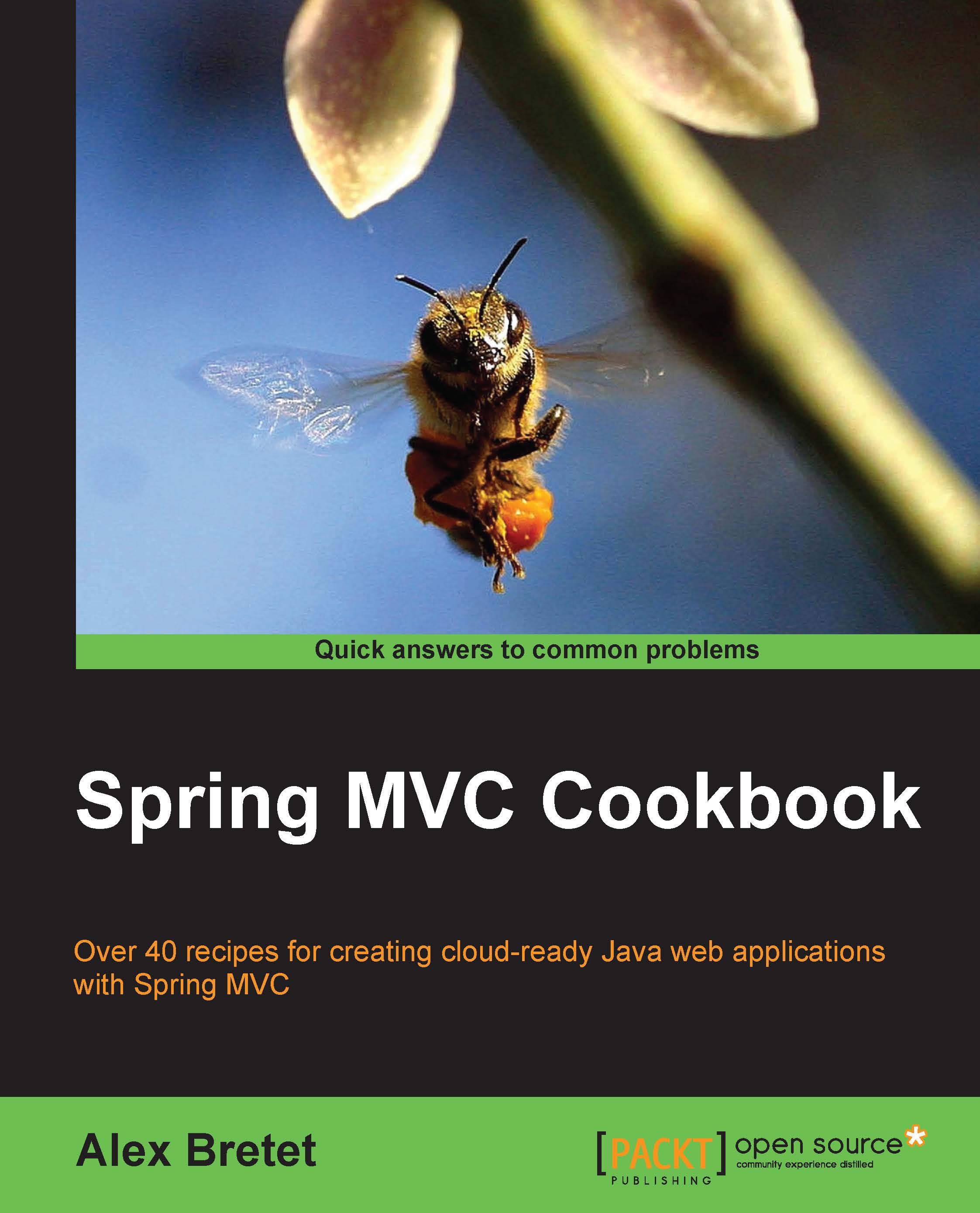
Spring MVC Cookbook
$60.99
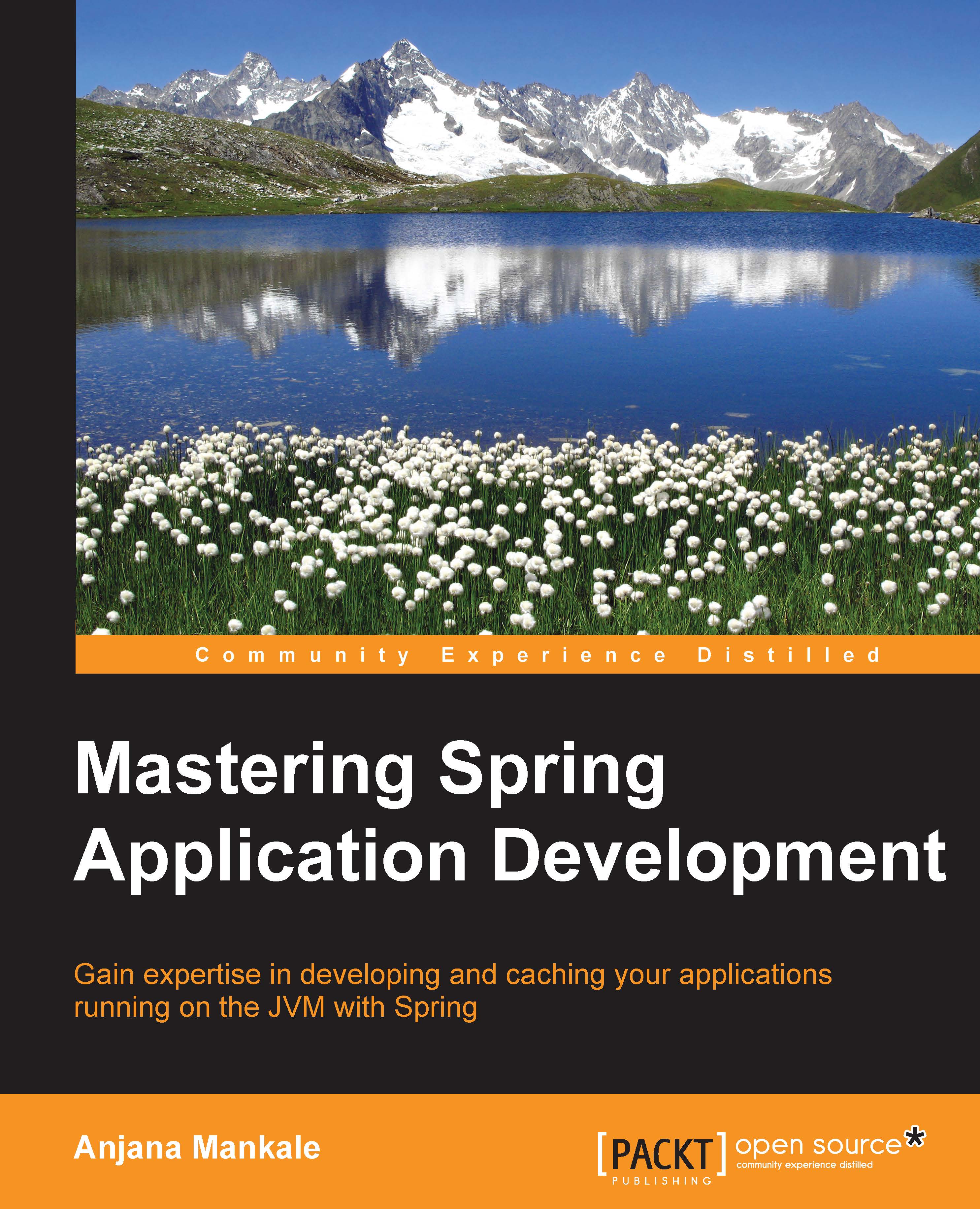
Mastering Spring Application Development
$46.99
Spring Essentials
$48.99
Total $ 156.97 Stars icon

Table of Contents

8 Chapters
1. Getting Started with Spring Core Chevron down icon Chevron up icon
2. Building the Web Layer with Spring Web MVC Chevron down icon Chevron up icon
3. Accessing Data with Spring Chevron down icon Chevron up icon
4. Understanding WebSocket Chevron down icon Chevron up icon
5. Securing Your Applications Chevron down icon Chevron up icon
6. Building a Single-Page Spring Application Chevron down icon Chevron up icon
7. Integrating with Other Web Frameworks Chevron down icon Chevron up icon
Index Chevron down icon Chevron up icon

Customer reviews

Rating distribution
Full star icon Full star icon Half star icon Empty star icon Empty star icon 2.5
(2 Ratings)
5 star 0%
4 star 0%
3 star 50%
2 star 50%
1 star 0%
D. Troyer May 08, 2017
Full star icon Full star icon Full star icon Empty star icon Empty star icon 3
This is a good book for someone who has already worked with Spring or Spring Boot but doesn't fully understand what Spring is doing behind the scenes and would like a high level overview. This probably isn't a very good book for just starting out from nothing. Examples are incomplete and I'm not sure that you actually end up building anything without doing some unspecified work on your own.
Amazon Verified review Amazon
Jeremy Sep 30, 2016
Full star icon Full star icon Empty star icon Empty star icon Empty star icon 2
Not really sure who this book is for. I'm in the process of learning Spring and have watched videos and thankfully read another book before this one but this book simply mentions Spring fundamental ideas, MAYBE shows an incomplete example (luckily I knew what the author was talking about) and then moves on. At times the author would mention 'you can also do it this way but let's move on'. In short, if there were examples, they are incomplete and you have to know Spring to begin with and topics are mentioned that he never covers. You won't learn Spring with this book.
Amazon Verified review Amazon
Get free access to Packt library with over 7500+ books and video courses for 7 days!
Start Free Trial

FAQs

What is the digital copy I get with my Print order? Chevron down icon Chevron up icon

When you buy any Print edition of our Books, you can redeem (for free) the eBook edition of the Print Book you’ve purchased. This gives you instant access to your book when you make an order via PDF, EPUB or our online Reader experience.

What is the delivery time and cost of print book? Chevron down icon Chevron up icon

Shipping Details

USA:

'

Economy: Delivery to most addresses in the US within 10-15 business days

Premium: Trackable Delivery to most addresses in the US within 3-8 business days

UK:

Economy: Delivery to most addresses in the U.K. within 7-9 business days.
Shipments are not trackable

Premium: Trackable delivery to most addresses in the U.K. within 3-4 business days!
Add one extra business day for deliveries to Northern Ireland and Scottish Highlands and islands
EU:

Premium: Trackable delivery to most EU destinations within 4-9 business days.

Australia:

Economy: Can deliver to P. O. Boxes and private residences.
Trackable service with delivery to addresses in Australia only.
Delivery time ranges from 7-9 business days for VIC and 8-10 business days for Interstate metro
Delivery time is up to 15 business days for remote areas of WA, NT & QLD.

Premium: Delivery to addresses in Australia only
Trackable delivery to most P. O. Boxes and private residences in Australia within 4-5 days based on the distance to a destination following dispatch.

India:

Premium: Delivery to most Indian addresses within 5-6 business days

Rest of the World:

Premium: Countries in the American continent: Trackable delivery to most countries within 4-7 business days

Asia:

Premium: Delivery to most Asian addresses within 5-9 business days

Disclaimer:
All orders received before 5 PM U.K time would start printing from the next business day. So the estimated delivery times start from the next day as well. Orders received after 5 PM U.K time (in our internal systems) on a business day or anytime on the weekend will begin printing the second to next business day. For example, an order placed at 11 AM today will begin printing tomorrow, whereas an order placed at 9 PM tonight will begin printing the day after tomorrow.


Unfortunately, due to several restrictions, we are unable to ship to the following countries:

  1. Afghanistan
  2. American Samoa
  3. Belarus
  4. Brunei Darussalam
  5. Central African Republic
  6. The Democratic Republic of Congo
  7. Eritrea
  8. Guinea-bissau
  9. Iran
  10. Lebanon
  11. Libiya Arab Jamahriya
  12. Somalia
  13. Sudan
  14. Russian Federation
  15. Syrian Arab Republic
  16. Ukraine
  17. Venezuela
What is custom duty/charge? Chevron down icon Chevron up icon

Customs duty are charges levied on goods when they cross international borders. It is a tax that is imposed on imported goods. These duties are charged by special authorities and bodies created by local governments and are meant to protect local industries, economies, and businesses.

Do I have to pay customs charges for the print book order? Chevron down icon Chevron up icon

The orders shipped to the countries that are listed under EU27 will not bear custom charges. They are paid by Packt as part of the order.

List of EU27 countries: www.gov.uk/eu-eea:

A custom duty or localized taxes may be applicable on the shipment and would be charged by the recipient country outside of the EU27 which should be paid by the customer and these duties are not included in the shipping charges been charged on the order.

How do I know my custom duty charges? Chevron down icon Chevron up icon

The amount of duty payable varies greatly depending on the imported goods, the country of origin and several other factors like the total invoice amount or dimensions like weight, and other such criteria applicable in your country.

For example:

  • If you live in Mexico, and the declared value of your ordered items is over $ 50, for you to receive a package, you will have to pay additional import tax of 19% which will be $ 9.50 to the courier service.
  • Whereas if you live in Turkey, and the declared value of your ordered items is over € 22, for you to receive a package, you will have to pay additional import tax of 18% which will be € 3.96 to the courier service.
How can I cancel my order? Chevron down icon Chevron up icon

Cancellation Policy for Published Printed Books:

You can cancel any order within 1 hour of placing the order. Simply contact customercare@packt.com with your order details or payment transaction id. If your order has already started the shipment process, we will do our best to stop it. However, if it is already on the way to you then when you receive it, you can contact us at customercare@packt.com using the returns and refund process.

Please understand that Packt Publishing cannot provide refunds or cancel any order except for the cases described in our Return Policy (i.e. Packt Publishing agrees to replace your printed book because it arrives damaged or material defect in book), Packt Publishing will not accept returns.

What is your returns and refunds policy? Chevron down icon Chevron up icon

Return Policy:

We want you to be happy with your purchase from Packtpub.com. We will not hassle you with returning print books to us. If the print book you receive from us is incorrect, damaged, doesn't work or is unacceptably late, please contact Customer Relations Team on customercare@packt.com with the order number and issue details as explained below:

  1. If you ordered (eBook, Video or Print Book) incorrectly or accidentally, please contact Customer Relations Team on customercare@packt.com within one hour of placing the order and we will replace/refund you the item cost.
  2. Sadly, if your eBook or Video file is faulty or a fault occurs during the eBook or Video being made available to you, i.e. during download then you should contact Customer Relations Team within 14 days of purchase on customercare@packt.com who will be able to resolve this issue for you.
  3. You will have a choice of replacement or refund of the problem items.(damaged, defective or incorrect)
  4. Once Customer Care Team confirms that you will be refunded, you should receive the refund within 10 to 12 working days.
  5. If you are only requesting a refund of one book from a multiple order, then we will refund you the appropriate single item.
  6. Where the items were shipped under a free shipping offer, there will be no shipping costs to refund.

On the off chance your printed book arrives damaged, with book material defect, contact our Customer Relation Team on customercare@packt.com within 14 days of receipt of the book with appropriate evidence of damage and we will work with you to secure a replacement copy, if necessary. Please note that each printed book you order from us is individually made by Packt's professional book-printing partner which is on a print-on-demand basis.

What tax is charged? Chevron down icon Chevron up icon

Currently, no tax is charged on the purchase of any print book (subject to change based on the laws and regulations). A localized VAT fee is charged only to our European and UK customers on eBooks, Video and subscriptions that they buy. GST is charged to Indian customers for eBooks and video purchases.

What payment methods can I use? Chevron down icon Chevron up icon

You can pay with the following card types:

  1. Visa Debit
  2. Visa Credit
  3. MasterCard
  4. PayPal
What is the delivery time and cost of print books? Chevron down icon Chevron up icon

Shipping Details

USA:

'

Economy: Delivery to most addresses in the US within 10-15 business days

Premium: Trackable Delivery to most addresses in the US within 3-8 business days

UK:

Economy: Delivery to most addresses in the U.K. within 7-9 business days.
Shipments are not trackable

Premium: Trackable delivery to most addresses in the U.K. within 3-4 business days!
Add one extra business day for deliveries to Northern Ireland and Scottish Highlands and islands

EU:

Premium: Trackable delivery to most EU destinations within 4-9 business days.

Australia:

Economy: Can deliver to P. O. Boxes and private residences.
Trackable service with delivery to addresses in Australia only.
Delivery time ranges from 7-9 business days for VIC and 8-10 business days for Interstate metro
Delivery time is up to 15 business days for remote areas of WA, NT & QLD.

Premium: Delivery to addresses in Australia only
Trackable delivery to most P. O. Boxes and private residences in Australia within 4-5 days based on the distance to a destination following dispatch.

India:

Premium: Delivery to most Indian addresses within 5-6 business days

Rest of the World:

Premium: Countries in the American continent: Trackable delivery to most countries within 4-7 business days

Asia:

Premium: Delivery to most Asian addresses within 5-9 business days

Disclaimer:
All orders received before 5 PM U.K time would start printing from the next business day. So the estimated delivery times start from the next day as well. Orders received after 5 PM U.K time (in our internal systems) on a business day or anytime on the weekend will begin printing the second to next business day. For example, an order placed at 11 AM today will begin printing tomorrow, whereas an order placed at 9 PM tonight will begin printing the day after tomorrow.


Unfortunately, due to several restrictions, we are unable to ship to the following countries:

  1. Afghanistan
  2. American Samoa
  3. Belarus
  4. Brunei Darussalam
  5. Central African Republic
  6. The Democratic Republic of Congo
  7. Eritrea
  8. Guinea-bissau
  9. Iran
  10. Lebanon
  11. Libiya Arab Jamahriya
  12. Somalia
  13. Sudan
  14. Russian Federation
  15. Syrian Arab Republic
  16. Ukraine
  17. Venezuela
Modal Close icon
Modal Close icon