Search icon CANCEL
Subscription
0
Cart icon
Your Cart (0 item)
Close icon
You have no products in your basket yet
Save more on your purchases! discount-offer-chevron-icon
Savings automatically calculated. No voucher code required.
Arrow left icon
Explore Products
Best Sellers
New Releases
Books
Videos
Audiobooks
Learning Hub
Newsletter Hub
Free Learning
Arrow right icon
timer SALE ENDS IN
0 Days
:
00 Hours
:
00 Minutes
:
00 Seconds
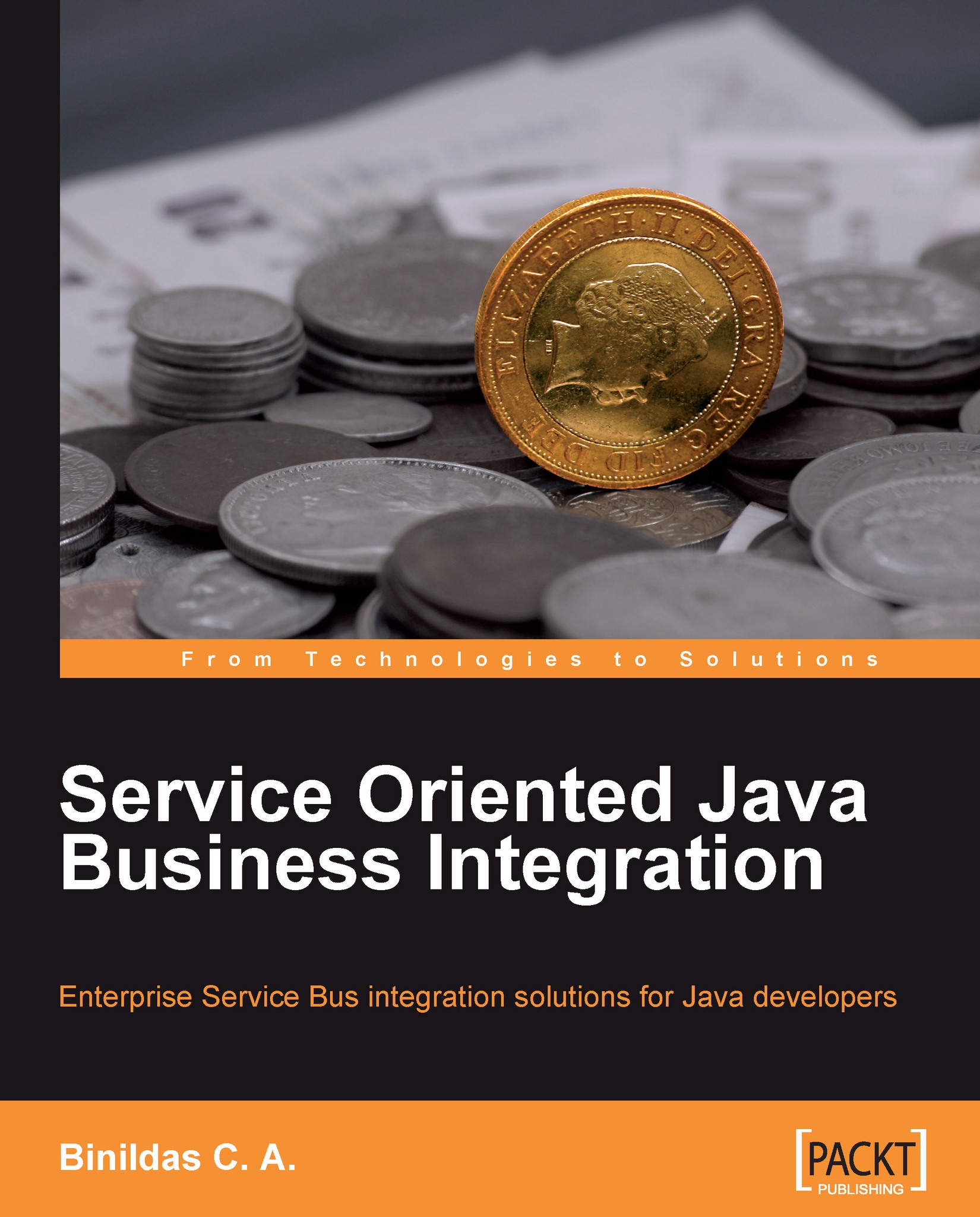
Service Oriented Java Business Integration

Service Oriented Java Business Integration: Enterprise Service Bus integration solutions for Java developers with this SOA book and eBook

eBook
$27.89 $30.99
Paperback
$51.99
Subscription
Free Trial
Renews at $19.99p/m

What do you get with Print?

Product feature icon Instant access to your digital copy whilst your Print order is Shipped
Product feature icon Paperback book shipped to your preferred address
Product feature icon Redeem a companion digital copy on all Print orders
Product feature icon Access this title in our online reader with advanced features
Product feature icon DRM FREE - Read whenever, wherever and however you want
Modal Close icon
Payment Processing...
tick Completed

Shipping Address

Billing Address

Shipping Methods
Table of content icon View table of contents Preview book icon Preview Book

Service Oriented Java Business Integration

Chapter 2. Java Business Integration

Integration has been an area for specialists for years, since no standards exist across vendor products. This increases the Total Cost of Ownership (TCO) to implement and maintain any integration solution. Even though integration is a necessary evil, CIOs and IT managers postpone decisions and actions, and sometimes go for ad-hoc or temporary solutions. Any such activity will complicate the already confused stove pipes and it is the need of the hour to have standardization. Here we are going to inspect the need of another standard for business integration, and also look into the details of what this standard is all about.

So we will cover the following in this chapter:

  • Service oriented architecture in the context of integration

  • Relationship between web services and SOA

  • Service oriented integration

  • J2EE, JCA, and JBI—how they relate

  • Introduction to JBI

  • JBI Nomenclature—main components in JBI

  • Provider-consumer roles in JBI

  • JBI Message Exchange Patterns (MEP)

SOA...

SOA—The Motto


In Chapter 1, we went through integration and also visited the major integration architectures. We have been doing integration for many decades in proprietary or ad-hoc manner. Today, the buzz word is SOA and in the integration space, we are talking about Service Oriented Integration (SOI). Let us look into the essentials of SOA and see whether the existing standards and APIs are sufficient in the integration space.

Why We Need SOA

We have been using multiple technologies for developing application components, and a few of them are listed as follows:

  • Remote Procedure Call (RPC)

  • Common Object Request Broker Architecture (CORBA)

  • Distributed Component Object Model (DCOM)

  • .NET remoting

  • Enterprise Java Beans (EJBs)

  • Java Remote Method Invocation (RMI)

One drawback, which can be seen in almost all these technologies, is their inability to interoperate. In other words, if a .NET remoting component has to send bytes to a Java RMI component, there are workarounds that may not work all the times...

JBI in J2EE—How they Relate


The Java 2 Enterprise Edition (J2EE) platform provides containers for client applications, web components based on servlets and Java Server Pages (JSP), and Enterprise JavaBeans (EJB) components. These J2EE containers provide deployment and run-time support for application components. They also provide a federated view of the platform-level services, provided by the underlying application server for the application components. In this section, we will look at where JBI is positioned in the J2EE stack.

Servlets, Portlets, EJB, JCA, and so on

The world of Java is fabulous. Java speaks about portable code (.class files), portable data (JAXP and XML), portable components (EJB), and now portable services (JAX-WS). However, untill now, there was no standard way by which we could do business-level integration across application servers from multiple vendors.

Business integration can be done with business components or with business services. We know that EJB components...

JBI in Detail


In Chapter 1, we discussed ESB architecture which can facilitate the collaboration between services. JBI provides a collaboration framework which provides standard interfaces for integration components and protocols to plug into, thus allowing the assembly of SOI frameworks.

JSR 208

JSR 208 is an extension of J2EE, but it is specific for JBI Service Provider Interfaces (SPI). SOA and SOI are the targets of JBI and hence it is built around WSDL. Integration components can be plugged into the JBI environment using a service model based on WSDL. Service composition is a major target in ESB architecture and the JBI environment aggregates multiple service definitions in the WSDL form into the message infrastructure.

In the context of a larger service composition, we have multiple partners (service providers or service consumers) and the metadata for interaction of these individual partners are termed as the business protocol. The metadata of choreography played by a business process...

Provider—Consumer Contract


In the JBI environment, the provider and consumer always interact based on a services model. A service interface is the common aspect between them. WSDL 1.1 and 2.0 are used to define the contract through the services interface.

The following figure represents the two parts of the WSDL representation of a service:

In the Abstract Model, WSDL describes the propagation of a message through a type system. A message has sequence and cardinality specified by its Message Exchange Pattern (MEP). A Message can be a Fault Message also. An MEP is associated with one or more messages using an Operation. An Interface can contain a single Operation or a group of Operations represented in an abstract fashion—independent of wire formats and transport protocols.

An Interface in the Abstract Model is bound to a specific wire format and transport protocol via Binding. A Binding is associated with a network address in an Endpoint and a single Service in the concrete model aggregates...

Message Exchange Patterns (MEP)


Service consumers interact with service providers for message exchange employing one or more service invocation patterns. The MEP defines the names, sequence, and cardinality of messages in an exchange. There are many service invocation patterns, and, from a JBI perspective, any JBI-compliant ESB implementation must support the following four service invocations:

  • One-Way: Service consumer issues a request to the service provider. No error (fault) path is provided.

  • Reliable One-Way: Service consumer issues a request to the service provider. Provider may respond with a fault if it fails to process the request.

  • Request-Response: Service Consumer issues a request to the service provider, with expectation of response. Provider may respond with a fault if it fails to process request.

  • Request Optional-Response: Service consumer issues a request to the service provider, which may result in a response. Both consumer and provider have the option of generating a...

ESB—Will it Solve all Our Pain Points


In Chapter 1, we introduced ESB and also looked into what JBI has got to offer here. If you are familiar with SOA principles, one subtle fact, which is evident now is that ESB or JBI are not an end by themselves, but a means towards an end (which is SOA). An ESB is not required to build an SOA, nor is JBI required for ESB or SOA. However, all of them have something in common using JBI—we can build standard components to be deployed into ESB architectures. Thus, JBI by itself is one of the ways by which we can attain SOA. There is also a caveat to this—just following JBI or ESB will not guarantee that you attain SOA. Increasingly, you will hear requests from your project stakeholders to implement an ESB without considering SOA as a whole, such that they want immediate solutions. It is technically feasible to build ESB, which act as pipes interconnecting systems, but the success of such ESB architectures without considering the SOA landscape, which it...

Summary


JBI is the new integration API introduced in the J2EE world. It is a great enabler for SOA because it defines ESB architecture, which can facilitate the collaboration between services. It provides for loosely coupled integration by separating out the providers and consumers to mediate through the bus.

The NMR provides a common integration channel through which the messages flow. Services are published in the bus using the WSDL standard. Providers and consumers are the different roles taken by the integration components with respect to the bus, when plugged into the JBI bus. Message exchange takes place through different MEPs, each providing different levels of reliability.

The next chapter will introduce a JBI container. Be ready to wet your hands with some code too—to build and deploy your first JBI sample.

Left arrow icon Right arrow icon

What you will learn

  • Assembling services and porting them across containers using JBI Exposing EJB as a WSDL-compliant service across firewalls Binding remote services to ESB to be consumed internally Exposing local components in ESB like POJO as externally accessible WSDL-compliant services Providing a web service gateway for external consumers Accessing web services over a reliable transport channel like JMS Implementing web service versioning using ESB Implementing service aggregation at ESB Transactions, Security, Clustering, and JMX in ESB Chapter 1 begins with a quick tour on Enterprise Integration and the associated issues so that you can better understand the problem that we are trying to solve, rather than following a solution for an unknown problem. We also introduce Enterprise Service Bus (ESB) architecture and compare and contrast that with other integration architectures.Chapter 2 introduces Java Business Integration (JBI), inspects the need for another standard for Business Integration, and looks into the details of what this standard is all about.Chapter 3 introduces ServiceMix, which is an open-source ESB platform in the Java programming language, built from the ground up with JBI APIs and principles. It also runs through a few other ESB products.Chapter 4 looks at how we have been binding services locally or remotely even before the ESB became popular. The chapter demonstrates how tunneling using conventional J2EE tools will help to expose even technology-specific API services. An example of such a service is an EJB service to be exposed through firewalls over HTTP, so that the service becomes technology agonistic.Chapter 5 introduces XFire, which is a new generation Java SOAP framework to easily expose web services. Here we demonstrate the integration capabilities of XFire.Chapter 6 teaches you JBI packaging and deployment. After going through this chapter you will be able to build, package, and deploy integration artifacts as standard JBI packages into the JBI container.Chapter 7 teaches you how to create your own components and deploy them onto the JBI container. This chapter visits the core API from the ServiceMix as well as from the JBI specification, which will function as useful helper classes using which you can develop integration components quickly.Chapter 8 shows you how to bind Enterprise Java Beans components to the ESB. EJB is the Distributed Component paradigm in the Java-J2EE world and the industry has a lot invested in this technology. Coexisting services with those components will help you to reuse those existing investments so that we can continue building new systems based on higher levels of SOA maturity.Chapter 9 shows POJO Binding to the ESB using JSR181. POJO components can be easily exposed as WSDL-compliant services to the JBI bus.Chapter 10 illustrates how to bind web services to the ServiceMix ESB, thus creating a web services gateway at the ESB layer.Chapter 11 looks at how Java Message Service (JMS), which is a platform-dependent messaging technology, can increase the QoS features of web services by making web services accessible through the JMS channel.Chapter 12 introduces Java XML binding and XStream, which is a simple open-source library to serialize Java objects to XML and back again. We show the XStream integration with ESB demonstrating streaming of data across the bus.Chapter 13 visits the JDK Proxy classes and then explains the JBI Proxy in detail with examples. We show a practical use of the JBI Proxy—Proxying the external web services in the JBI bus.Chapter 14 explains versioning in the SOA context and explains various strategies and approaches to versioning services. It also explains and demonstrates a versioning example leveraging the targetNamespace attribute. Versioning services, especially versioning of web services, is a topic of heated discussion in many forums and sites.Chapter 15 explains that the EAI patterns are nuggets of advice made out of aggregating basic Message Exchange Pattern elements to solve frequently recurring integration problems. We can look at EAI patterns as design patterns for solving integration problems. This chapter demonstrates many of the common EAI patterns.Chapter 16 looks into a sample use case. One of the useful applications of ESB is to provide a "Services Workbench" in which we can use various integration patterns available to aggregate services to carry out business processes.Chapter 17 visits a few selected QoS features such as Transactions, Security, Clustering, and Management, which can impact the programming and deployment aspects using ESB.
Estimated delivery fee Deliver to United States

Economy delivery 10 - 13 business days

Free $6.95

Premium delivery 6 - 9 business days

$21.95
(Includes tracking information)

Product Details

Country selected
Publication date, Length, Edition, Language, ISBN-13
Publication date : Mar 12, 2008
Length: 436 pages
Edition :
Language : English
ISBN-13 : 9781847194404
Vendor :
Apache
Category :
Languages :

What do you get with Print?

Product feature icon Instant access to your digital copy whilst your Print order is Shipped
Product feature icon Paperback book shipped to your preferred address
Product feature icon Redeem a companion digital copy on all Print orders
Product feature icon Access this title in our online reader with advanced features
Product feature icon DRM FREE - Read whenever, wherever and however you want
Modal Close icon
Payment Processing...
tick Completed

Shipping Address

Billing Address

Shipping Methods
Estimated delivery fee Deliver to United States

Economy delivery 10 - 13 business days

Free $6.95

Premium delivery 6 - 9 business days

$21.95
(Includes tracking information)

Product Details

Publication date : Mar 12, 2008
Length: 436 pages
Edition :
Language : English
ISBN-13 : 9781847194404
Vendor :
Apache
Category :
Languages :

Packt Subscriptions

See our plans and pricing
Modal Close icon
$19.99 billed monthly
Feature tick icon Unlimited access to Packt's library of 7,000+ practical books and videos
Feature tick icon Constantly refreshed with 50+ new titles a month
Feature tick icon Exclusive Early access to books as they're written
Feature tick icon Solve problems while you work with advanced search and reference features
Feature tick icon Offline reading on the mobile app
Feature tick icon Simple pricing, no contract
$199.99 billed annually
Feature tick icon Unlimited access to Packt's library of 7,000+ practical books and videos
Feature tick icon Constantly refreshed with 50+ new titles a month
Feature tick icon Exclusive Early access to books as they're written
Feature tick icon Solve problems while you work with advanced search and reference features
Feature tick icon Offline reading on the mobile app
Feature tick icon Choose a DRM-free eBook or Video every month to keep
Feature tick icon PLUS own as many other DRM-free eBooks or Videos as you like for just $5 each
Feature tick icon Exclusive print discounts
$279.99 billed in 18 months
Feature tick icon Unlimited access to Packt's library of 7,000+ practical books and videos
Feature tick icon Constantly refreshed with 50+ new titles a month
Feature tick icon Exclusive Early access to books as they're written
Feature tick icon Solve problems while you work with advanced search and reference features
Feature tick icon Offline reading on the mobile app
Feature tick icon Choose a DRM-free eBook or Video every month to keep
Feature tick icon PLUS own as many other DRM-free eBooks or Videos as you like for just $5 each
Feature tick icon Exclusive print discounts

Frequently bought together


Stars icon
Total $ 161.97
PhoneGap 4 Mobile Application Development Cookbook
$54.99
Service Oriented Java Business Integration
$51.99
Atlassian Confluence 5 Essentials
$54.99
Total $ 161.97 Stars icon

Table of Contents

17 Chapters
Why Enterprise Service Bus Chevron down icon Chevron up icon
Java Business Integration Chevron down icon Chevron up icon
JBI Container—ServiceMix Chevron down icon Chevron up icon
Binding— The Conventional Way Chevron down icon Chevron up icon
Some XFire Binding Tools Chevron down icon Chevron up icon
JBI Packaging and Deployment Chevron down icon Chevron up icon
Developing JBI Components Chevron down icon Chevron up icon
Binding EJB in a JBI Container Chevron down icon Chevron up icon
POJO Binding Using JSR181 Chevron down icon Chevron up icon
Bind Web Services in ESB—Web Services Gateway Chevron down icon Chevron up icon
Access Web Services Using the JMS Channel Chevron down icon Chevron up icon
Java XML Binding using XStream Chevron down icon Chevron up icon
JBI Proxy Chevron down icon Chevron up icon
Web Service Versioning Chevron down icon Chevron up icon
Enterprise Integration Patterns in ESB Chevron down icon Chevron up icon
Sample Service Aggregation Chevron down icon Chevron up icon
Transactions, Security, Clustering, and JMX Chevron down icon Chevron up icon

Customer reviews

Top Reviews
Rating distribution
Full star icon Full star icon Full star icon Full star icon Half star icon 4.1
(8 Ratings)
5 star 50%
4 star 25%
3 star 12.5%
2 star 12.5%
1 star 0%
Filter icon Filter
Top Reviews

Filter reviews by


Vamseedhar R. Sane May 26, 2008
Full star icon Full star icon Full star icon Full star icon Full star icon 5
The Service Oriented Java Business Integration has an organized structure, and is very well written overall. It is specifically targeted towards Java developers, as well as professionals who are integration architects. One of the best features of this book is the hands on method that it uses. Every concept is handled with detail, and it also provides aids for sample uses. It offers both diagrams and explanations for them, and it has a total list of code and instructions for deploying the samples, as well as running them.The author also takes the time to explain what will happen when the code is processed. This book is excellent for times when you need to wait for something, such as when you're on a flight, and there is little to do. Even if you don't have a computer handy to try out the things that the author talks about, a reader can understand a lot with the code listings, as well as the instructions. Many problems which are noted by the author are things which many integration architects have to deal with on a daily basis.The book has a number of good sections which are related to JBI, ESB, along with XPath, XFire, and ServiceMix. All these things are explained with examples that are highly detailed. There are excellent sections which show you how to properly develop customized JBI components, as well as packaging and deploying them. The chapters in this book which I enjoyed the most are the ones for EAI patterns, as well as the ones which explained the versioning for services. I highly recommend this book for those who are beginners of either SOA or JBI.One thing that you have to keep in mind is that this book is quite hands on. Any Manager or Architect who must understand ESB, particularly at the strategy or conceptual level, would gain a lot from this book, especially if they aren't big fans of code samples. I found this book to be ideal if you're looking to learn the buzz words, along with a little bit of code(low level). This is a book of concepts, and those who are looking for a more conceptual guide will be enthralled with this book.
Amazon Verified review Amazon
Chris A. Ostrowski Oct 20, 2008
Full star icon Full star icon Full star icon Full star icon Full star icon 5
While not for the beginner, "Service-Oriented Java Business Integration" is an excellent reference for anyone looking to implement SOA-based solutions in their organization. Chapter 9, "POJO Binding Using JSR-181" is an excellent reference for those developers looking to implement complex solutions using POJOs - the best reference for JSR-181 I've seen so far and Chapter 15, "Enterprise Integration Patterns in ESB" is a must-read for all SOA architects.
Amazon Verified review Amazon
Raj May 07, 2008
Full star icon Full star icon Full star icon Full star icon Full star icon 5
If you are an Architect or Manager and need to understand ESB only at a strategy and conceptual level and you very much hate code samples, then this is not the right book to purchase. If you need just ESB theory, you can look at the book "Enterprise Service Bus". And if you want all nifty gritty details of JBI, the specification from Sun should help you. But if you want to understand those buzz words and also like to see some low level code, this book is something which you cannot ignore.This is a book of concepts and code that clearly explains what JBI and ESB is. If you need a technical book with how-to approaches on ESB, this is the only book available today. Few other books are available with low level code, but you will never end up running the samples due to the requirements of heavy IDEs and/or Workshops. But using this book even a less experienced developer will be able to run the samples in day 1.Anyone can understand the need to use a suitable runtime or framework, if you have to understand any concepts in code. The author has done enough justice there by selecting Apache Open source ServiceMix which is freely downloadable. Even though the code samples are run using this framework, the concepts and integration tricks used here are reusable and extendable to any other ESB runtime. This is something the other reviewer has missed, it seems.The author balance complex message exchange patterns with a large number of visuals. I spotted few minor editing typos, but they don't get in the way of the material.I recommend this book to anyone who needs to understand JBI, ESB and Web Service integration.
Amazon Verified review Amazon
D Apr 28, 2008
Full star icon Full star icon Full star icon Full star icon Full star icon 5
The book is just over 400 pages and is aimed at Java developers and integration architects using JBI and the Apache ServiceMix JBI container. The book is broadly broken down into four sections.The first section explains the basics of enterprise application integration and discusses different integration architectures such as point-to-point and hub-and-spoke. This section of the book continues to describe the differences between other integration architectures and ESB and explains why we should use an ESB. A description of JBI follows with JSR 208 being described along with the JBI nomenclature - e.g. Service Engine, Binding Component, Normalized Message Router etc.. Different Message Exchange Patterns are then described before ServiceMix is introduced. The discussion on ServiceMix begins by explaining the architecture of the product and continues to show how ServiceMix can be installed and tested on both Windows and Ubuntu. A brief description of the different JBI components comprising ServiceMix is given before a sample HTTP service is developed and bound to ServiceMix.The second section of the book describes binding - one of he most important aspects of an ESB. The discussion on binding begins by describing what binding is and giving an example of binding a stateless session bean method to Apache SOAP. Details are provided on how to use XFire for binding and how to bind EJBs, Web Services and POJOs. The relevant JBI packaging and deployment details are given for each of these types of binding.The next section of the book details web service versioning and enterprise integration patterns in ESB. Nine different EAI patterns including "Content-based router", "Content enricher" and "XPath splitter" are all discussed. As is common with the rest of the book, source code examples are provided to discuss all of these aspects.The final section of the book provides a sample service aggregation and shows how JBI can be used with ServiceMix to aggregate several web services to perform a single business process.At just over 400 pages this is an excellent introduction to JBI using the Apache ServiceMix product. The author provides plenty of detail and sample code throughout out the book. This isn't a dry textbook on ESB, rather the author provides a good mix of theory and practice with numerous code samples which can be downloaded in their entirety from the publisher's web site. Although this book uses ServiceMix as the ESB of choice, I think this book will be useful to Java developers wishing to gain further knowledge of ESBs and JBI in general. This book is thoroughly recommended to Java developers and analysts who are using or planning to use JBI in particular combined with Apache ServiceMix.
Amazon Verified review Amazon
Daniel Gradecak Apr 28, 2008
Full star icon Full star icon Full star icon Full star icon Empty star icon 4
I took some time to read this book and I do not think I lost my so "precious" time. I would say that the book is not intended for Java beginners but more for people with a good technical background and especially with at least, some knowledge of the Java Enterprise world. Never the less, if you are not a specialist, just like I am not one, you could still read the book and you could learn a lot of new stuff.Indeed, the book is taking you from the beginning and tries to lead you through different technologies like Java Messaging service (JMS), Enterprise Java Beans (EJB), WebServices (WS) and a few more. The author is clearly explaining how to use those different technologies within an Enterprise Service Bus (ESB) and how to implement it using the Java Business Integration (JBI) specification. The aim is to make you understand of how you could use any technology to achieve the Service Oriented Architecture.A good point is that the theory is accompanied with a lot of examples based on Service Mix, which is an Apache JBI implementation. Those samples are insisting on EJB and WS, I would qualify them as realistic or real world samples. My opinion is that it could help a lot of people and companies not to rewrite their existing code but to rather reuse the code they already have and to make it working within a JBI container. You could find some explanations on how to make a real enterprise application using Service Mix and a huge assortment of useful packages like XStream or Axis. Also, on how to expose your EJBs as WSDL, which I find interesting. The samples provided in the book are accompanied with a lot of code and the whole build process. Thus even if you are not familiar with all those technologies you will be able to test and see the samples running.All that is strengthen by the link to the Java Connector Architecture and to the point on how to exchange the information between all those different/heterogeneous systems.While the book is correctly explaining the point of JBI, I would really appreciate to hear some words about the Service Component Architecture (SCA) and to see something about REST, but not only about WS. There are also a couple of references to VoIP and probably that a parallel could be shown with the SLEE (or JAIN SLEE) specification.I also think there should be less explanation about WebServices and especially about the WS versioning, but some more words about XA transactions and services orchestration.Finally, I really do recommend the book to those who are not familiar with ESBs or SOA and that want to learn something without investigating a lot on the web alone. Also, as I already mentioned to those who want to use a JBI container but have a lot of EJB and WS implementations around.
Amazon Verified review Amazon
Get free access to Packt library with over 7500+ books and video courses for 7 days!
Start Free Trial

FAQs

What is the digital copy I get with my Print order? Chevron down icon Chevron up icon

When you buy any Print edition of our Books, you can redeem (for free) the eBook edition of the Print Book you’ve purchased. This gives you instant access to your book when you make an order via PDF, EPUB or our online Reader experience.

What is the delivery time and cost of print book? Chevron down icon Chevron up icon

Shipping Details

USA:

'

Economy: Delivery to most addresses in the US within 10-15 business days

Premium: Trackable Delivery to most addresses in the US within 3-8 business days

UK:

Economy: Delivery to most addresses in the U.K. within 7-9 business days.
Shipments are not trackable

Premium: Trackable delivery to most addresses in the U.K. within 3-4 business days!
Add one extra business day for deliveries to Northern Ireland and Scottish Highlands and islands

EU:

Premium: Trackable delivery to most EU destinations within 4-9 business days.

Australia:

Economy: Can deliver to P. O. Boxes and private residences.
Trackable service with delivery to addresses in Australia only.
Delivery time ranges from 7-9 business days for VIC and 8-10 business days for Interstate metro
Delivery time is up to 15 business days for remote areas of WA, NT & QLD.

Premium: Delivery to addresses in Australia only
Trackable delivery to most P. O. Boxes and private residences in Australia within 4-5 days based on the distance to a destination following dispatch.

India:

Premium: Delivery to most Indian addresses within 5-6 business days

Rest of the World:

Premium: Countries in the American continent: Trackable delivery to most countries within 4-7 business days

Asia:

Premium: Delivery to most Asian addresses within 5-9 business days

Disclaimer:
All orders received before 5 PM U.K time would start printing from the next business day. So the estimated delivery times start from the next day as well. Orders received after 5 PM U.K time (in our internal systems) on a business day or anytime on the weekend will begin printing the second to next business day. For example, an order placed at 11 AM today will begin printing tomorrow, whereas an order placed at 9 PM tonight will begin printing the day after tomorrow.


Unfortunately, due to several restrictions, we are unable to ship to the following countries:

  1. Afghanistan
  2. American Samoa
  3. Belarus
  4. Brunei Darussalam
  5. Central African Republic
  6. The Democratic Republic of Congo
  7. Eritrea
  8. Guinea-bissau
  9. Iran
  10. Lebanon
  11. Libiya Arab Jamahriya
  12. Somalia
  13. Sudan
  14. Russian Federation
  15. Syrian Arab Republic
  16. Ukraine
  17. Venezuela
What is custom duty/charge? Chevron down icon Chevron up icon

Customs duty are charges levied on goods when they cross international borders. It is a tax that is imposed on imported goods. These duties are charged by special authorities and bodies created by local governments and are meant to protect local industries, economies, and businesses.

Do I have to pay customs charges for the print book order? Chevron down icon Chevron up icon

The orders shipped to the countries that are listed under EU27 will not bear custom charges. They are paid by Packt as part of the order.

List of EU27 countries: www.gov.uk/eu-eea:

A custom duty or localized taxes may be applicable on the shipment and would be charged by the recipient country outside of the EU27 which should be paid by the customer and these duties are not included in the shipping charges been charged on the order.

How do I know my custom duty charges? Chevron down icon Chevron up icon

The amount of duty payable varies greatly depending on the imported goods, the country of origin and several other factors like the total invoice amount or dimensions like weight, and other such criteria applicable in your country.

For example:

  • If you live in Mexico, and the declared value of your ordered items is over $ 50, for you to receive a package, you will have to pay additional import tax of 19% which will be $ 9.50 to the courier service.
  • Whereas if you live in Turkey, and the declared value of your ordered items is over € 22, for you to receive a package, you will have to pay additional import tax of 18% which will be € 3.96 to the courier service.
How can I cancel my order? Chevron down icon Chevron up icon

Cancellation Policy for Published Printed Books:

You can cancel any order within 1 hour of placing the order. Simply contact customercare@packt.com with your order details or payment transaction id. If your order has already started the shipment process, we will do our best to stop it. However, if it is already on the way to you then when you receive it, you can contact us at customercare@packt.com using the returns and refund process.

Please understand that Packt Publishing cannot provide refunds or cancel any order except for the cases described in our Return Policy (i.e. Packt Publishing agrees to replace your printed book because it arrives damaged or material defect in book), Packt Publishing will not accept returns.

What is your returns and refunds policy? Chevron down icon Chevron up icon

Return Policy:

We want you to be happy with your purchase from Packtpub.com. We will not hassle you with returning print books to us. If the print book you receive from us is incorrect, damaged, doesn't work or is unacceptably late, please contact Customer Relations Team on customercare@packt.com with the order number and issue details as explained below:

  1. If you ordered (eBook, Video or Print Book) incorrectly or accidentally, please contact Customer Relations Team on customercare@packt.com within one hour of placing the order and we will replace/refund you the item cost.
  2. Sadly, if your eBook or Video file is faulty or a fault occurs during the eBook or Video being made available to you, i.e. during download then you should contact Customer Relations Team within 14 days of purchase on customercare@packt.com who will be able to resolve this issue for you.
  3. You will have a choice of replacement or refund of the problem items.(damaged, defective or incorrect)
  4. Once Customer Care Team confirms that you will be refunded, you should receive the refund within 10 to 12 working days.
  5. If you are only requesting a refund of one book from a multiple order, then we will refund you the appropriate single item.
  6. Where the items were shipped under a free shipping offer, there will be no shipping costs to refund.

On the off chance your printed book arrives damaged, with book material defect, contact our Customer Relation Team on customercare@packt.com within 14 days of receipt of the book with appropriate evidence of damage and we will work with you to secure a replacement copy, if necessary. Please note that each printed book you order from us is individually made by Packt's professional book-printing partner which is on a print-on-demand basis.

What tax is charged? Chevron down icon Chevron up icon

Currently, no tax is charged on the purchase of any print book (subject to change based on the laws and regulations). A localized VAT fee is charged only to our European and UK customers on eBooks, Video and subscriptions that they buy. GST is charged to Indian customers for eBooks and video purchases.

What payment methods can I use? Chevron down icon Chevron up icon

You can pay with the following card types:

  1. Visa Debit
  2. Visa Credit
  3. MasterCard
  4. PayPal
What is the delivery time and cost of print books? Chevron down icon Chevron up icon

Shipping Details

USA:

'

Economy: Delivery to most addresses in the US within 10-15 business days

Premium: Trackable Delivery to most addresses in the US within 3-8 business days

UK:

Economy: Delivery to most addresses in the U.K. within 7-9 business days.
Shipments are not trackable

Premium: Trackable delivery to most addresses in the U.K. within 3-4 business days!
Add one extra business day for deliveries to Northern Ireland and Scottish Highlands and islands

EU:

Premium: Trackable delivery to most EU destinations within 4-9 business days.

Australia:

Economy: Can deliver to P. O. Boxes and private residences.
Trackable service with delivery to addresses in Australia only.
Delivery time ranges from 7-9 business days for VIC and 8-10 business days for Interstate metro
Delivery time is up to 15 business days for remote areas of WA, NT & QLD.

Premium: Delivery to addresses in Australia only
Trackable delivery to most P. O. Boxes and private residences in Australia within 4-5 days based on the distance to a destination following dispatch.

India:

Premium: Delivery to most Indian addresses within 5-6 business days

Rest of the World:

Premium: Countries in the American continent: Trackable delivery to most countries within 4-7 business days

Asia:

Premium: Delivery to most Asian addresses within 5-9 business days

Disclaimer:
All orders received before 5 PM U.K time would start printing from the next business day. So the estimated delivery times start from the next day as well. Orders received after 5 PM U.K time (in our internal systems) on a business day or anytime on the weekend will begin printing the second to next business day. For example, an order placed at 11 AM today will begin printing tomorrow, whereas an order placed at 9 PM tonight will begin printing the day after tomorrow.


Unfortunately, due to several restrictions, we are unable to ship to the following countries:

  1. Afghanistan
  2. American Samoa
  3. Belarus
  4. Brunei Darussalam
  5. Central African Republic
  6. The Democratic Republic of Congo
  7. Eritrea
  8. Guinea-bissau
  9. Iran
  10. Lebanon
  11. Libiya Arab Jamahriya
  12. Somalia
  13. Sudan
  14. Russian Federation
  15. Syrian Arab Republic
  16. Ukraine
  17. Venezuela
Modal Close icon
Modal Close icon