Search icon CANCEL
Subscription
0
Cart icon
Your Cart (0 item)
Close icon
You have no products in your basket yet
Arrow left icon
Explore Products
Best Sellers
New Releases
Books
Events
Videos
Audiobooks
Packt Hub
Free Learning
Arrow right icon
timer SALE ENDS IN
0 Days
:
00 Hours
:
00 Minutes
:
00 Seconds
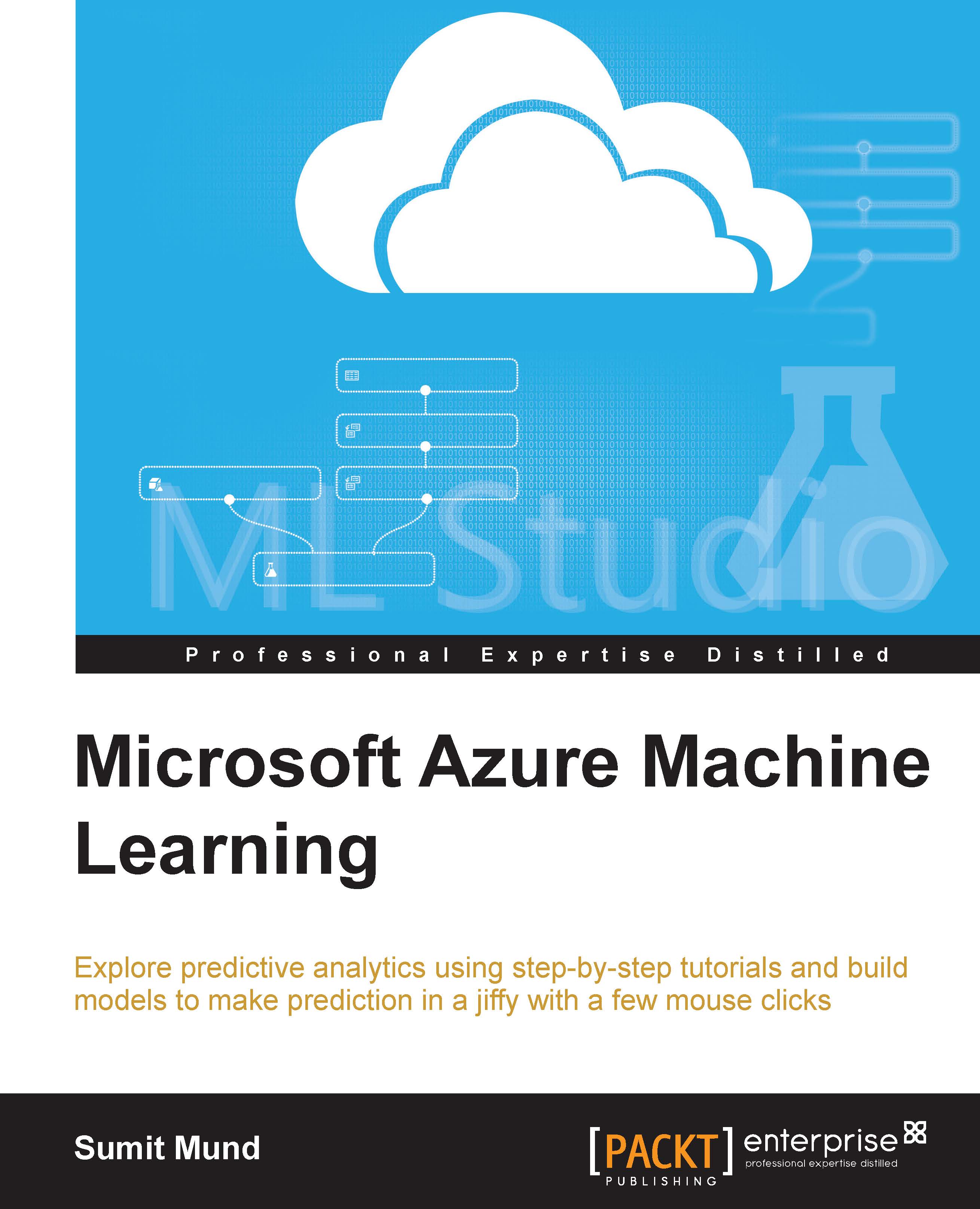
Microsoft Azure Machine Learning

Microsoft Azure Machine Learning: Explore predictive analytics using step-by-step tutorials and build models to make prediction in a jiffy with a few mouse clicks

Arrow left icon
Profile Icon Sumit Mund
Arrow right icon
$45.99
Full star icon Full star icon Full star icon Full star icon Empty star icon 4 (5 Ratings)
Paperback Jun 2015 212 pages 1st Edition
eBook
$34.19 $37.99
Paperback
$45.99
Arrow left icon
Profile Icon Sumit Mund
Arrow right icon
$45.99
Full star icon Full star icon Full star icon Full star icon Empty star icon 4 (5 Ratings)
Paperback Jun 2015 212 pages 1st Edition
eBook
$34.19 $37.99
Paperback
$45.99
eBook
$34.19 $37.99
Paperback
$45.99

What do you get with Print?

Product feature icon Instant access to your digital copy whilst your Print order is Shipped
Product feature icon Paperback book shipped to your preferred address
Product feature icon Redeem a companion digital copy on all Print orders
Product feature icon Access this title in our online reader with advanced features
Product feature icon DRM FREE - Read whenever, wherever and however you want
Product feature icon AI Assistant (beta) to help accelerate your learning
Modal Close icon
Payment Processing...
tick Completed

Shipping Address

Billing Address

Shipping Methods
Table of content icon View table of contents Preview book icon Preview Book

Microsoft Azure Machine Learning

Chapter 1. Introduction

Welcome to the world of predictive analytics and machine learning! Azure Machine Learning enables you to perform predictive analytics with the application of machine learning. Traditionally, it has been an area for experts. Developing and deploying a predictive modeling solution using machine learning has never been simple and easy, even for experts. Microsoft seems to have taken most of the pain out with this new cloud-based offering that allows you to develop and deploy a predictive solution in the simplest and quickest possible way. Even beginners would find it easy and simple to understand.

This chapter, while setting the context for the rest of the book, will present the related topics from a bird's eye view.

Introduction to predictive analytics

Predictive analytics is a niche area of analytics that deals with making predictions of unknown events that may or may not be in future. One example of this would be to predict whether a flight will be delayed or not before the flight takes off. You should not misunderstand that predictive analytics only deals with future events. It can be any concerned event, for example, an event where you need to predict whether a given credit card transaction is a fraud or not when the transaction has already taken place. In this case, the event has already taken place. Similarly, If you are given some properties of soil, and you need to predict a certain other chemical property of soil, then you are actually predicting something that is present.

Predictive Analytics leverages tools and techniques from Mathematics, Statistics, Data Mining and Machine Learning plays a very important role in it. In a typical predictive analytics project, you usually go through different stages in an iterative manner, as depicted in the following figure;

Introduction to predictive analytics

Problem definition and scoping

In the beginning, you need to understand; what are the business needs and the solutions they are seeking? This may lead you to a solution that lies in predictive analytics. Then, you need to translate the business problem in an analytics problem, for example, the business might be interested in giving a boost to the catalog sales for the existing customers. So, your problem might get translated to predict the number of widgets a customer would buy if you know the demographic information about them, such as their age, gender, income, location, and so on, or the price of an item, given their purchase history of the past several years. While defining the problem, you also need to define the scope of the project; otherwise, it might end up in a never-ending process.

Data collection

The solution starts with data collection. In some cases, the data may already be there in enterprise storages or in the cloud, that you just have to utilize and in other cases, you need to collect the data from disparate sources. It may also require you to do some ETL (Extract, Transform, and Load) work as part of data collection.

Data exploration and preparation

After you have all the data you need, you can proceed to understand it fully. You do so by data exploration and visualization. This may also involve some statistical analysis.

Data in the real world is often messy. You should always check the data quality and how it fits for your purpose. You have to deal with missing values, improper data, and so on. Again, data may not be present in the proper format, as you would need it to make predictions. So, you may need some preprocessing to get the data in the desired shape. Often, people call it data wrangling. After this, you can either select or extract the exact features that lead you to the prediction.

Model development

After the data is prepared, you choose the algorithm and build a model to make a prediction. This is where machine learning algorithms come in handy. A subset of the prepared data is taken to train the model and then you can choose to test your model with another set or the rest of the prepared data to evaluate its performance. While evaluating the performance, you can try different algorithms and choose the one that performs the best.

Model deployment

If it is a one-off analysis, you may not bother deploying your trained model. However, often, the prediction made by the model might be used somewhere else. For example, for an e-commerce company, a prediction model might recommend products for a prospective customer visiting the website. In another example, after you have built a model to predict the sales volume for the year, different sales departments across different locations might need to use it to make the forecasts for their region. In such scenarios, you have to deploy your trained model as a web service or in some other type of production, so that others can consume it either by a custom application, Microsoft Excel, or a similar tool.

For most of the practical cases, these phases never remain in isolation and are always worked on in an iterative manner.

This book, with an overview of the different common options available for data exploration and preparation, focuses on model development and deployment. In fact, model development and deployment is the core offering of Azure Machine Learning with the limited options for data exploration and preparation. You can make use of other Azure services, such as HDInsight, Azure SQL Database, and so on, or programming languages outside it for the same.

Machine learning

Samuel Arthur, known to be the father of machine learning, defines it as a field of study that gives computers the ability to learn without being explicitly programmed. To simplify it, machine learning is a scientific discipline that explores the construction and study of algorithms that can learn from data. Such algorithms operate by building a model from example inputs and use that model to make predictions or decisions rather than following strictly static program instructions.

To illustrate, consider that you have a dataset that contains the information about age, education, gender, and annual income of a sufficiently large number of people. Suppose you are interested in predicting someone's income. So, you will build a model by choosing a machine learning algorithm and train the model with the dataset. After you train your model, it can then predict the income of a new person if you provide it with age, education, and gender data. To explain it further, you have not programmed something explicitly, such as if a male's age is greater than 50 and whether he has a master's degree, then he would earn say $100,000 per annum. However, what you did was just choose a generic algorithm and gave it the data, so that it discovers all the relationships between the different variables or features (here, age, gender, and education) with the target variable income. So, the algorithm learned from the data and hence got trained. Now, with the trained algorithm, you can predict someone's income if you know their other variables.

The preceding example is a typical kind of machine learning problem where there exists a target variable or class; here that is income. So, the algorithm learns from the training data or examples and then after being trained, the algorithm predicts for a new case or data point. Such learning is known as the Supervised Machine Learning. It works as shown in the following figure:

Machine learning

There is another kind of machine learning where there is no target variable or the concept of training data or examples, so here, the prediction is also of a different kind. Consider the same dataset again that contains data of age, gender, education, and income of a sufficiently large number of people. You have to run a targeted marketing campaign, so you have to divide or group the people into three clusters. In this case as well, you can use a different kind of machine learning generic algorithm on the dataset that would automatically group the people into three groups or clusters. This kind of machine learning is known as unsupervised machine learning.

There is also another kind of machine learning that makes recommendations; remember how Amazon recommends books or Netflix recommends movies—which might surprise you as to how magically they know about a user's choice or taste.

Though machine learning is not limited to these three kinds, for the scope of this book, we would limit it to these three.

Again, the scope of this book and, of course, Azure Machine Learning limits the application of machine learning to just the area of predictive analytics only. You should be aware that machine learning is not limited to this. Machine learning finds it roots in artificial intelligence and powers a variety of applications, some of which you use in everyday life, for example, web search engines, such as Bing or Google are powered by Machine Learning or applications, so also personal digital assistants like Microsoft's Cortana and Apple's Siri. These days, driverless cars are also in the news, which use machine learning. So, such applications are countless.

Types of machine learning problems

The following are some of the common kinds of problems solved through machine learning.

Classification

Classification is the kind of machine learning problem where inputs are divided into two or more classes and the learner produces a model that assigns unknown inputs to one (or multi-label classification) or more of these classes or labels. This is typically handled in a supervised way. Spam detection is an example of classification, where the inputs or examples are e-mail (or other) messages and the classes are "spam" and "not spam" and the model to predict a new e-mail as spam or not are based on example data.

Regression

Regression problems involve predicting a numerical or continuous value for the target variable for the new data given in the dataset with one or more features or dependent variables and associated target values. A simple example can be where you have historical data of the price paid for different properties in your locality for say the last 5 years. Here, the price paid is the target variable and the different attributes of a property, such as the total built-up area; the type of property, such as a flat or semi-detached house; and so on, are different features or variables. A regression problem would be to predict the property price of a new property available in the market for sale.

Clustering

Clustering is an unsupervised learning problem and works on a dataset with no label or class variable. This kind of algorithm takes all of the data and groups them into different clusters say 1, 2, and 3, which were not known previously. The clustering problem is fundamentally different from the classification problem. The classification problem is a supervised learning problem where your class or target variable is known to train a dataset, whereas in clustering, there is no concept of label and training data. It works on all the data, and groups them into different clusters.

So, to put it simply, if you have a dataset and a class/label or target variable as a categorical variable, and you have to predict the target variable for a new dataset based on the given dataset (example), then this is a classification problem. If you are just given a dataset with no label or target variable and you just have to group them into n clusters, then it's a clustering case.

Common machine learning techniques/algorithms

The following are some of the very popular machine learning algorithms:

Linear regression

Linear regression is probably the most popular and classic statistical technique used for regression problems to make prediction for a continuous value from one or more variables or features. This algorithm uses a linear function and it optimizes the coefficients that fit best to the training data. If you have only one variable, then you may think of this model as a straight line that best fits the data. For more features, this algorithm optimizes best hyperplane that fits the training data.

Logistic regression

Logistic regression is a statistical technique used for classification problems. It models the relationship between a dependent variable or a class label and independent variables (features) and then makes a prediction of a categorical dependent variable or a class label. You may think of this algorithm as a linear regression for a classification problem.

Decision tree-based ensemble models

A decision tree is a set of questions or decisions and their possible consequences arranged in a hierarchical fission. While the plain decision tree is not very powerful, an assembly of trees with the averaged out results can be very effective. These are ensemble models and differ by how the decision is sampled or chosen. Random forest or decision forest and boosted decision tree are two very popular and powerful algorithms. Decision tree-based algorithms can be used for both classification and regression problems.

Neural networks and deep learning

Neural networks algorithms are inspired by how a human brain works. It builds a network of computation units, neurons, or nodes. In a typical network, there are three layers of nodes: first, the input layer, the middle layer or hidden layer, and in the end, the output layers. Neural networks algorithms can be used for both classification and regression problems.

A special kind of neural networks algorithms where there are more than three layers along with the input and output layers and more than one hidden layers are known as Deep learning algorithms. These are getting increasingly popular these days because of remarkable results.

Though Azure Machine Learning is capable of deep learning (convolutional neural network—a flavor of the deep learning model as of writing of this book), the book does not include it.

Introduction to Azure Machine Learning

Microsoft Azure Machine Learning or in short Azure ML is a complete cloud service. It is accessible through the browser Internet Explorer (IE) 10 or its later versions. This means that you don't need to buy any hardware or software and don't need to worry about deployment and maintenance.

So, it's a fully managed cloud service that enables analysts, data scientists, and developers to build, test, and deploy predictive analytics into their applications or in a standalone analysis. It turns machine learning into a service in the easiest possible way and lets you build a model visually through drag and drop. Azure ML helps you to gain insight even of massive datasets, bringing all the benefits of the cloud by integrating other big data that processes an Azure service such as HDInsight (Hadoop) to machine learning.

Azure ML is powered by a decent set of machine learning algorithms. Microsoft claims that these are state-of-the-art algorithms coming from Microsoft Research and some of these actually power flagship products, such as Bing search, Xbox, Cortana, and so on.

ML Studio

Azure Machine Learning Studio or in short ML Studio is the development environment for Azure ML. It's totally browser-based and hence is accessible from a modern browser, such as IE 10 or its later versions. It also provides a collaborative environment where you can share your work with others.

ML Studio provides a visual workspace to build, test, and iterate on a predictive model easily and interactively. You create a workspace and create experiments inside it. You can consider making an experiment inside ML Studio as a project where you drag and drop datasets and analysis modules onto an interactive canvas, connecting them together to form a predictive model. Usually, you iterate your model's design, edit the experiment, save a copy if desired, and run it again. When you're ready, you can publish your experiment as a web service, so that it can be accessed by others or other applications.

When your requirement can't be met visually by dragging and dropping modules, ML Studio allows you to extend your experiment by writing code in either R or Python scripting. It also provides you a module that allows you to play with data using SQL queries.

Summary

You just finished the first chapter, which not only introduces you to predictive analytics, machine learning, and Azure ML, but also sets the context for the rest of the book. You started by exploring predictive analytics and learned about the different stages for a typical predictive analytics task. You then moved on to a high-level understanding of machine learning by gaining some knowledge about it. You also learned about the common type of problems solved through machine learning and some of the popular algorithms. After that, you got a very high-level overview of Azure ML and ML Studio.

The next chapter is all about ML Studio. It introduces you to the development environment of Azure ML with an overview of the different components of ML Studio.

Left arrow icon Right arrow icon

Description

The book is intended for those who want to learn how to use Azure Machine Learning. Perhaps you already know a bit about Machine Learning, but have never used ML Studio in Azure; or perhaps you are an absolute newbie. In either case, this book will get you up-and-running quickly.

Who is this book for?

The book is intended for those who want to learn how to use Azure Machine Learning. Perhaps you already know a bit about Machine Learning, but have never used ML Studio in Azure; or perhaps you are an absolute newbie. In either case, this book will get you up-and-running quickly.

What you will learn

  • Learn to use Azure Machine Learning Studio to visualize and preprocess data
  • Build models and make predictions using data classification, regression, and clustering algorithms
  • Build a basic recommender system
  • Deploy your predictive solution as a Web service API
  • Integrate R and Python code in your model built with ML Studio
  • Explore with more than one case study
Estimated delivery fee Deliver to United States

Economy delivery 10 - 13 business days

Free $6.95

Premium delivery 6 - 9 business days

$21.95
(Includes tracking information)

Product Details

Country selected
Publication date, Length, Edition, Language, ISBN-13
Publication date : Jun 16, 2015
Length: 212 pages
Edition : 1st
Language : English
ISBN-13 : 9781784390792
Vendor :
Microsoft
Category :
Languages :
Tools :

What do you get with Print?

Product feature icon Instant access to your digital copy whilst your Print order is Shipped
Product feature icon Paperback book shipped to your preferred address
Product feature icon Redeem a companion digital copy on all Print orders
Product feature icon Access this title in our online reader with advanced features
Product feature icon DRM FREE - Read whenever, wherever and however you want
Product feature icon AI Assistant (beta) to help accelerate your learning
Modal Close icon
Payment Processing...
tick Completed

Shipping Address

Billing Address

Shipping Methods
Estimated delivery fee Deliver to United States

Economy delivery 10 - 13 business days

Free $6.95

Premium delivery 6 - 9 business days

$21.95
(Includes tracking information)

Product Details

Publication date : Jun 16, 2015
Length: 212 pages
Edition : 1st
Language : English
ISBN-13 : 9781784390792
Vendor :
Microsoft
Category :
Languages :
Tools :

Packt Subscriptions

See our plans and pricing
Modal Close icon
$19.99 billed monthly
Feature tick icon Unlimited access to Packt's library of 7,000+ practical books and videos
Feature tick icon Constantly refreshed with 50+ new titles a month
Feature tick icon Exclusive Early access to books as they're written
Feature tick icon Solve problems while you work with advanced search and reference features
Feature tick icon Offline reading on the mobile app
Feature tick icon Simple pricing, no contract
$199.99 billed annually
Feature tick icon Unlimited access to Packt's library of 7,000+ practical books and videos
Feature tick icon Constantly refreshed with 50+ new titles a month
Feature tick icon Exclusive Early access to books as they're written
Feature tick icon Solve problems while you work with advanced search and reference features
Feature tick icon Offline reading on the mobile app
Feature tick icon Choose a DRM-free eBook or Video every month to keep
Feature tick icon PLUS own as many other DRM-free eBooks or Videos as you like for just $5 each
Feature tick icon Exclusive print discounts
$279.99 billed in 18 months
Feature tick icon Unlimited access to Packt's library of 7,000+ practical books and videos
Feature tick icon Constantly refreshed with 50+ new titles a month
Feature tick icon Exclusive Early access to books as they're written
Feature tick icon Solve problems while you work with advanced search and reference features
Feature tick icon Offline reading on the mobile app
Feature tick icon Choose a DRM-free eBook or Video every month to keep
Feature tick icon PLUS own as many other DRM-free eBooks or Videos as you like for just $5 each
Feature tick icon Exclusive print discounts

Frequently bought together


Stars icon
Total $ 145.97
Python Machine Learning
$50.99
Microsoft Azure Machine Learning
$45.99
Building Web Services with Windows Azure (new)
$48.99
Total $ 145.97 Stars icon

Table of Contents

14 Chapters
1. Introduction Chevron down icon Chevron up icon
2. ML Studio Inside Out Chevron down icon Chevron up icon
3. Data Exploration and Visualization Chevron down icon Chevron up icon
4. Getting Data in and out of ML Studio Chevron down icon Chevron up icon
5. Data Preparation Chevron down icon Chevron up icon
6. Regression Models Chevron down icon Chevron up icon
7. Classification Models Chevron down icon Chevron up icon
8. Clustering Chevron down icon Chevron up icon
9. A Recommender System Chevron down icon Chevron up icon
10. Extensibility with R and Python Chevron down icon Chevron up icon
11. Publishing a Model as a Web Service Chevron down icon Chevron up icon
12. Case Study Exercise I Chevron down icon Chevron up icon
13. Case Study Exercise II Chevron down icon Chevron up icon
Index Chevron down icon Chevron up icon

Customer reviews

Rating distribution
Full star icon Full star icon Full star icon Full star icon Empty star icon 4
(5 Ratings)
5 star 20%
4 star 60%
3 star 20%
2 star 0%
1 star 0%
Sushil Kumar Behera Jun 21, 2015
Full star icon Full star icon Full star icon Full star icon Full star icon 5
I appreciate this book as a new learner of predictive analysis and machine learning. This book is designed such a way that even someone who has no knowledge of data analysis can understand the bits and pieces. I am highly recommending to buy this book.
Amazon Verified review Amazon
Sam Sep 20, 2015
Full star icon Full star icon Full star icon Full star icon Empty star icon 4
i got an ebook version of this book. I was hoping that this book would contain explanation on various algorithms that are currently being used in Azure Machine Learning. Instead this guides the user on how to make use of the various features in Azure Machine Learning. It walks the reader through each screen and explains its various features. It also explains the various formulae that are used in generating the report parameters. There is a basic explanation of what the formula does and how to interpret it. If you understand the concepts or have encountered them before (which most likely is the case) then you will enjoy the explanations. But some of the concepts that are very microsoft specific, like the Matchbox recommender system, the details are light. There are no references for the reader for him/her to read up more material regarding the concepts.The author has supplemented each chapter with a basic exercise on how to use the particular feature in machine learning studio. They are very basic. The author ends the book with two case studies from publicly available data. The first case study make use of TranStats data collection from U.S. Department of Transportation (DOT) which is the performance data of the arrival and departure performance of various aircrafts in United States. Some of the readers will remember a similar case study that ASA 2009 data visualization challenge. It was a good read to apply the concepts learnt to a actual case. The second case study is from Kaggle titled Africa Soil Property Prediction Challenge. It encourages user to try out their own models and there are no results for you to compare with. I liked reading the book, but it left me dry on what some of the concepts mean and why and where you would make use of them. If I was light on the theory of various modeling techniques, then this would be a difficult book to follow. As you would left pondering why does the author makes certain decisions about its various parameters.I would conclude that if you know how the models work and understand the underlying concepts then this is a good book to introduce you to Azure Machine Learning Studio. If you are looking to learn the models using Azure Machine Learning, then I would say buy this as your second or third book after you have gained some understanding of the models or be prepared to google or brush up the old textbooks in your bookshelf.
Amazon Verified review Amazon
Ricardo Camarena Nov 27, 2015
Full star icon Full star icon Full star icon Full star icon Empty star icon 4
Es una buena guía introductoria, actualizada y completa acerca del uso de ML Studio. Referente a la estadística, hace los señalamientos necesarios a las fórmulas pero se requiere de libros de apoyo o conocimientos sólidos.
Amazon Verified review Amazon
Thierry Vallaud Dec 23, 2016
Full star icon Full star icon Full star icon Full star icon Empty star icon 4
Azure Machine Learning est un logiciel de machine learning/data mining facile a apprendre avec une interface graphique très intuitive.On y accède via un compte Azure pour quelques euros de n'importe quel browser. On charge ces données dans le logiciel ou sur le cloud d'Azure en fonction des volumes. Le volume de données est quasi infini.Le logiciel permet tous les modèles classiques du ML : supervisés et non supervisés avec par exemple des randoms forest, des moteurs de règles de cooccurrence....Une fois au point le model est très facile à déployer sur le cloud mais on peut aussi tout récupérer. On peut rajouter du code Python ou R si nécessaires mais ce n'est pas obligatoire, l'interface permettant de tout faire une fois bien maitrisée. Le livre explique bien cela. A lire si vous voulez maitriser un des logiciels qui a probablement le plus d'avenir dans la data science..
Amazon Verified review Amazon
Kindle Customer Sep 22, 2015
Full star icon Full star icon Full star icon Empty star icon Empty star icon 3
Review of “Microsoft Azure Machine Learning” by Sumit MundChapter 1:1. Starting from the initial pages, the prose is a bit verbose e.g. a. “Traditionally, it has been an area for experts. Developing and deploying a predictive modeling solution using machine learning has never been simple and easy, even for experts.” – OK, enough with the “experts” theme. We get it. It’s hard. One sentence would is enough to get the point across. This level of verbosity is a hallmark of the book as there are examples of this overstatement and restatement throughout. b. “You should not misunderstand that predictive analytics…” should be simply “You should understand…” the double negative is confusing and unnecessary. c. While not painfully obvious, it is clear that English is not the author’s native language. There are places where an inappropriate word or phrase is used e.g. “This kind of algorithm takes all of the data and groups them into different clusters…” – the use of the word “them” is unusual, a more common usage would be “…groups it into different clusters”. This is jarring to a native English speaking reader. d. In many places the word “the” is dropped inappropriately – again creating a jarring experience for one fluent in English. e. Phrases are sometimes mal-formed as if directly translated from a different language.2. Too much time is spent explaining basic themes such as defining project scope, the relative value and completeness of the data, etc. These things are already known to those of us in the software development field and for those that are professionals in their related engineering fields that would find this tool very useful, restating the obvious borders on insulting.3. Model reuse – again, too many examples. We get the notion of “code reuse”.4. Whomever the editor was for this book needs to be reviewed for competency : a. Missed an OBVIOUS FAIL when starting with the VERY FIRST EXAMPLE in the section entitled “Creating and running an experiment – do it yourself”. Item 1 on the list contains the following text: “…and then choose the Black Experiment …”. I’m pretty sure the author meant “BLANK” not “BLACK”. Oops. b. Incorrect word used: “A decision tree is a set of questions or decisions and their possible consequences arranged in a hierarchical FISSION” <- word wanted is “FASHION”. Oops. c. In the “No Free Lunch” section, the sentence that begins “So in practice” is as follows: “So in practice ,whenever” <- the command and space are transposed. Oops. The worst part is that Word points this out in glaring fashion.5. The example for uploading a data set describes how it’s done – not really useful as it’s just a matter of following the prompts. THERE IS NO EXAMPLE DATASET CREATED THAT WILL BE UPLOADED! What use is a process with no concrete application? Show me how but don’t actually walk me through the create data portion of the process and then upload it? Useless. A better way of doing this would have been to show the “Enter Data” portion, actually provide a few lines of data, save it to the PC, THEN use the upload process to fetch back the newly created data.OK, that’s the bad. I would say that approximately 1/5th of the book is verbose fluff/filler – it could be removed without detracting from the knowledge and intent of the book.In general, the book needs to be gone over by one who is actually fluent in English to correct the oddities that appear in the text and to fix the obvious grammar errors. That the first example was missed is a real fail, in my opinion.The Good:1. The book does a good job of introducing the user to the Azure Machine Learning portal. Myself, having never needed to use the engine, I think the author does a decent job of walking the reader through the necessary steps to get up and running.2. The author does not overburden the reader with too much information nor does the author pound a point to death – over speak it a bit, yes, but not to the point of frustration on the users part.3. The data sets chosen as examples vary widely giving the reader exposure to a large number of unrelated analysis tasks that should cover the areas of expertise of most readers, everything from flower analysis (the Iris example) to flight delays.4. The examples build one upon the other and, for the most part, follow a good, logical sequence (see above for the one suggestion for a change).5. The author even goes so far as to introduce customization via the “Python” and/or “R” languages without drowning the user in minutiae nor smothering them with syntax of the selected language.The summary:1. If I were searching for a book that would walk me through the basics of how to use the Microsoft Azure Machine Learning system, this would be a good book to use as a first guide.2. 4 stars out of 5.
Amazon Verified review Amazon
Get free access to Packt library with over 7500+ books and video courses for 7 days!
Start Free Trial

FAQs

What is the digital copy I get with my Print order? Chevron down icon Chevron up icon

When you buy any Print edition of our Books, you can redeem (for free) the eBook edition of the Print Book you’ve purchased. This gives you instant access to your book when you make an order via PDF, EPUB or our online Reader experience.

What is the delivery time and cost of print book? Chevron down icon Chevron up icon

Shipping Details

USA:

'

Economy: Delivery to most addresses in the US within 10-15 business days

Premium: Trackable Delivery to most addresses in the US within 3-8 business days

UK:

Economy: Delivery to most addresses in the U.K. within 7-9 business days.
Shipments are not trackable

Premium: Trackable delivery to most addresses in the U.K. within 3-4 business days!
Add one extra business day for deliveries to Northern Ireland and Scottish Highlands and islands
EU:

Premium: Trackable delivery to most EU destinations within 4-9 business days.

Australia:

Economy: Can deliver to P. O. Boxes and private residences.
Trackable service with delivery to addresses in Australia only.
Delivery time ranges from 7-9 business days for VIC and 8-10 business days for Interstate metro
Delivery time is up to 15 business days for remote areas of WA, NT & QLD.

Premium: Delivery to addresses in Australia only
Trackable delivery to most P. O. Boxes and private residences in Australia within 4-5 days based on the distance to a destination following dispatch.

India:

Premium: Delivery to most Indian addresses within 5-6 business days

Rest of the World:

Premium: Countries in the American continent: Trackable delivery to most countries within 4-7 business days

Asia:

Premium: Delivery to most Asian addresses within 5-9 business days

Disclaimer:
All orders received before 5 PM U.K time would start printing from the next business day. So the estimated delivery times start from the next day as well. Orders received after 5 PM U.K time (in our internal systems) on a business day or anytime on the weekend will begin printing the second to next business day. For example, an order placed at 11 AM today will begin printing tomorrow, whereas an order placed at 9 PM tonight will begin printing the day after tomorrow.


Unfortunately, due to several restrictions, we are unable to ship to the following countries:

  1. Afghanistan
  2. American Samoa
  3. Belarus
  4. Brunei Darussalam
  5. Central African Republic
  6. The Democratic Republic of Congo
  7. Eritrea
  8. Guinea-bissau
  9. Iran
  10. Lebanon
  11. Libiya Arab Jamahriya
  12. Somalia
  13. Sudan
  14. Russian Federation
  15. Syrian Arab Republic
  16. Ukraine
  17. Venezuela
What is custom duty/charge? Chevron down icon Chevron up icon

Customs duty are charges levied on goods when they cross international borders. It is a tax that is imposed on imported goods. These duties are charged by special authorities and bodies created by local governments and are meant to protect local industries, economies, and businesses.

Do I have to pay customs charges for the print book order? Chevron down icon Chevron up icon

The orders shipped to the countries that are listed under EU27 will not bear custom charges. They are paid by Packt as part of the order.

List of EU27 countries: www.gov.uk/eu-eea:

A custom duty or localized taxes may be applicable on the shipment and would be charged by the recipient country outside of the EU27 which should be paid by the customer and these duties are not included in the shipping charges been charged on the order.

How do I know my custom duty charges? Chevron down icon Chevron up icon

The amount of duty payable varies greatly depending on the imported goods, the country of origin and several other factors like the total invoice amount or dimensions like weight, and other such criteria applicable in your country.

For example:

  • If you live in Mexico, and the declared value of your ordered items is over $ 50, for you to receive a package, you will have to pay additional import tax of 19% which will be $ 9.50 to the courier service.
  • Whereas if you live in Turkey, and the declared value of your ordered items is over € 22, for you to receive a package, you will have to pay additional import tax of 18% which will be € 3.96 to the courier service.
How can I cancel my order? Chevron down icon Chevron up icon

Cancellation Policy for Published Printed Books:

You can cancel any order within 1 hour of placing the order. Simply contact customercare@packt.com with your order details or payment transaction id. If your order has already started the shipment process, we will do our best to stop it. However, if it is already on the way to you then when you receive it, you can contact us at customercare@packt.com using the returns and refund process.

Please understand that Packt Publishing cannot provide refunds or cancel any order except for the cases described in our Return Policy (i.e. Packt Publishing agrees to replace your printed book because it arrives damaged or material defect in book), Packt Publishing will not accept returns.

What is your returns and refunds policy? Chevron down icon Chevron up icon

Return Policy:

We want you to be happy with your purchase from Packtpub.com. We will not hassle you with returning print books to us. If the print book you receive from us is incorrect, damaged, doesn't work or is unacceptably late, please contact Customer Relations Team on customercare@packt.com with the order number and issue details as explained below:

  1. If you ordered (eBook, Video or Print Book) incorrectly or accidentally, please contact Customer Relations Team on customercare@packt.com within one hour of placing the order and we will replace/refund you the item cost.
  2. Sadly, if your eBook or Video file is faulty or a fault occurs during the eBook or Video being made available to you, i.e. during download then you should contact Customer Relations Team within 14 days of purchase on customercare@packt.com who will be able to resolve this issue for you.
  3. You will have a choice of replacement or refund of the problem items.(damaged, defective or incorrect)
  4. Once Customer Care Team confirms that you will be refunded, you should receive the refund within 10 to 12 working days.
  5. If you are only requesting a refund of one book from a multiple order, then we will refund you the appropriate single item.
  6. Where the items were shipped under a free shipping offer, there will be no shipping costs to refund.

On the off chance your printed book arrives damaged, with book material defect, contact our Customer Relation Team on customercare@packt.com within 14 days of receipt of the book with appropriate evidence of damage and we will work with you to secure a replacement copy, if necessary. Please note that each printed book you order from us is individually made by Packt's professional book-printing partner which is on a print-on-demand basis.

What tax is charged? Chevron down icon Chevron up icon

Currently, no tax is charged on the purchase of any print book (subject to change based on the laws and regulations). A localized VAT fee is charged only to our European and UK customers on eBooks, Video and subscriptions that they buy. GST is charged to Indian customers for eBooks and video purchases.

What payment methods can I use? Chevron down icon Chevron up icon

You can pay with the following card types:

  1. Visa Debit
  2. Visa Credit
  3. MasterCard
  4. PayPal
What is the delivery time and cost of print books? Chevron down icon Chevron up icon

Shipping Details

USA:

'

Economy: Delivery to most addresses in the US within 10-15 business days

Premium: Trackable Delivery to most addresses in the US within 3-8 business days

UK:

Economy: Delivery to most addresses in the U.K. within 7-9 business days.
Shipments are not trackable

Premium: Trackable delivery to most addresses in the U.K. within 3-4 business days!
Add one extra business day for deliveries to Northern Ireland and Scottish Highlands and islands

EU:

Premium: Trackable delivery to most EU destinations within 4-9 business days.

Australia:

Economy: Can deliver to P. O. Boxes and private residences.
Trackable service with delivery to addresses in Australia only.
Delivery time ranges from 7-9 business days for VIC and 8-10 business days for Interstate metro
Delivery time is up to 15 business days for remote areas of WA, NT & QLD.

Premium: Delivery to addresses in Australia only
Trackable delivery to most P. O. Boxes and private residences in Australia within 4-5 days based on the distance to a destination following dispatch.

India:

Premium: Delivery to most Indian addresses within 5-6 business days

Rest of the World:

Premium: Countries in the American continent: Trackable delivery to most countries within 4-7 business days

Asia:

Premium: Delivery to most Asian addresses within 5-9 business days

Disclaimer:
All orders received before 5 PM U.K time would start printing from the next business day. So the estimated delivery times start from the next day as well. Orders received after 5 PM U.K time (in our internal systems) on a business day or anytime on the weekend will begin printing the second to next business day. For example, an order placed at 11 AM today will begin printing tomorrow, whereas an order placed at 9 PM tonight will begin printing the day after tomorrow.


Unfortunately, due to several restrictions, we are unable to ship to the following countries:

  1. Afghanistan
  2. American Samoa
  3. Belarus
  4. Brunei Darussalam
  5. Central African Republic
  6. The Democratic Republic of Congo
  7. Eritrea
  8. Guinea-bissau
  9. Iran
  10. Lebanon
  11. Libiya Arab Jamahriya
  12. Somalia
  13. Sudan
  14. Russian Federation
  15. Syrian Arab Republic
  16. Ukraine
  17. Venezuela
Modal Close icon
Modal Close icon