Search icon CANCEL
Subscription
0
Cart icon
Your Cart (0 item)
Close icon
You have no products in your basket yet
Save more on your purchases! discount-offer-chevron-icon
Savings automatically calculated. No voucher code required.
Arrow left icon
Explore Products
Best Sellers
New Releases
Books
Videos
Audiobooks
Learning Hub
Newsletter Hub
Free Learning
Arrow right icon
timer SALE ENDS IN
0 Days
:
00 Hours
:
00 Minutes
:
00 Seconds
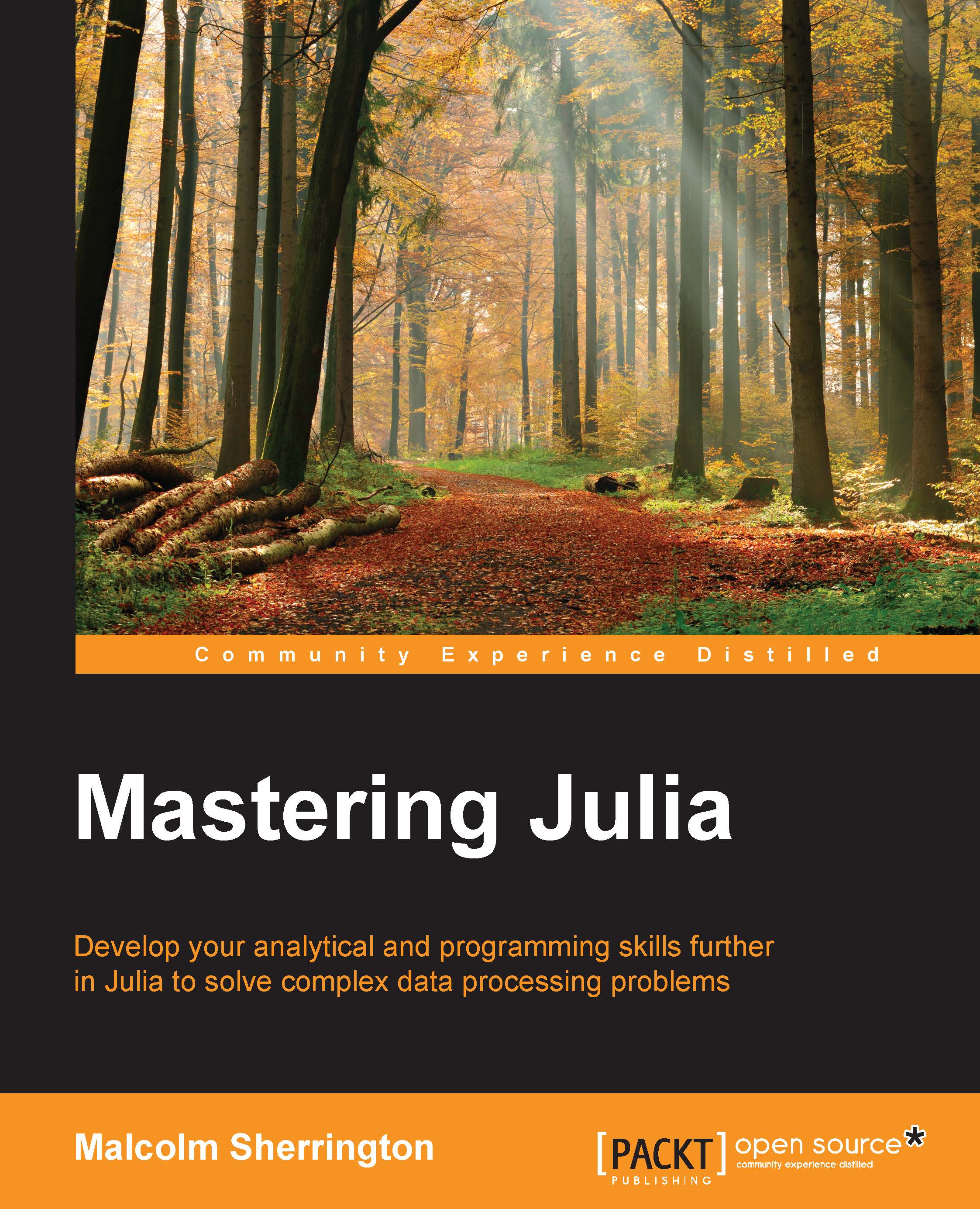
Mastering Julia
Mastering Julia

Mastering Julia: Develop your analytical and programming skills further in Julia to solve complex data processing problems

eBook
$43.19 $47.99
Paperback
$60.99
Subscription
Free Trial
Renews at $19.99p/m

What do you get with Print?

Product feature icon Instant access to your digital copy whilst your Print order is Shipped
Product feature icon Paperback book shipped to your preferred address
Product feature icon Redeem a companion digital copy on all Print orders
Product feature icon Access this title in our online reader with advanced features
Product feature icon DRM FREE - Read whenever, wherever and however you want
Product feature icon AI Assistant (beta) to help accelerate your learning
Modal Close icon
Payment Processing...
tick Completed

Shipping Address

Billing Address

Shipping Methods
Table of content icon View table of contents Preview book icon Preview Book

Mastering Julia

Chapter 2. Developing in Julia

Julia is a feature-rich language. It was designed to appeal to the novice programmer and purist alike. Indeed for those whose interests lie in data science, statistics and mathematical modeling, Julia is well equipped to meet all their needs.

Our aim is to furnish the reader with the necessary knowledge to begin programming in Julia almost immediately. So rather than begin with an overview of the language's syntax, control structures and the like, we will introduce Julia's facets gradually over the rest of this book. Over the next two chapters we will look at some of the basic and advanced features of the Julia core. Many of the features such as graphics and database access, which are implemented via the package system will be left until later.

If you are familiar with programming in Python, R, MATLAB and so on, you will not find the journey terribly arduous, in fact we believe it will be a particularly pleasant one.

At the present time Julia...

Integers, bits, bytes, and bools

Julia is a strongly typed language allowing the programmer to specify a variable's type precisely. However in common with most interpreted languages it does not require the type to be declared when a variable is declared, rather it infers it from the form of the declaration.

A variable in Julia is any combination of upper or lowercase letters, digits and the underscore (_) and exclamation (!) characters. It must start with a letter or an underscore _. Conventionally variable names consist of lowercase letters with long names separated by underscores rather than using camel case.

To determine a variable type we can use the typeof() function.

So typically:

julia>  x = 2;   typeof(x)  #  =>  gives Int64
julia>  x = 2.0;  typeof(x) # =>  gives Float64

Notice that the type (see the preceding code) starts with a capital letter and ends with a number which indicates the number of bit length of the variable. The bit length defaults to the word length...

Arrays

An array is an indexable collection of (normally) homogeneous values such as integers, floats, booleans. In Julia, unlike many programming languages, the index starts at 1 not 0.

One simple way to create an array is to enumerate its values:

julia> A = [0, 1, 1, 2, 3, 5, 8, 13, 21, 34, 55, 89, 144, 233, 377];
15-element Array{Int64,1}

These are the first 15 values of the Fibonacci series and because all values are listed as integers the array created is of type Int64. The other number refers to the number of dimensions of the array, in this case 1.

In conjunction of loops in the Asian option example in the previous chapter, we meet the definition of a range as: start:[step]:end

julia> A = [1:10]; B = [1:3:15]; C =[1:0.5:5];

Here A is [1,2,3,4,5,6,7,8,9,10], B is [1,4,7,10,13] and C is [1.0,1.5,2.0,2.5,3.0,3.5,4.0,4.5,5.0]

Because the step in C is specified as a float value the array is of type Float64 not Int64.

Julia also provides functions such as zeros, ones and rand which provide...

Char and strings

So far we have been dealing with numeric and boolean datatypes. In this section we will look at character representation and how Julia handles ASCII and UTF-8 strings of characters. We will also introduce the concept of regular expressions, widely used in pattern matching and filtering operations.

Characters

Julia has a built-in type Char to represent a character. A character occupies 32 bits not 8, so a character can represent a UTF-8 symbol and may be assigned in a number of ways:

julia> c = 'A'
julia> c = char(65)
julia> c = '\U0041'

All these represent the ASCII character capital A.

It is possible to specify a character code of '\Uffff' but char conversion does not check that every value is valid. However, Julia provides an isvalid_char() function:

julia> c = '\Udff3';
julia> is_valid_char(c; ) # => gives false.

Julia uses the special C-like syntax for certain ASCII control characters such as '\b',&apos...

Real, complex, and rational numbers

Now we will consider how to handle real and complex numbers in Julia and also introduce an alternate representation of fixed-point reals as a fraction comprising two integers, the Rational datatype.

Further we will discuss the use of the Big() function to handle integers and real numbers which are too large to be represented by the primitive Julia numeric types.

Reals

We have met real numbers a few times already. The generic type is FloatingPoint which is sub-classed from Real:

abstract Real <: Number
abstract FloatingPoint <: Real
bitstype 16 Float16 <: FloatingPoint
bitstype 32 Float32 <: FloatingPoint
bitstype 64 Float64 <: FloatingPoint

A float can be defined as x = 100.0 or x = 1e2 or x = 1f2; all represent the number 100.

The first will be of the type equivalent to WORD_SIZE, the second of type Float64 and the third (using f rather than the e notation) of type Float32.

There is also a p notation which can be used with hexadecimals, that...

Composite types

A composition type is a collection of named fields, grouped together and treated as a single entity; these are termed records and structures in some programming languages.

If the type can also have functions (methods) associated with them the resulting collection is termed an object and the languages which support them (Java, C++, Python, Ruby, and so on) as object-oriented.

In Julia, functions are not bundled up with the data structures they operate on. The choice of the method a function uses is termed dispatch. When the types of ALL of a function's arguments are considered when determining the method employed, this is termed multiple dispatch and Julia uses this rather than the single dispatch we associated with object methods. We will be considering the implication of multiple dispatch in detail in the next chapter.

Composite type details are defined with the type keyword, followed by a list of field names, optionally annotated with the :: operator and terminated with...

Integers, bits, bytes, and bools


Julia is a strongly typed language allowing the programmer to specify a variable's type precisely. However in common with most interpreted languages it does not require the type to be declared when a variable is declared, rather it infers it from the form of the declaration.

A variable in Julia is any combination of upper or lowercase letters, digits and the underscore (_) and exclamation (!) characters. It must start with a letter or an underscore _. Conventionally variable names consist of lowercase letters with long names separated by underscores rather than using camel case.

To determine a variable type we can use the typeof() function.

So typically:

julia>  x = 2;   typeof(x)  #  =>  gives Int64
julia>  x = 2.0;  typeof(x) # =>  gives Float64

Notice that the type (see the preceding code) starts with a capital letter and ends with a number which indicates the number of bit length of the variable. The bit length defaults to the word length of...

Arrays


An array is an indexable collection of (normally) homogeneous values such as integers, floats, booleans. In Julia, unlike many programming languages, the index starts at 1 not 0.

One simple way to create an array is to enumerate its values:

julia> A = [0, 1, 1, 2, 3, 5, 8, 13, 21, 34, 55, 89, 144, 233, 377];
15-element Array{Int64,1}

These are the first 15 values of the Fibonacci series and because all values are listed as integers the array created is of type Int64. The other number refers to the number of dimensions of the array, in this case 1.

In conjunction of loops in the Asian option example in the previous chapter, we meet the definition of a range as: start:[step]:end

julia> A = [1:10]; B = [1:3:15]; C =[1:0.5:5];

Here A is [1,2,3,4,5,6,7,8,9,10], B is [1,4,7,10,13] and C is [1.0,1.5,2.0,2.5,3.0,3.5,4.0,4.5,5.0]

Because the step in C is specified as a float value the array is of type Float64 not Int64.

Julia also provides functions such as zeros, ones and rand which provide...

Char and strings


So far we have been dealing with numeric and boolean datatypes. In this section we will look at character representation and how Julia handles ASCII and UTF-8 strings of characters. We will also introduce the concept of regular expressions, widely used in pattern matching and filtering operations.

Characters

Julia has a built-in type Char to represent a character. A character occupies 32 bits not 8, so a character can represent a UTF-8 symbol and may be assigned in a number of ways:

julia> c = 'A'
julia> c = char(65)
julia> c = '\U0041'

All these represent the ASCII character capital A.

It is possible to specify a character code of '\Uffff' but char conversion does not check that every value is valid. However, Julia provides an isvalid_char() function:

julia> c = '\Udff3';
julia> is_valid_char(c; ) # => gives false.

Julia uses the special C-like syntax for certain ASCII control characters such as '\b','\t','\n','\r',\'f' for backspace, tab, newline, carriage...

Real, complex, and rational numbers


Now we will consider how to handle real and complex numbers in Julia and also introduce an alternate representation of fixed-point reals as a fraction comprising two integers, the Rational datatype.

Further we will discuss the use of the Big() function to handle integers and real numbers which are too large to be represented by the primitive Julia numeric types.

Reals

We have met real numbers a few times already. The generic type is FloatingPoint which is sub-classed from Real:

abstract Real <: Number
abstract FloatingPoint <: Real
bitstype 16 Float16 <: FloatingPoint
bitstype 32 Float32 <: FloatingPoint
bitstype 64 Float64 <: FloatingPoint

A float can be defined as x = 100.0 or x = 1e2 or x = 1f2; all represent the number 100.

The first will be of the type equivalent to WORD_SIZE, the second of type Float64 and the third (using f rather than the e notation) of type Float32.

There is also a p notation which can be used with hexadecimals, that is...

Left arrow icon Right arrow icon

Description

Julia is a well-constructed programming language with fast execution speed, eliminating the classic problem of performing analysis in one language and translating it for performance into a second. This book will help you develop and enhance your programming skills in Julia to solve real-world automation challenges. This book starts off with a refresher on installing and running Julia on different platforms. Next, you will compare the different ways of working with Julia and explore Julia's key features in-depth by looking at design and build. You will see how data works using simple statistics and analytics, and discover Julia's speed, its real strength, which makes it particularly useful in highly intensive computing tasks and observe how Julia can cooperate with external processes in order to enhance graphics and data visualization. Finally, you will look into meta-programming and learn how it adds great power to the language and establish networking and distributed computing with Julia.

What you will learn

  • Install and build Julia and configure it with your environment Build a data science project through the entire cycle of ETL, analytics, and data visualization Understand the type system and principles of multiple dispatch for a better coding experience in Julia Interact with data files and data frames to study simple statistics and analytics Display graphics and visualizations to carry out modeling and simulation in Julia Use Julia to interact with SQL and NoSQL databases Work with distributed systems on the Web and in the cloud Develop your own packages and contribute to the Julia Community
Estimated delivery fee Deliver to United States

Economy delivery 10 - 13 business days

Free $6.95

Premium delivery 6 - 9 business days

$21.95
(Includes tracking information)

Product Details

Country selected
Publication date, Length, Edition, Language, ISBN-13
Publication date : Jul 22, 2015
Length: 410 pages
Edition : 1st
Language : English
ISBN-13 : 9781783553310
Category :
Languages :
Tools :

What do you get with Print?

Product feature icon Instant access to your digital copy whilst your Print order is Shipped
Product feature icon Paperback book shipped to your preferred address
Product feature icon Redeem a companion digital copy on all Print orders
Product feature icon Access this title in our online reader with advanced features
Product feature icon DRM FREE - Read whenever, wherever and however you want
Product feature icon AI Assistant (beta) to help accelerate your learning
Modal Close icon
Payment Processing...
tick Completed

Shipping Address

Billing Address

Shipping Methods
Estimated delivery fee Deliver to United States

Economy delivery 10 - 13 business days

Free $6.95

Premium delivery 6 - 9 business days

$21.95
(Includes tracking information)

Product Details

Publication date : Jul 22, 2015
Length: 410 pages
Edition : 1st
Language : English
ISBN-13 : 9781783553310
Category :
Languages :
Tools :

Packt Subscriptions

See our plans and pricing
Modal Close icon
$19.99 billed monthly
Feature tick icon Unlimited access to Packt's library of 7,000+ practical books and videos
Feature tick icon Constantly refreshed with 50+ new titles a month
Feature tick icon Exclusive Early access to books as they're written
Feature tick icon Solve problems while you work with advanced search and reference features
Feature tick icon Offline reading on the mobile app
Feature tick icon Simple pricing, no contract
$199.99 billed annually
Feature tick icon Unlimited access to Packt's library of 7,000+ practical books and videos
Feature tick icon Constantly refreshed with 50+ new titles a month
Feature tick icon Exclusive Early access to books as they're written
Feature tick icon Solve problems while you work with advanced search and reference features
Feature tick icon Offline reading on the mobile app
Feature tick icon Choose a DRM-free eBook or Video every month to keep
Feature tick icon PLUS own as many other DRM-free eBooks or Videos as you like for just $5 each
Feature tick icon Exclusive print discounts
$279.99 billed in 18 months
Feature tick icon Unlimited access to Packt's library of 7,000+ practical books and videos
Feature tick icon Constantly refreshed with 50+ new titles a month
Feature tick icon Exclusive Early access to books as they're written
Feature tick icon Solve problems while you work with advanced search and reference features
Feature tick icon Offline reading on the mobile app
Feature tick icon Choose a DRM-free eBook or Video every month to keep
Feature tick icon PLUS own as many other DRM-free eBooks or Videos as you like for just $5 each
Feature tick icon Exclusive print discounts

Frequently bought together


Stars icon
Total $ 159.97
Getting started with Julia Programming Language
$43.99
Mastering Julia
$60.99
Julia for Data Science
$54.99
Total $ 159.97 Stars icon

Table of Contents

11 Chapters
1. The Julia Environment Chevron down icon Chevron up icon
2. Developing in Julia Chevron down icon Chevron up icon
3. Types and Dispatch Chevron down icon Chevron up icon
4. Interoperability Chevron down icon Chevron up icon
5. Working with Data Chevron down icon Chevron up icon
6. Scientific Programming Chevron down icon Chevron up icon
7. Graphics Chevron down icon Chevron up icon
8. Databases Chevron down icon Chevron up icon
9. Networking Chevron down icon Chevron up icon
10. Working with Julia Chevron down icon Chevron up icon
Index Chevron down icon Chevron up icon

Customer reviews

Top Reviews
Rating distribution
Full star icon Full star icon Full star icon Full star icon Half star icon 4.4
(7 Ratings)
5 star 57.1%
4 star 28.6%
3 star 14.3%
2 star 0%
1 star 0%
Filter icon Filter
Top Reviews

Filter reviews by


James Jul 01, 2020
Full star icon Full star icon Full star icon Full star icon Full star icon 5
Came recommended from a friend, the book helped allot with my studies. I can highly recommend this book to anyone who wants to learn or is learning about Julia.
Amazon Verified review Amazon
Amazon Customer Dec 11, 2016
Full star icon Full star icon Full star icon Full star icon Full star icon 5
The definitive work on Julia and its capabilities.
Amazon Verified review Amazon
Alessandro Piovaccari Sep 24, 2015
Full star icon Full star icon Full star icon Full star icon Full star icon 5
I have been using many programming languages over the years, and I find Julia efficient and fascinating. Julia combines the power and versatility of Python and it's extension, with the simplicity of Matlab. This, like many other PACKT books, is very well written and quite useful if are seriously thinking about using Julia for your scientific computing.
Amazon Verified review Amazon
Jan Galkowski Dec 06, 2015
Full star icon Full star icon Full star icon Full star icon Full star icon 5
Nice introduction. Doesn't answer the basic question, though, of why to use Julia when there are so many other good options out there.
Amazon Verified review Amazon
Amazon Customer Nov 10, 2017
Full star icon Full star icon Full star icon Full star icon Empty star icon 4
I thought this was a very good book because I find the Julia documentation lacking. The Julia language can do so many things and the author tried to explore them all, but this was also why it got 4 stars and not 5. It is entitled Mastering Julia, but when I finished I didn't feel like I had mastered Julia. I did have a much better understanding of Julia, though, and for that I thank the author. I have been a professional programmer since the 1980s and worked with at least a dozen different languages. I really like the Julia language, it's portability, and it's ease of use especially when doing the parallel programming aspects. I ask the author to look at the book pairings like: Java in a Nutshell and Java Examples in a Nutshell. Programmers learn by example when moving to another language. I think more fledged out examples would be helpful.
Amazon Verified review Amazon
Get free access to Packt library with over 7500+ books and video courses for 7 days!
Start Free Trial

FAQs

What is the digital copy I get with my Print order? Chevron down icon Chevron up icon

When you buy any Print edition of our Books, you can redeem (for free) the eBook edition of the Print Book you’ve purchased. This gives you instant access to your book when you make an order via PDF, EPUB or our online Reader experience.

What is the delivery time and cost of print book? Chevron down icon Chevron up icon

Shipping Details

USA:

'

Economy: Delivery to most addresses in the US within 10-15 business days

Premium: Trackable Delivery to most addresses in the US within 3-8 business days

UK:

Economy: Delivery to most addresses in the U.K. within 7-9 business days.
Shipments are not trackable

Premium: Trackable delivery to most addresses in the U.K. within 3-4 business days!
Add one extra business day for deliveries to Northern Ireland and Scottish Highlands and islands

EU:

Premium: Trackable delivery to most EU destinations within 4-9 business days.

Australia:

Economy: Can deliver to P. O. Boxes and private residences.
Trackable service with delivery to addresses in Australia only.
Delivery time ranges from 7-9 business days for VIC and 8-10 business days for Interstate metro
Delivery time is up to 15 business days for remote areas of WA, NT & QLD.

Premium: Delivery to addresses in Australia only
Trackable delivery to most P. O. Boxes and private residences in Australia within 4-5 days based on the distance to a destination following dispatch.

India:

Premium: Delivery to most Indian addresses within 5-6 business days

Rest of the World:

Premium: Countries in the American continent: Trackable delivery to most countries within 4-7 business days

Asia:

Premium: Delivery to most Asian addresses within 5-9 business days

Disclaimer:
All orders received before 5 PM U.K time would start printing from the next business day. So the estimated delivery times start from the next day as well. Orders received after 5 PM U.K time (in our internal systems) on a business day or anytime on the weekend will begin printing the second to next business day. For example, an order placed at 11 AM today will begin printing tomorrow, whereas an order placed at 9 PM tonight will begin printing the day after tomorrow.


Unfortunately, due to several restrictions, we are unable to ship to the following countries:

  1. Afghanistan
  2. American Samoa
  3. Belarus
  4. Brunei Darussalam
  5. Central African Republic
  6. The Democratic Republic of Congo
  7. Eritrea
  8. Guinea-bissau
  9. Iran
  10. Lebanon
  11. Libiya Arab Jamahriya
  12. Somalia
  13. Sudan
  14. Russian Federation
  15. Syrian Arab Republic
  16. Ukraine
  17. Venezuela
What is custom duty/charge? Chevron down icon Chevron up icon

Customs duty are charges levied on goods when they cross international borders. It is a tax that is imposed on imported goods. These duties are charged by special authorities and bodies created by local governments and are meant to protect local industries, economies, and businesses.

Do I have to pay customs charges for the print book order? Chevron down icon Chevron up icon

The orders shipped to the countries that are listed under EU27 will not bear custom charges. They are paid by Packt as part of the order.

List of EU27 countries: www.gov.uk/eu-eea:

A custom duty or localized taxes may be applicable on the shipment and would be charged by the recipient country outside of the EU27 which should be paid by the customer and these duties are not included in the shipping charges been charged on the order.

How do I know my custom duty charges? Chevron down icon Chevron up icon

The amount of duty payable varies greatly depending on the imported goods, the country of origin and several other factors like the total invoice amount or dimensions like weight, and other such criteria applicable in your country.

For example:

  • If you live in Mexico, and the declared value of your ordered items is over $ 50, for you to receive a package, you will have to pay additional import tax of 19% which will be $ 9.50 to the courier service.
  • Whereas if you live in Turkey, and the declared value of your ordered items is over € 22, for you to receive a package, you will have to pay additional import tax of 18% which will be € 3.96 to the courier service.
How can I cancel my order? Chevron down icon Chevron up icon

Cancellation Policy for Published Printed Books:

You can cancel any order within 1 hour of placing the order. Simply contact customercare@packt.com with your order details or payment transaction id. If your order has already started the shipment process, we will do our best to stop it. However, if it is already on the way to you then when you receive it, you can contact us at customercare@packt.com using the returns and refund process.

Please understand that Packt Publishing cannot provide refunds or cancel any order except for the cases described in our Return Policy (i.e. Packt Publishing agrees to replace your printed book because it arrives damaged or material defect in book), Packt Publishing will not accept returns.

What is your returns and refunds policy? Chevron down icon Chevron up icon

Return Policy:

We want you to be happy with your purchase from Packtpub.com. We will not hassle you with returning print books to us. If the print book you receive from us is incorrect, damaged, doesn't work or is unacceptably late, please contact Customer Relations Team on customercare@packt.com with the order number and issue details as explained below:

  1. If you ordered (eBook, Video or Print Book) incorrectly or accidentally, please contact Customer Relations Team on customercare@packt.com within one hour of placing the order and we will replace/refund you the item cost.
  2. Sadly, if your eBook or Video file is faulty or a fault occurs during the eBook or Video being made available to you, i.e. during download then you should contact Customer Relations Team within 14 days of purchase on customercare@packt.com who will be able to resolve this issue for you.
  3. You will have a choice of replacement or refund of the problem items.(damaged, defective or incorrect)
  4. Once Customer Care Team confirms that you will be refunded, you should receive the refund within 10 to 12 working days.
  5. If you are only requesting a refund of one book from a multiple order, then we will refund you the appropriate single item.
  6. Where the items were shipped under a free shipping offer, there will be no shipping costs to refund.

On the off chance your printed book arrives damaged, with book material defect, contact our Customer Relation Team on customercare@packt.com within 14 days of receipt of the book with appropriate evidence of damage and we will work with you to secure a replacement copy, if necessary. Please note that each printed book you order from us is individually made by Packt's professional book-printing partner which is on a print-on-demand basis.

What tax is charged? Chevron down icon Chevron up icon

Currently, no tax is charged on the purchase of any print book (subject to change based on the laws and regulations). A localized VAT fee is charged only to our European and UK customers on eBooks, Video and subscriptions that they buy. GST is charged to Indian customers for eBooks and video purchases.

What payment methods can I use? Chevron down icon Chevron up icon

You can pay with the following card types:

  1. Visa Debit
  2. Visa Credit
  3. MasterCard
  4. PayPal
What is the delivery time and cost of print books? Chevron down icon Chevron up icon

Shipping Details

USA:

'

Economy: Delivery to most addresses in the US within 10-15 business days

Premium: Trackable Delivery to most addresses in the US within 3-8 business days

UK:

Economy: Delivery to most addresses in the U.K. within 7-9 business days.
Shipments are not trackable

Premium: Trackable delivery to most addresses in the U.K. within 3-4 business days!
Add one extra business day for deliveries to Northern Ireland and Scottish Highlands and islands

EU:

Premium: Trackable delivery to most EU destinations within 4-9 business days.

Australia:

Economy: Can deliver to P. O. Boxes and private residences.
Trackable service with delivery to addresses in Australia only.
Delivery time ranges from 7-9 business days for VIC and 8-10 business days for Interstate metro
Delivery time is up to 15 business days for remote areas of WA, NT & QLD.

Premium: Delivery to addresses in Australia only
Trackable delivery to most P. O. Boxes and private residences in Australia within 4-5 days based on the distance to a destination following dispatch.

India:

Premium: Delivery to most Indian addresses within 5-6 business days

Rest of the World:

Premium: Countries in the American continent: Trackable delivery to most countries within 4-7 business days

Asia:

Premium: Delivery to most Asian addresses within 5-9 business days

Disclaimer:
All orders received before 5 PM U.K time would start printing from the next business day. So the estimated delivery times start from the next day as well. Orders received after 5 PM U.K time (in our internal systems) on a business day or anytime on the weekend will begin printing the second to next business day. For example, an order placed at 11 AM today will begin printing tomorrow, whereas an order placed at 9 PM tonight will begin printing the day after tomorrow.


Unfortunately, due to several restrictions, we are unable to ship to the following countries:

  1. Afghanistan
  2. American Samoa
  3. Belarus
  4. Brunei Darussalam
  5. Central African Republic
  6. The Democratic Republic of Congo
  7. Eritrea
  8. Guinea-bissau
  9. Iran
  10. Lebanon
  11. Libiya Arab Jamahriya
  12. Somalia
  13. Sudan
  14. Russian Federation
  15. Syrian Arab Republic
  16. Ukraine
  17. Venezuela
Modal Close icon
Modal Close icon