Search icon CANCEL
Subscription
0
Cart icon
Your Cart (0 item)
Close icon
You have no products in your basket yet
Save more on your purchases! discount-offer-chevron-icon
Savings automatically calculated. No voucher code required.
Arrow left icon
Explore Products
Best Sellers
New Releases
Books
Videos
Audiobooks
Learning Hub
Newsletter Hub
Free Learning
Arrow right icon
timer SALE ENDS IN
0 Days
:
00 Hours
:
00 Minutes
:
00 Seconds
Learning RSLogix 5000 Programming

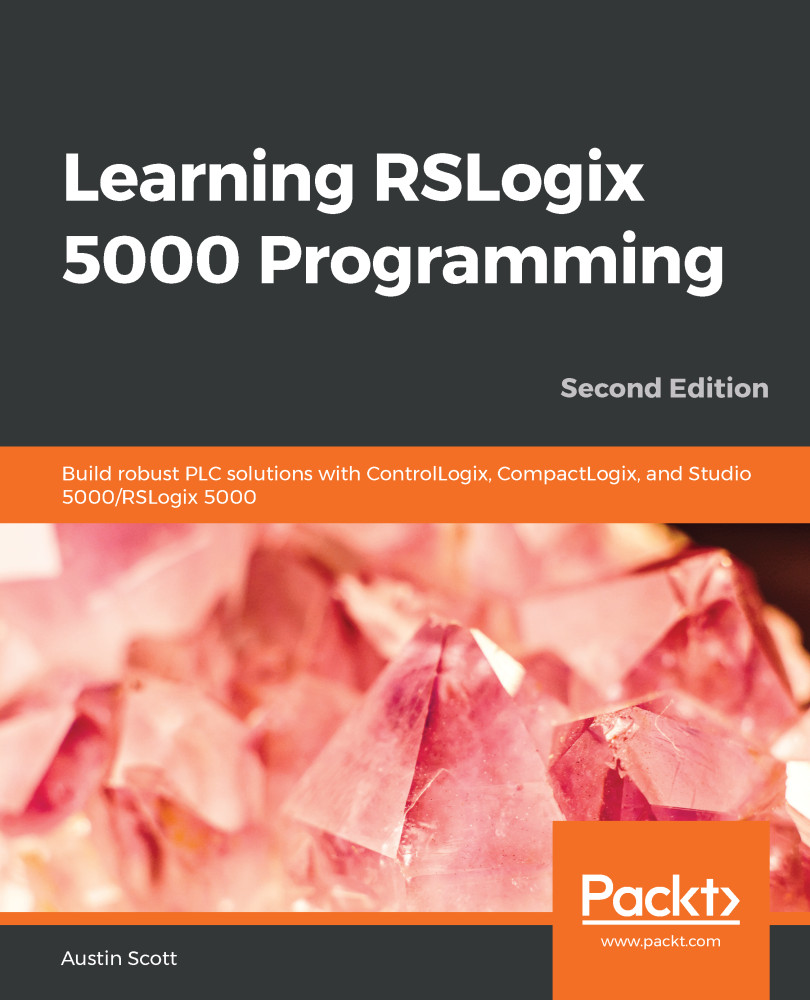
Learning RSLogix 5000 Programming: Build robust PLC solutions with ControlLogix, CompactLogix, and Studio 5000/RSLogix 5000 , Second Edition

eBook
$35.99 $39.99
Paperback
$49.99
Subscription
Free Trial
Renews at $19.99p/m

What do you get with Print?

Product feature icon Instant access to your digital copy whilst your Print order is Shipped
Product feature icon Paperback book shipped to your preferred address
Product feature icon Redeem a companion digital copy on all Print orders
Product feature icon Access this title in our online reader with advanced features
Product feature icon DRM FREE - Read whenever, wherever and however you want
Product feature icon AI Assistant (beta) to help accelerate your learning
Modal Close icon
Payment Processing...
tick Completed

Shipping Address

Billing Address

Shipping Methods
Table of content icon View table of contents Preview book icon Preview Book

Learning RSLogix 5000 Programming

The History of Rockwell Automation Technologies

This book begins with some background history of industrial control systems and the Rockwell Automation ecosystem. It is essential to understand the legacy systems provided by Rockwell Automation because some of them can still be found operating in the field today. Also, it is important to understand the overall Rockwell Automation offering, the terminology, and how the platforms we focus on in this book fit into that world.

In this chapter, we will introduce Rockwell Automation and provide a history of the evolution of their technologies, right up to the Logix platform. Due to the 15- to 20-year industrial controller lifespan, it is not uncommon to encounter older versions of hardware and firmware and so it is critical to understand their evolution.

The following topics will be covered in this chapter:

  • Controlling equipment with water, air, and power

  • A brief history of Rockwell Automation

  • Understanding Integrated Architecture

In the first section of this chapter, we will look at the earliest examples of control systems in history.

Controlling equipment with water, air, and power

The earliest control systems can be traced back to the float regulator mechanisms that were used in Greece around 270 BC. The need for accurate time tracking inspired the Greek water clock (clepsydra), which leveraged the simple float regulator to maintain a constant flow of water. The float regulator would maintain the water level in a primary tank at a constant depth; water kept at a constant depth maintained a constant water pressure.

Constant pressure resulted in a constant flow of water through a tube that would fill a secondary tank at a constant rate. The level of the second tank was used to measure time, which was displayed on a dial using a second float. A similar float regulator mechanism is still used in our toilets today. A construct that uses input from another device (float) to maintain a value (water level) is called a feedback controller.

The following diagram details the components of a simple Greek water clock (clepsydra):

In the next section, we will discuss the advent of pneumatics and its place within industrial control systems.

The rise of pneumatics

The Greeks also invented a more sophisticated feedback control mechanism that utilized steam or compressed air, rather than water, called pneumatics. The Greek mathematician Hero of Alexandria created inventions that were powered by steam or the wind. German physicist Otto von Guericke (1602 – 1686) was the first to invent a vacuum pump that can draw out air or gas from the attached vessel. After the industrial revolution, the air pressure from pneumatics was used as a method of activation and signal transmission within control systems. In the 1950s and 1960s, pneumatics signal transmission started to be replaced by electric signal transmission, which gave rise to the modern control systems we see today. However, it is not uncommon to see pneumatics still used today in a wide range of applications. Today, pneumatics are still a ubiquitous part of many Heating Ventilation and Air Conditioning (HVAC) systems.

The following diagram illustrates a typical pneumatic HVAC heating system (image courtesy of Spirax Sarco Limited):

The preceding diagram shows how a pneumatic controller is used to regulate the temperature of a steam heating system using a pneumatic temperature control valve based on the feedback loop from the temperature sensor.

In the next section, we will introduce the electromechanical relay and discuss how it changed industrial automation forever.

Understanding electric relay logic

The electromechanical relay was first created in 1835 by Joseph Henry (1797 – 1878). Although Joseph Henry built and demonstrated the first mechanical relay, he had no intention of applying it to a practical application. The relay was used to demonstrate the phenomenon of self-inductance and mutual inductance to his students. In 1836, when Samuel F. B. Morse learned of the electromechanical relay, he began to consider its potential application for communications and controlling machinery.

Samuel Morse soon used Henry's relay device to carry morse code signals over long distances of wire. As electromechanical relays began to be widely adopted to control electrical equipment, a standard method of documenting the relay wiring was required. This led to the advent of ladder diagrams, which were used to document the convoluted logic of these systems so that they could be maintained and upgraded.

Control systems evolved into a complex mixture of industrial relays, rotary drum sequencers, pneumatic plunger timers, counters, motors, push buttons, selector switches, limit switches, and valves, all connected together and controlled using hundreds or thousands of failure-prone electromechanical relays. As complex control systems evolved and were maintained, they inevitably transformed into a rat's nest of wires, leading to outages and extended turnarounds. General Motors (GM) had grown tired of the shortcomings of hardwired relay logic within their automotive factories and were aware of advances in solid-state computers. So, as the story goes, on New Year's Day 1968, they detailed a specification for what would later be known as the Programmable Logic Controller (PLC). GM’s requirements were as follows:

  • Competitively priced with a traditional relay logic system
  • Leveraging a solid-state system that is flexible, such as a computer
  • Programmed in a manner that aligns with accepted relay ladder engineering diagrams
  • Robust enough to work in industrial environments where they would be exposed to dirt, moisture, electromagnetism, and vibration
  • Modular and expandable to support a wide range of process sizes and types

We have now covered the past 2,000 years of industrial automation evolution. In the next section, we will introduce Rockwell Automation and detail their contributions to the automation industry.

A brief history of Rockwell Automation

In 1901, while working for Milwaukee Electric, Lynde Bradley (a teenager at the time) devised a better way to build the controllers that regulate motor speed. He soon quit his job, secured a small $1,000 investment from his lifelong friend, Dr. Stanton Allen, and co-founded the Allen-Bradley company with his brother, Harry Bradley, in 1903. The primary focus of Allen-Bradley was,for several decades, motor controllers, until they received an unusual request from GM in 1968 to build a system to replace their hardwired relay logic with something more dynamic—a standard machine controller.

Program Data Quantizer II and the Programmable Matrix Controller

Allen-Bradley responded to GM's request with two solutions—first, a large, difficult-to-program, expensive minicomputer-based Program Data Quantizer (PDQ) II in 1970 and later, the smaller and easier-to-program Programmable Matrix Controller (PMC) in 1971. The PMC was an early precursor to the modern PLC, and Allen-Bradley later adopted the term PLC for future releases of their automation products.

Allen-Bradley used the term PLC, rather than programmable controller,which was the previously used industry-accepted term. PLC became the standard moving forward as PCs became incorporated into control systems.

Although Allen-Bradley did not win the GM bid, the PMC continued to evolve until the release of the PLC-2. GM awarded the contract to Dick Morley and his company, Bedford and Associates. Dick Morely spun off a new company, named Modicon, and started to sell a PLC product called the Modicon 084 (named because it was prototype #84) based on this initial design.

PLC-2 controllers

Allen-Bradley introduced their very first PLC (PLC-1) in 1970, and it continued to evolve until the release of the PLC-2 in 1978. The PLC-2 played a vital role in the Space Shuttle program as Rockwell International was a primary contractor. The PLC-2/20 and many other AB controls were used in the manufacturing and testing of the 153-foot one-time-use tank, which fueled and provided structure to the shuttle.

The PLC-2 family of processors featured three versions:

  • PLC-2/10
  • PLC-2/20
  • PLC-2/30

The more-powerful PLC-2 processors ran on a 1772-LP3D4 processor running at 47 to 63 Hz and supporting up to 16 K (16 data bits) of memory capacity.

The following diagram depicts the original PLC-2/30 controller:
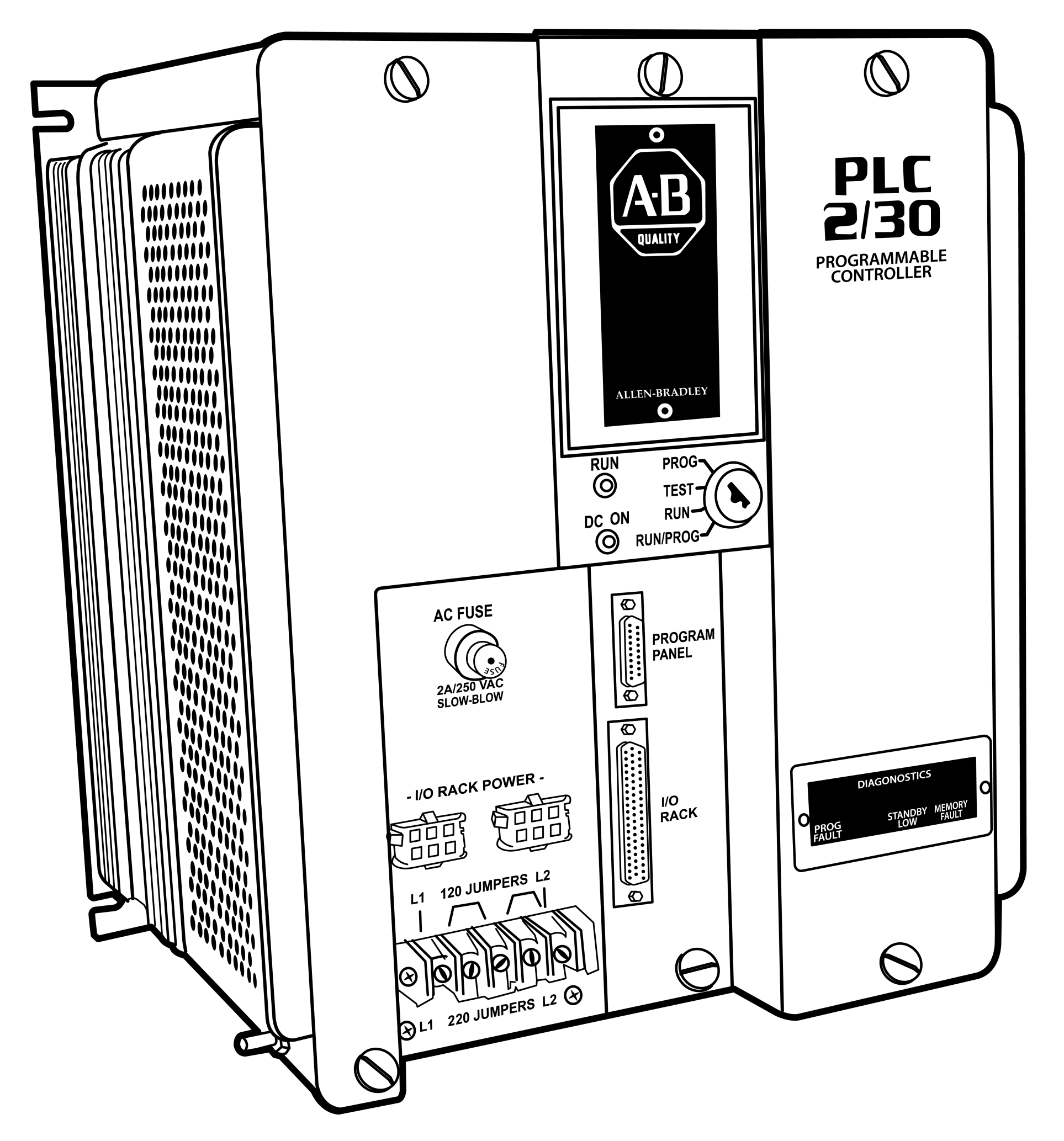
It is possible that a few PLC-2/30s or PLC-2/20s could still be found in the field today. The PLC-2 can be programmed using 32-bit operating systems, such as Windows 8. The PLC-2 can be programmed using the 6200 programming terminal or Application Interface (AI) programming version 6.24 and a serial interface. The Rockwell AI software is an MS-DOS-based programming interface that provides a text-based graphical interface for viewing and editing ladder logic.

In the next section, we will discuss the third PLC created by Allen-Bradley—the PLC-3.

PLC-3 controllers

The PLC-3 was introduced in 1981 (the same year that the first Space Shuttle launched) and provided significant scalability increase for control systems. The PLC-3 was usually packaged with a programming terminal, much like the PLC-2. The PLC-3 supported up to 128 K (16 data bits) of memory capacity.

The following diagram depicts the Allen-Bradley PLC-3 controller unit, which featured a numeric keypad for programming and adjustments:

In the following section, we will introduce the robust PLC-5 platform, which replaced the PLC-3 and can still be found operating in some plants today.

PLC-5 controllers

The 1785 catalog number PLC-5 was launched in 1986 based on the Motorola 68000 32-bit CISC microprocessor and was designed to scale and support both centralized and distributed control architectures.Allen-Bradley defined a centralized architecture design as one that featured a single processor managing a plant where a distributed architecture contained multiple processors and user interfaces to manage a plant.

At the time of its release, a PLC-5 network would likely be managed by a VAX/VMS host or a panel-view operator terminal and programmed using dedicated programming terminal computers engineered by Allen-Bradley. As the PLC-5 platform evolved, it later adopted Ethernet connectivity (PLC-5/20E, PLC-5/40E, and PLC-5/80E) using a 15-pin Ethernet port, the first Allen-Bradley PLCs to do so.

Around the same time as the PLC-5 release in 1985, Allen-Bradley was acquired by Rockwell International (now known as Rockwell Automation), but the Allen-Bradley name and logo can still be found on many of Rockwell Automation's products.

The PLC-5 was an extremely robust platform and although it has been discontinued and replaced with the ControlLogix platform by Rockwell, it continues to operate in many plants. I have personally owned a PLC-5/40E and worked with plants that still operate these devices today.

Over the years of development of the PLC-5, Allen-Bradley released 15 versions of the platform, which were later categorized by Rockwell as Classic PLC-5 processors and Enhanced PLC-5 processors.

PLC-5 processors that contain an E after the series number are Ethernet-enabled (for example, PLC-5/20E, PLC-5/40E, and PLC-5/80E). PLC-5 processors that contain an L after the series number also support an extended local I/O connection (for example, PLC-5/40L and PLC-5/60L).

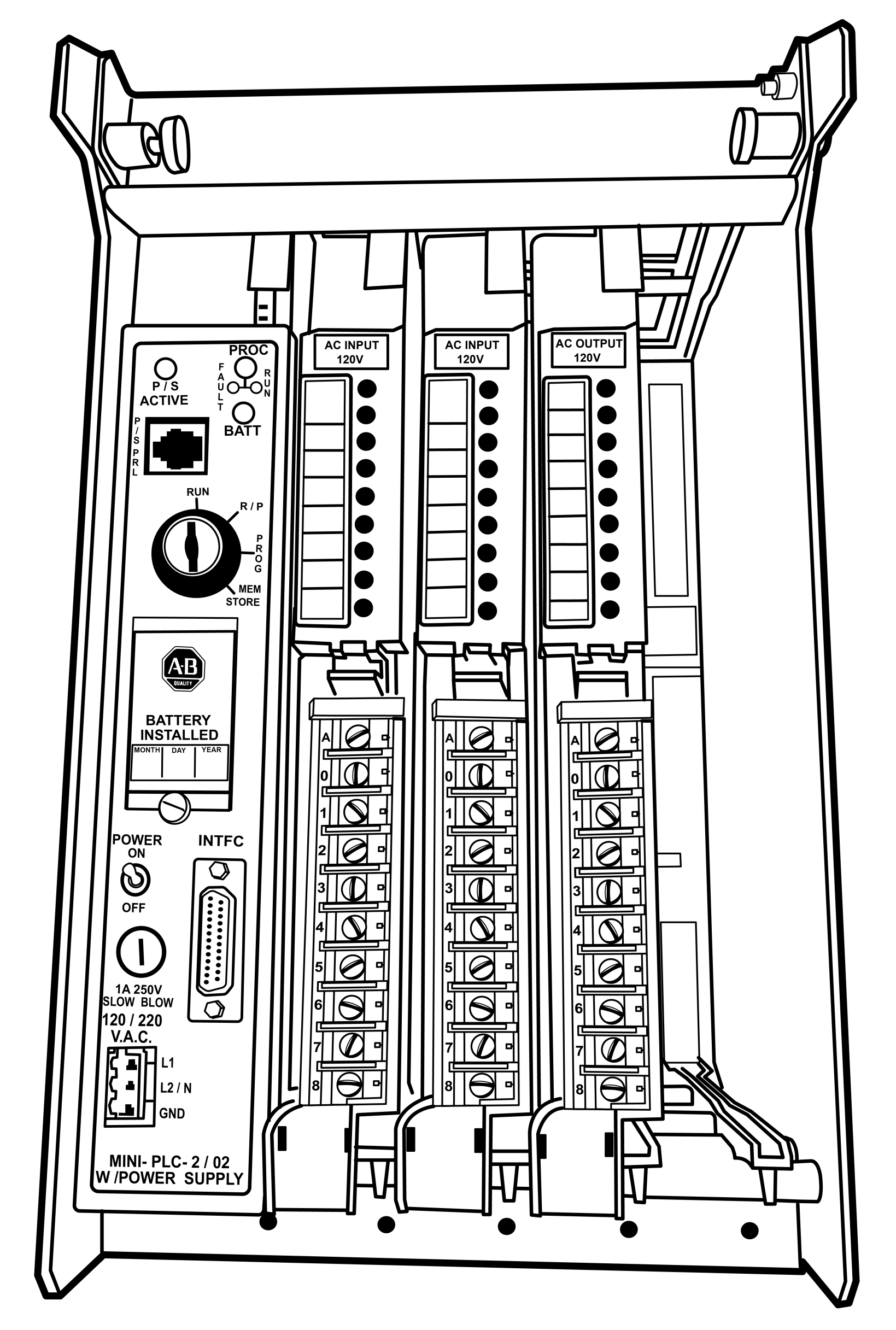
The PLC-5 Classic family of processors leveraged DataHighway Plus (DH+) and remote I/O for its communications. The PLC-5 Enhanced family of processors also had serial communications and Ethernet communications. Although the early programming software for the PLC-5 was DOS-based, Allen-Bradley eventually created a Windows-based programming environment for the PLC-5, called RSLogix5. The PLC-5 rack was entirely made of metal, making it very heavy and giving it an industrial feel. The following diagram depicts the PLC-5 rack with a processor and some I/O cards:
In the next section, we will discuss Allen-Bradley's first foray into the midsize control system market with the SLC-500 controller.

SLC-500 controllers

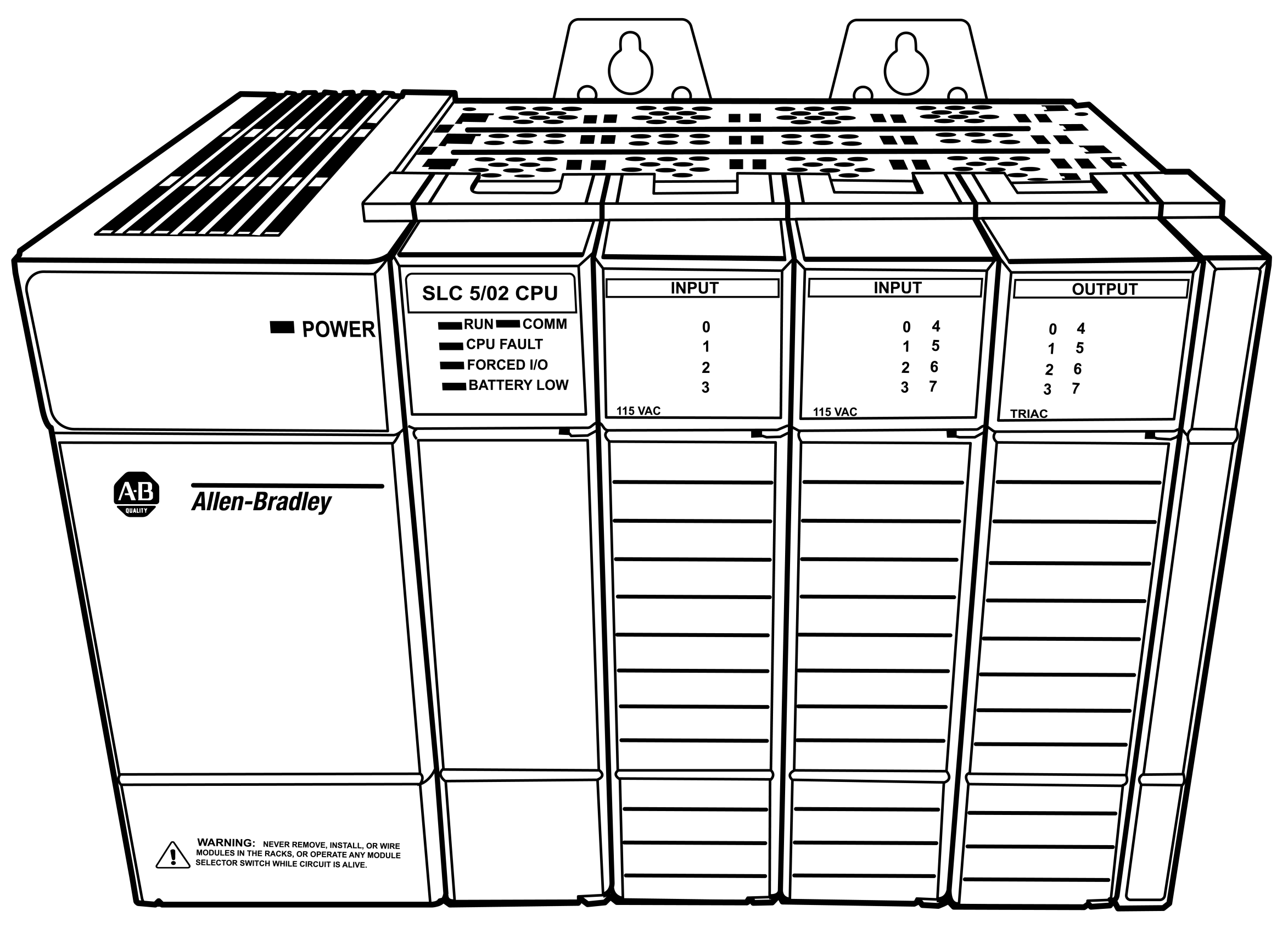
The SLC-500 was launched in 1991 and was designed to be used in smaller plants; in fact, SLC stands for Small Logic Controller. The SLC-500 is an integrated platform that contains the CPU, power supply, and I/O in a single unit. The SLC-500 platform eventually received communications support for DH485 (Data Highway) and Ethernet. The Allen-Bradley RSLogix 500 software was used to program the SLC-500s. The SLC-500 has been replaced with the newer CompactLogix 5370 or 5380 control platforms. The following is a diagram of the SLC-500 controller:
Next, we will introduce the low-cost control system solution from Allen-Bradley, the MicroLogix controller.

MicroLogix

MicroLogix and Flex I/O were launched in 1994. MicroLogix used the RSLogix 500 software for programming their PLCs (the same software used for the SLC controller family). The first MicroLogix unit to be introduced was the MicroLogix 100 PLC, which was released with several different combinations of I/O. Its creation was a response to the need for a low-cost automation solution with a limited feature set. The MicroLogix controller did not originally use a rack and modular cards, but rather a fixed set of input and output channels.

The following is a diagram of a Rockwell MicroLogix controller:

Over the years, Rockwell also introduced other new MicroLogix controllers, such as the Bulletin 1763 MicroLogix 1100, the Bulletin 1762 MicroLogix 1200, and the Bulletin1766 MicroLogix 1400 series. The 1100, 1200, and 1400 series controllers have reached their end of life and have been replaced with the Micro800 series or CompactLogix series of controllers.

What is a Rockwell Bulletin number? A Bulletin is a brief posting of public information. Product lines within Rockwell are associated with a Bulletin number. A Bulletin and its associated number are posted when a new semiconductor product starts development within Rockwell. The Bulletin number is the internal project number associated with a product line during research and development within Rockwell. The Bulletin number is maintained after the product is released.

You can always check the end-of-life status of a particular product by going to the Rockwell product life cycle page at https://www.rockwellautomation.com/global/support/product-compatibility-migration/lifecycle-status/overview.page.

Now, we are ready to introduce the ControlLogix line of controllers, which are the primary focus of this book.

ControlLogix controllers

The ControlLogix controller was first launched in 1997 as a replacement for Allen-Bradley's previous large-scale control platform—the PLC-5. The ControlLogix platform includes the Bulletin 1756 ControlLogix 5550 controller, the Bulletin 1756 ControlLogix I/O modules, and the RSLogix 5000 programming software platform (now referred to as Logix Designer). ControlLogix represented a significant technological step forward, which included a 32-bit ARM-6 RISC-core microprocessor and the ABrisc Boolean processor combined with a bus interface on the same silicon chip. At launch, the Series 5 (also referred to as L5 and ControlLogix 5550) ControlLogix controllers were able to execute code three times faster than the PLC-5. The L5 controller is considered to be a Programmable Automation Controller (PAC), rather than a traditional PLC, due to its modern design, power, and capabilities beyond a traditional PLC (such as motion control, advanced networking, batching, and sequential control). The ControlLogix platform is built on the ControlBus backplane, which performs like a mini-network and allows devices to be Removed or Inserted Under Power (RIUP).

Warning – removing modules while under power can create an arc and have disastrous consequences in explosive environments.

The L5 has since been retired from the lineup, so we will focus on the newer L6 and L7 controllers in this book. Throughout this book, we will refer to the ControlLogix controllers as PACs, which are the modern-day equivalent of PLCs. In 2002, the Bulletin 1756 ControlLogix L6 processor was released with a more powerful processor, more memory, and the CompactFlash non-volatile memory card was added to the lineup.

Even though the ControlLogix platform is approaching its 20th birthday, it is still in the early stages of its product life cycle. For example, Allen-Bradley’s 1747 series SLC-500 family, which was introduced in 1989, is still available for sale today. Although it is no longer actively developed, the SLC-500 represents a product life in excess of 25 years.

ControlLogix represents a standard control engine with a standard development environment and tight integration between the programming software, controller, and I/O modules. This close integration greatly reduces the automation engineering development time and cost. The following diagram is of the L5 (Logix5550) controller, which was the very first ControlLogix processor card:

In the following section, we will introduce Rockwell Automation's Integrated Architecture product strategy and show you how the ControlLogix family fits into this bigger picture.

Understanding Integrated Architecture

Like many other vendors, Rockwell Automation has recently rebranded and reorganized its offering. The ControlLogix family is part of Rockwell Automation's larger solution offering, called Integrated Architecture. Integrated Architecture is a relatively new term in the world of Rockwell Automation, but the concept has been in place for quite some time. It represents a convergence of the control and information systems within an operating environment. We have seen a continuous increase in demand for operational information to be provided to the corporate information system in real time to fulfill maintenance needs, environmental reporting, accounting, and other corporate requirements. At the same time, we have seen operational technology move from proprietary protocols and data access technology to traditional IT technologies, such as TCP/IP and Ethernet. The promise of Integrated Architecture is the ability to implement plant-wide optimization quickly, reduce technical project risk, increase machine performance, and improve long-term reliability.

The five core technologies of the Integrated Architecture PAC product line include the following:

  • ControlLogix

  • CompactLogix

  • GuardLogix

  • DriveLogix

  • SoftLogix

  • MicroLogix/Micro800

The following diagram outlines the Integrated Architecture structure and where ControlLogix fits into the mix:

FlexLogix (Bulletin 1794) controllers were also part of the Logix PAC family that was used to communicate PLC-5 and SLC-500 Flex I/O blocks. However, FlexLogix has now been retired from the lineup, so it will not be covered in this book. However, 1794 Flex I/O racks continue to be supported, so these will be discussed.

The product formally known as RSLogix 5000 (used for programming ControlLogix and CompactLogix controllers) is now included within the Automation Engineering and Design software suite called Studio 5000 and is now referred to as Logix Designer. For the remainder of this book, we will refer to Logix Designer, which is essentially just the newest version of RSLogix 5000.

Rockwell's rebranding of Studio 5000 has also generated several other products and features. One such feature is the Connected Components Workbench software, which aims to streamline the development of the overall control system by incorporating PLC programming, device configuration, and HMI editing into a single product offering. We will not touch on the Connected Components Workbench software in this book, but it is important to be aware of its role in the Rockwell product ecosystem.

Summary

In this chapter, we delved into the history of industrial automation, starting with the Greek water clock and moving right up to modern control systems. We learned about the controllers and product lines that were developed by Allen-Bradley and Rockwell Automation over the years and discussed their evolution. We also touched on the modern controller solutions that are part of Studio 5000 and Integrated Architecture.

In the next chapter, we will take a deep dive into the ControlLogix platform and start to work with modern Rockwell Automation controllers.

Further reading

Questions

The following questions can be used to test your retention of the concepts introduced in this chapter. You can find the answers to these questions in the back of the book under Assessments:

  1. What device is considered to be one of the first control systems?
  2. What device did Samuel F. B. Morse create in 1836 that is still widely used in automation systems today?
  3. What was the name of the company started by Lynde Bradley and Harry Bradley in 1903?
  4. What was the name of the device created as a result of the GM request for information to replace hardwired relay logic in 1968?
  5. What PLC platform was launched in 1991 that was designed to be used in smaller plants and stands for Small Logic Controller?
  6. What PLC platform was launched in 1997 as a replacement for Allen-Bradley's previous large-scale control platform, the PLC-5?
  7. What is the Rockwell Automation umbrella term for integrated convergence of the control and information systems within an operational environment?
Left arrow icon Right arrow icon

Key benefits

  • Build real-world solutions using ControlLogix, CompactLogix, and RSLogix 5000/Studio 5000
  • Understand the different controllers and form factors offered by the ControlLogix and CompactLogix platforms
  • Explore the latest changes in the Studio 5000 Automation Engineering and Design software suite

Description

Understanding programmable logic controller (PLC) programming with Rockwell Software’s Logix Designer and the Studio 5000 platform, which includes ControlLogix, CompactLogix, and SoftLogix, is key to building robust PLC solutions. RSLogix 5000/Studio 5000’s Logix Designer are user-friendly IEC 61131-3-compliant interfaces for programming the current generation of Rockwell Automation Controllers using Ladder Diagram (LD), Function Block Diagram (FBD), Structured Text (ST), and Sequential Function Chart (SFC). This second edition of Learning RSLogix 5000 Programming guides you through the technicalities and comes packed with the latest features of Studio 5000, industrial networking fundamentals, and industrial cybersecurity best practices. You’ll go through the essential hardware and software components of Logix, before learning all about the new L8 processor model and the latest Studio 5000 architecture to build effective integrated solutions. Entirely new for this edition, you’ll discover a chapter on cybersecurity concepts with RSLogix 5000. The book even gets you hands-on with building a robot bartender control system from start to finish. By the end of this Logix 5000 book, you’ll have a clear understanding of the capabilities of the Logix platform and be able to confidently navigate Rockwell Automation Literature Library resources.

Who is this book for?

If you’re a PLC programmer, an electrician, an instrumentation technician, or an automation professional with basic PLC programming knowledge, but no knowledge of RSLogix 5000, this RSLogix 5000 book is for you. You’ll also find the book useful if you’re already familiar with automation and want to learn about RSLogix 5000 software in a short time span.

What you will learn

  • Gain insights into Rockwell Automation and the evolution of the Logix platform
  • Find out the key platform changes in Studio 5000 and Logix Designer
  • Explore a variety of ControlLogix and CompactLogix controllers
  • Understand the Rockwell Automation industrial networking fundamentals
  • Implement cybersecurity best practices using Rockwell Automation technologies
  • Discover the key considerations for engineering a Rockwell Automation solution
Estimated delivery fee Deliver to United States

Economy delivery 10 - 13 business days

Free $6.95

Premium delivery 6 - 9 business days

$21.95
(Includes tracking information)

Product Details

Country selected
Publication date, Length, Edition, Language, ISBN-13
Publication date : Jul 06, 2020
Length: 384 pages
Edition : 2nd
Language : English
ISBN-13 : 9781789532463
Category :
Tools :

What do you get with Print?

Product feature icon Instant access to your digital copy whilst your Print order is Shipped
Product feature icon Paperback book shipped to your preferred address
Product feature icon Redeem a companion digital copy on all Print orders
Product feature icon Access this title in our online reader with advanced features
Product feature icon DRM FREE - Read whenever, wherever and however you want
Product feature icon AI Assistant (beta) to help accelerate your learning
Modal Close icon
Payment Processing...
tick Completed

Shipping Address

Billing Address

Shipping Methods
Estimated delivery fee Deliver to United States

Economy delivery 10 - 13 business days

Free $6.95

Premium delivery 6 - 9 business days

$21.95
(Includes tracking information)

Product Details

Publication date : Jul 06, 2020
Length: 384 pages
Edition : 2nd
Language : English
ISBN-13 : 9781789532463
Category :
Tools :

Packt Subscriptions

See our plans and pricing
Modal Close icon
$19.99 billed monthly
Feature tick icon Unlimited access to Packt's library of 7,000+ practical books and videos
Feature tick icon Constantly refreshed with 50+ new titles a month
Feature tick icon Exclusive Early access to books as they're written
Feature tick icon Solve problems while you work with advanced search and reference features
Feature tick icon Offline reading on the mobile app
Feature tick icon Simple pricing, no contract
$199.99 billed annually
Feature tick icon Unlimited access to Packt's library of 7,000+ practical books and videos
Feature tick icon Constantly refreshed with 50+ new titles a month
Feature tick icon Exclusive Early access to books as they're written
Feature tick icon Solve problems while you work with advanced search and reference features
Feature tick icon Offline reading on the mobile app
Feature tick icon Choose a DRM-free eBook or Video every month to keep
Feature tick icon PLUS own as many other DRM-free eBooks or Videos as you like for just $5 each
Feature tick icon Exclusive print discounts
$279.99 billed in 18 months
Feature tick icon Unlimited access to Packt's library of 7,000+ practical books and videos
Feature tick icon Constantly refreshed with 50+ new titles a month
Feature tick icon Exclusive Early access to books as they're written
Feature tick icon Solve problems while you work with advanced search and reference features
Feature tick icon Offline reading on the mobile app
Feature tick icon Choose a DRM-free eBook or Video every month to keep
Feature tick icon PLUS own as many other DRM-free eBooks or Videos as you like for just $5 each
Feature tick icon Exclusive print discounts

Frequently bought together


Stars icon
Total $ 174.97
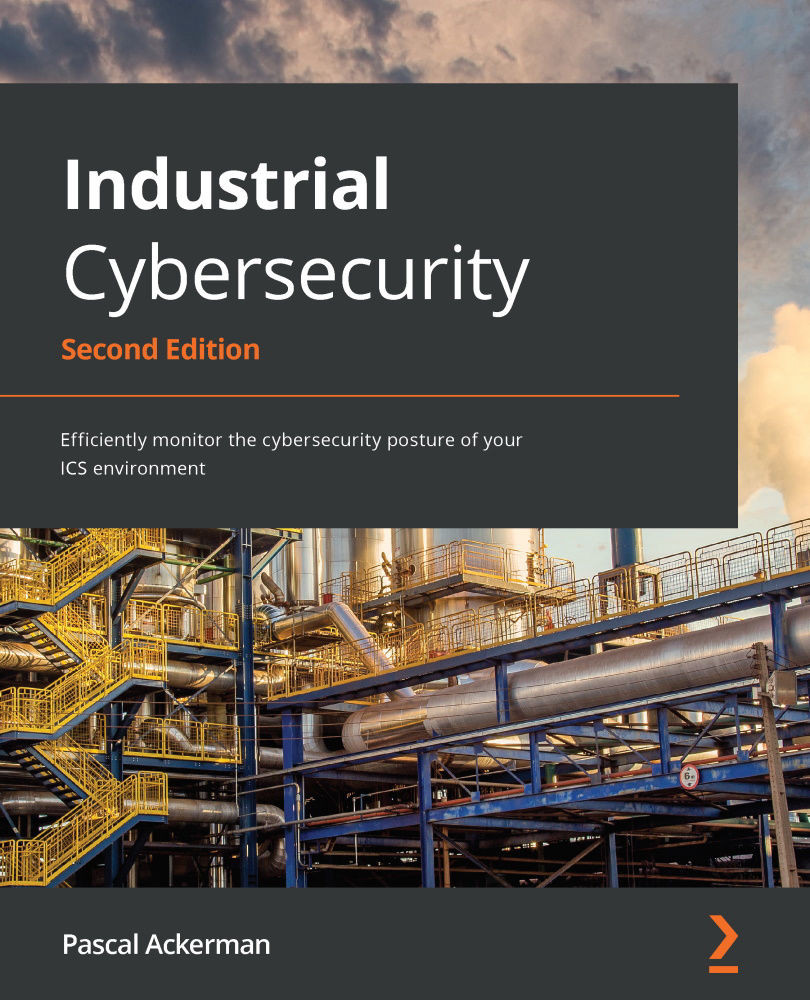
Industrial Cybersecurity
$54.99
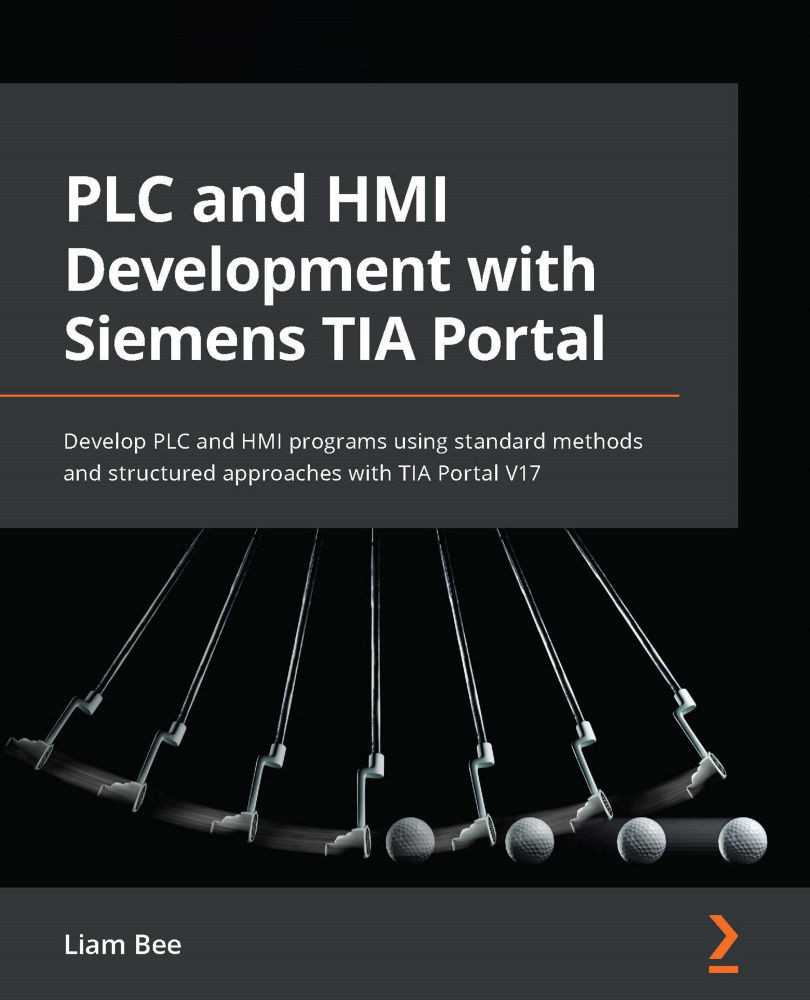
PLC and HMI Development with Siemens TIA Portal
$69.99
Learning RSLogix 5000 Programming
$49.99
Total $ 174.97 Stars icon

Table of Contents

20 Chapters
Section 1: Introduction to RSLogix Chevron down icon Chevron up icon
The History of Rockwell Automation Technologies Chevron down icon Chevron up icon
Understanding ControlLogix Chevron down icon Chevron up icon
Understanding CompactLogix Chevron down icon Chevron up icon
Understanding SoftLogix Chevron down icon Chevron up icon
Understanding Logix Emulate 5000 Chevron down icon Chevron up icon
Section 2: Logix Programming Basics Chevron down icon Chevron up icon
Industrial Network Communications Chevron down icon Chevron up icon
Configuring Logix Modules Chevron down icon Chevron up icon
Writing Ladder Logic Chevron down icon Chevron up icon
Writing Function Block Chevron down icon Chevron up icon
Writing Structured Text Chevron down icon Chevron up icon
Building Sequential Function Charts Chevron down icon Chevron up icon
Section 3: Advanced Logix Programming Chevron down icon Chevron up icon
Using Tasks and Programs for Project Organization Chevron down icon Chevron up icon
Faults and Troubleshooting in Logix Chevron down icon Chevron up icon
Understanding Cybersecurity Practices in Logix Chevron down icon Chevron up icon
Building a Robot Bartender in Logix Chevron down icon Chevron up icon
Assessments Chevron down icon Chevron up icon
Other Book You May Enjoy Chevron down icon Chevron up icon

Customer reviews

Top Reviews
Rating distribution
Full star icon Full star icon Full star icon Full star icon Half star icon 4.4
(8 Ratings)
5 star 75%
4 star 12.5%
3 star 0%
2 star 0%
1 star 12.5%
Filter icon Filter
Top Reviews

Filter reviews by


Amazon Customer Oct 10, 2022
Full star icon Full star icon Full star icon Full star icon Full star icon 5
This is a very good book to understand the basic level in programming, do publish more books like this one l, keep it up
Amazon Verified review Amazon
Albert Aug 25, 2023
Full star icon Full star icon Full star icon Full star icon Full star icon 5
Some reviews state that this book is mostly an advertisement for AB products, however as a working automation engineer, I found a lot of the information in the beginning chapters of the book crucial to knowing the compatibility of PLC and PAC components for quick problem-solving in real world situations. Highly recommend this book as a refresher or to expand your knowledge for working professionals.
Amazon Verified review Amazon
Tyler McKee Jan 21, 2023
Full star icon Full star icon Full star icon Full star icon Full star icon 5
Got this to help in learning more about PLC programing easy to read and great content
Amazon Verified review Amazon
M. Hoffman Aug 18, 2020
Full star icon Full star icon Full star icon Full star icon Full star icon 5
This is this book I was looking for during my time as an automation specialist. Many of the topics that Austin covers are ones that I have come across from time spent with ControlLogix and CompactLogix systems at various O&G assets while performing automation changes and upgrades. Experienced users and beginners alike will find something to glean from after going through this book. Austin covers topics ranging from Card Numbering Conventions, I/O Buffering, Industrial Communications and Protocols, Processor Tuning, IEC 61131-3 languages, and an all-important chapter on Cybersecurity. The final chapter summarizes the book by building a robot bartender, an excellent way to apply learnings and reap the benefits of home automation projects.
Amazon Verified review Amazon
Sebastian Oct 02, 2020
Full star icon Full star icon Full star icon Full star icon Full star icon 5
The book has a great, logical progression going from the early history of automation right through to modern day cyber security concerns, with concrete examples all the way through. The book complements and builds upon Rockwell's own literature, transitioning and guiding you from high level concepts down to the low level detail.I really appreciate the writing style - its logical and clear. It is also highly illustrated which helps with absorbing information quickly. There were quite a few best practices that the author called out that I wasn't aware of! I found it really helpful as a reference.
Amazon Verified review Amazon
Get free access to Packt library with over 7500+ books and video courses for 7 days!
Start Free Trial

FAQs

What is the digital copy I get with my Print order? Chevron down icon Chevron up icon

When you buy any Print edition of our Books, you can redeem (for free) the eBook edition of the Print Book you’ve purchased. This gives you instant access to your book when you make an order via PDF, EPUB or our online Reader experience.

What is the delivery time and cost of print book? Chevron down icon Chevron up icon

Shipping Details

USA:

'

Economy: Delivery to most addresses in the US within 10-15 business days

Premium: Trackable Delivery to most addresses in the US within 3-8 business days

UK:

Economy: Delivery to most addresses in the U.K. within 7-9 business days.
Shipments are not trackable

Premium: Trackable delivery to most addresses in the U.K. within 3-4 business days!
Add one extra business day for deliveries to Northern Ireland and Scottish Highlands and islands

EU:

Premium: Trackable delivery to most EU destinations within 4-9 business days.

Australia:

Economy: Can deliver to P. O. Boxes and private residences.
Trackable service with delivery to addresses in Australia only.
Delivery time ranges from 7-9 business days for VIC and 8-10 business days for Interstate metro
Delivery time is up to 15 business days for remote areas of WA, NT & QLD.

Premium: Delivery to addresses in Australia only
Trackable delivery to most P. O. Boxes and private residences in Australia within 4-5 days based on the distance to a destination following dispatch.

India:

Premium: Delivery to most Indian addresses within 5-6 business days

Rest of the World:

Premium: Countries in the American continent: Trackable delivery to most countries within 4-7 business days

Asia:

Premium: Delivery to most Asian addresses within 5-9 business days

Disclaimer:
All orders received before 5 PM U.K time would start printing from the next business day. So the estimated delivery times start from the next day as well. Orders received after 5 PM U.K time (in our internal systems) on a business day or anytime on the weekend will begin printing the second to next business day. For example, an order placed at 11 AM today will begin printing tomorrow, whereas an order placed at 9 PM tonight will begin printing the day after tomorrow.


Unfortunately, due to several restrictions, we are unable to ship to the following countries:

  1. Afghanistan
  2. American Samoa
  3. Belarus
  4. Brunei Darussalam
  5. Central African Republic
  6. The Democratic Republic of Congo
  7. Eritrea
  8. Guinea-bissau
  9. Iran
  10. Lebanon
  11. Libiya Arab Jamahriya
  12. Somalia
  13. Sudan
  14. Russian Federation
  15. Syrian Arab Republic
  16. Ukraine
  17. Venezuela
What is custom duty/charge? Chevron down icon Chevron up icon

Customs duty are charges levied on goods when they cross international borders. It is a tax that is imposed on imported goods. These duties are charged by special authorities and bodies created by local governments and are meant to protect local industries, economies, and businesses.

Do I have to pay customs charges for the print book order? Chevron down icon Chevron up icon

The orders shipped to the countries that are listed under EU27 will not bear custom charges. They are paid by Packt as part of the order.

List of EU27 countries: www.gov.uk/eu-eea:

A custom duty or localized taxes may be applicable on the shipment and would be charged by the recipient country outside of the EU27 which should be paid by the customer and these duties are not included in the shipping charges been charged on the order.

How do I know my custom duty charges? Chevron down icon Chevron up icon

The amount of duty payable varies greatly depending on the imported goods, the country of origin and several other factors like the total invoice amount or dimensions like weight, and other such criteria applicable in your country.

For example:

  • If you live in Mexico, and the declared value of your ordered items is over $ 50, for you to receive a package, you will have to pay additional import tax of 19% which will be $ 9.50 to the courier service.
  • Whereas if you live in Turkey, and the declared value of your ordered items is over € 22, for you to receive a package, you will have to pay additional import tax of 18% which will be € 3.96 to the courier service.
How can I cancel my order? Chevron down icon Chevron up icon

Cancellation Policy for Published Printed Books:

You can cancel any order within 1 hour of placing the order. Simply contact customercare@packt.com with your order details or payment transaction id. If your order has already started the shipment process, we will do our best to stop it. However, if it is already on the way to you then when you receive it, you can contact us at customercare@packt.com using the returns and refund process.

Please understand that Packt Publishing cannot provide refunds or cancel any order except for the cases described in our Return Policy (i.e. Packt Publishing agrees to replace your printed book because it arrives damaged or material defect in book), Packt Publishing will not accept returns.

What is your returns and refunds policy? Chevron down icon Chevron up icon

Return Policy:

We want you to be happy with your purchase from Packtpub.com. We will not hassle you with returning print books to us. If the print book you receive from us is incorrect, damaged, doesn't work or is unacceptably late, please contact Customer Relations Team on customercare@packt.com with the order number and issue details as explained below:

  1. If you ordered (eBook, Video or Print Book) incorrectly or accidentally, please contact Customer Relations Team on customercare@packt.com within one hour of placing the order and we will replace/refund you the item cost.
  2. Sadly, if your eBook or Video file is faulty or a fault occurs during the eBook or Video being made available to you, i.e. during download then you should contact Customer Relations Team within 14 days of purchase on customercare@packt.com who will be able to resolve this issue for you.
  3. You will have a choice of replacement or refund of the problem items.(damaged, defective or incorrect)
  4. Once Customer Care Team confirms that you will be refunded, you should receive the refund within 10 to 12 working days.
  5. If you are only requesting a refund of one book from a multiple order, then we will refund you the appropriate single item.
  6. Where the items were shipped under a free shipping offer, there will be no shipping costs to refund.

On the off chance your printed book arrives damaged, with book material defect, contact our Customer Relation Team on customercare@packt.com within 14 days of receipt of the book with appropriate evidence of damage and we will work with you to secure a replacement copy, if necessary. Please note that each printed book you order from us is individually made by Packt's professional book-printing partner which is on a print-on-demand basis.

What tax is charged? Chevron down icon Chevron up icon

Currently, no tax is charged on the purchase of any print book (subject to change based on the laws and regulations). A localized VAT fee is charged only to our European and UK customers on eBooks, Video and subscriptions that they buy. GST is charged to Indian customers for eBooks and video purchases.

What payment methods can I use? Chevron down icon Chevron up icon

You can pay with the following card types:

  1. Visa Debit
  2. Visa Credit
  3. MasterCard
  4. PayPal
What is the delivery time and cost of print books? Chevron down icon Chevron up icon

Shipping Details

USA:

'

Economy: Delivery to most addresses in the US within 10-15 business days

Premium: Trackable Delivery to most addresses in the US within 3-8 business days

UK:

Economy: Delivery to most addresses in the U.K. within 7-9 business days.
Shipments are not trackable

Premium: Trackable delivery to most addresses in the U.K. within 3-4 business days!
Add one extra business day for deliveries to Northern Ireland and Scottish Highlands and islands

EU:

Premium: Trackable delivery to most EU destinations within 4-9 business days.

Australia:

Economy: Can deliver to P. O. Boxes and private residences.
Trackable service with delivery to addresses in Australia only.
Delivery time ranges from 7-9 business days for VIC and 8-10 business days for Interstate metro
Delivery time is up to 15 business days for remote areas of WA, NT & QLD.

Premium: Delivery to addresses in Australia only
Trackable delivery to most P. O. Boxes and private residences in Australia within 4-5 days based on the distance to a destination following dispatch.

India:

Premium: Delivery to most Indian addresses within 5-6 business days

Rest of the World:

Premium: Countries in the American continent: Trackable delivery to most countries within 4-7 business days

Asia:

Premium: Delivery to most Asian addresses within 5-9 business days

Disclaimer:
All orders received before 5 PM U.K time would start printing from the next business day. So the estimated delivery times start from the next day as well. Orders received after 5 PM U.K time (in our internal systems) on a business day or anytime on the weekend will begin printing the second to next business day. For example, an order placed at 11 AM today will begin printing tomorrow, whereas an order placed at 9 PM tonight will begin printing the day after tomorrow.


Unfortunately, due to several restrictions, we are unable to ship to the following countries:

  1. Afghanistan
  2. American Samoa
  3. Belarus
  4. Brunei Darussalam
  5. Central African Republic
  6. The Democratic Republic of Congo
  7. Eritrea
  8. Guinea-bissau
  9. Iran
  10. Lebanon
  11. Libiya Arab Jamahriya
  12. Somalia
  13. Sudan
  14. Russian Federation
  15. Syrian Arab Republic
  16. Ukraine
  17. Venezuela
Modal Close icon
Modal Close icon