Search icon CANCEL
Subscription
0
Cart icon
Your Cart (0 item)
Close icon
You have no products in your basket yet
Save more on your purchases! discount-offer-chevron-icon
Savings automatically calculated. No voucher code required.
Arrow left icon
Explore Products
Best Sellers
New Releases
Books
Videos
Audiobooks
Learning Hub
Newsletter Hub
Free Learning
Arrow right icon
timer SALE ENDS IN
0 Days
:
00 Hours
:
00 Minutes
:
00 Seconds
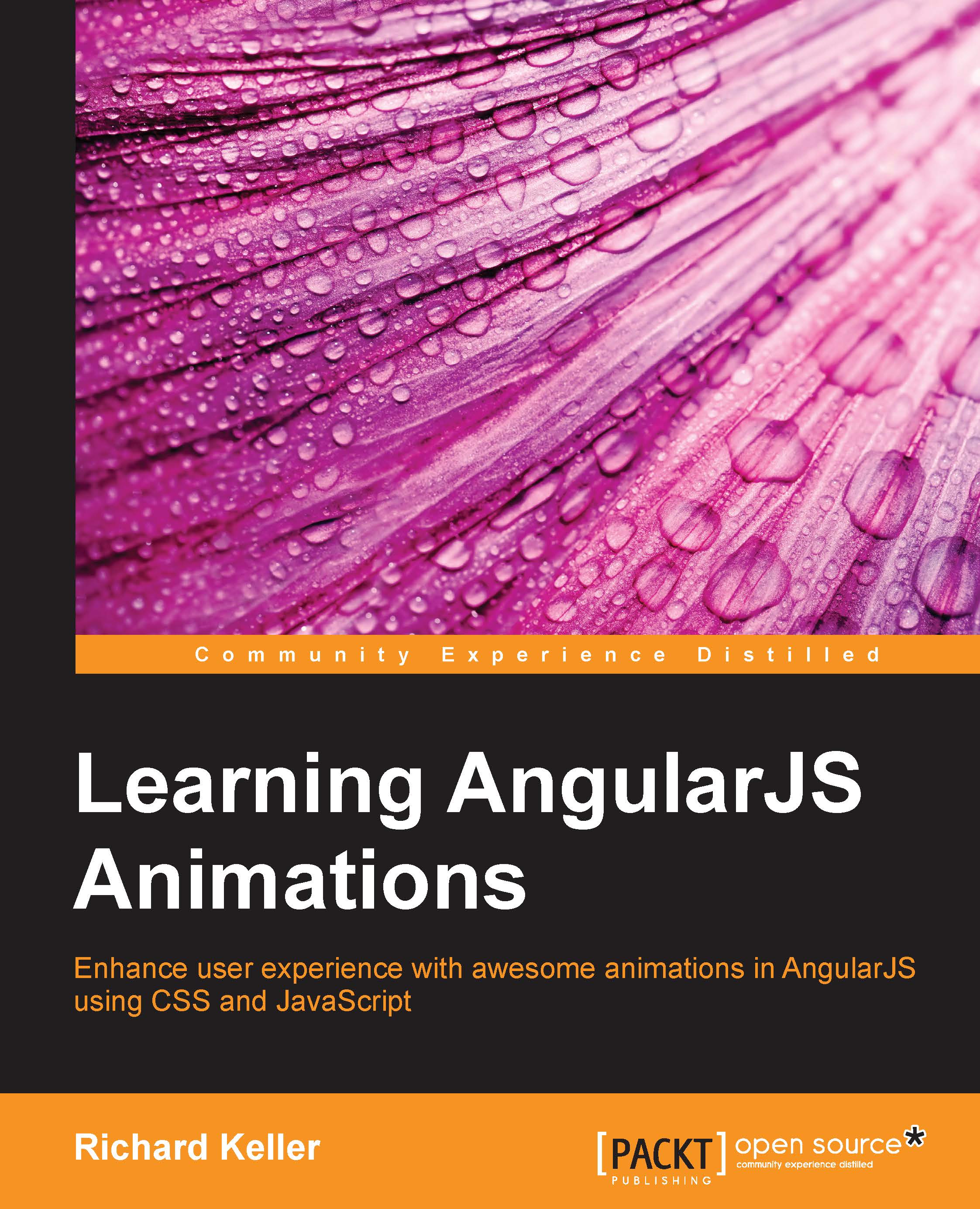
Learning AngularJS Animations

Learning AngularJS Animations: Enhance user experience with awesome animations in AngularJS using CSS and JavaScript

eBook
$15.29 $16.99
Paperback
$26.99
Subscription
Free Trial
Renews at $19.99p/m

What do you get with Print?

Product feature icon Instant access to your digital copy whilst your Print order is Shipped
Product feature icon Paperback book shipped to your preferred address
Product feature icon Redeem a companion digital copy on all Print orders
Product feature icon Access this title in our online reader with advanced features
Product feature icon DRM FREE - Read whenever, wherever and however you want
OR
Modal Close icon
Payment Processing...
tick Completed

Shipping Address

Billing Address

Shipping Methods
Table of content icon View table of contents Preview book icon Preview Book

Learning AngularJS Animations

Chapter 1. Getting Started

For the past few years, web development has been growing and changing continuously, as phones are getting smarter and Internet connections, tablets, desktops, and web browsers are getting faster. Nowadays, creating and hosting a website is cheap, but creating a web app with good user experience for all device sizes and resolutions is not that easy. AngularJS was created for us—full stack developers, frontend developers, and/or web designers—in order to avoid wasting time repeating ourselves so that we can produce more apps with scalability, maintainability, and testability as well as apps that are developed fast enough to accomplish time to market.

There is a key AngularJS module that has been designed for animations. This AngularJS animation module's purpose is not to be a library of precreated animations but to be a way in which great AngularJS built-in tools can be easily integrated with well-known CSS3 animations and JavaScript animations, besides giving the developer the liberty to extend it for custom directives and custom animations.

In this chapter, we will cover the following topics:

  • The definition of animation and the web context
  • The need for AngularJS animations
  • Choosing when to use JavaScript for animations
  • AngularJS – combining JavaScript and CSS3

The definition of animation and the web context

Animation, by definition, is the process of creating a continuous motion over a period of time. The World Wide Web started with static HTML pages, and then .gifs and JavaScript animations started to appear. There were nonstandard <blink> and <marquee> HTML tags too, which were very annoying and limited. These were supported only by very old browsers and are currently deprecated.

Since technologies improved and the Internet bandwidth increased, animations have been a big deal on web browsers across the years. Developers started using Adobe Flash™, Java applets, Microsoft Silverlight, and other third-party solutions that lacked interoperability. Until recently, it was hard to rely 100 percent on a solution. This problem led to the creation of standards such as CSS3 Transition and CSS3 keyframe animations.

Check out http://www.w3.org/TR/css3-animations/ and http://www.w3.org/TR/css3-transitions/ for W3C's working drafts.

Another key improvement to animations on web browsers is the evolution of JavaScript engines and layout engines. Together, these improvements created an environment that enabled us to animate our web applications with cross-devices and the interoperability safety of operating systems. Standardization is the solution.

HTML, CSS, and JavaScript have been used to create web applications, and recently, they have even been used to create native apps for iOS, Android, and other devices with solutions such as PhoneGap.

Check out http://phonegap.com for more information on creating apps using web technologies.

Microsoft adopted this stack (HTML, CSS, and JavaScript) as an option in order to create native apps for Windows 8 as well. This is evidence that CSS3 and ECMAScript will evolve faster and in partnership with big companies such as Google, Microsoft, and Apple.

Currently, all major web browsers are evergreen, which means that they automatically update themselves without asking the user to accept them; they update themselves silently. This is a new era for web development. Old browsers that used poor JavaScript engines and lacked support for CSS3 are dying.

The need for AngularJS animation

AngularJS calls itself a superheroic JavaScript Model View Whatever (MVW) framework—no kidding; this is on the main page. AngularJS is an extensive framework that helps frontend developers on many different aspects. One of these aspects is how to animate all the stuff that magically appears on the browser when we manipulate the scope variables.

Check out the website of AngularJS at https://angularjs.org/ for more information on this framework's awesomeness.

Tip

The AngularJS animation module ngAnimate is separate from the AngularJS core module, so it's necessary to include it as a dependency of your application.

The framework is already modular as of Version 1.3 and has the intention to be even more modularized with future releases. The ngAnimate module lets you animate the common directives built in AngularJS, such as ngRepeat, ngShow, ngHide, ngIf, ngInclude, ngSwitch, and ngView.

Including the ngAnimate module in the framework enables hooks that trigger animations that you want to be displayed during the normal life cycle of native directives and custom directives.

We just need to create the animation declarations that will be triggered by these hooks using CSS3 transitions, CSS3 keyframe animations, or even JavaScript animations with callback functions. We will learn how to create these animations in Chapter 3, Creating Our First Animation in AngularJS.

AngularJS follows the convention of the configuration design paradigm, so animations can be placed using plain CSS3 animations just by following the naming conventions that will be listed later.

Animations on AngularJS are completely based on CSS classes. Animation hooks enabled by the ngAnimate module are provided by classes that are added or removed from elements in specific events. The events in which we can hook animations are the enter, move, and leave events of the DOM element and the addition or removal of a class from the element. This is a simple but powerful unique concept, as animations should be used on these events. This approach makes animations on AngularJS very intuitive without much effort or using a lot of code.

This AngularJS approach is different from jQuery animate, as we declare animations based on classes instead of imperatively adding an animation using JavaScript wherever a DOM manipulation is expected to occur. As most of these DOM manipulations are implicit in AngularJS, the animations' approach is mainly declarative and the animation hook is not intrusive.

Animations are useful for users when they grab the user's attention, catching the users' eye for specific elements, and making their lives easier. Motion builds meaning about relationships between elements, functionality, and intention of the system; it enhances the user cognition.

Animations can create responsiveness when a button element is touched and clicked on and a new element is added to the view from the origin point of the button.

Animations can tell a user when an element is moved from point A to point B of the view, guiding the user's attention. They can improve conversion; in this case, we should always use split tests.

It is easily possible to implement all the cases that I described previously using the events hooks that ngAnimate provides to us.

Google Material Design is a great resource that tells you how to apply animations to a web app. Check out http://www.google.com/design/ for more information.

Choosing when to use JavaScript for animations

The CSS3 animations and transitions created a way for modern browsers to recognize what animations are. They also created a way for modern browsers to differentiate animations from other operations so that they can use the Graphics Processing Unit (GPU) to accelerate the hardware of the animation instead of the Central Processing Unit (CPU), which receives all other operations.

Another advantage of using CSS transitions and animations instead of JavaScript is the fact that JavaScript runs on a browser's main thread. CSS animations enable browsers to run operations on new threads and create different layers, which are separated from everything else happening on the main thread. In other words, while your main UI thread will be in heavy use, JavaScript animations might freeze although CSS animations will continue to work.

Note

CSS3 animations, CSS3 transitions, and JavaScript animations that use requestAnimationFrame are the best options in order to avoid the poor performance of animations.

Nowadays, web apps run on devices too, and browsers can stop CSS3 animations when the app is in the background tab, resulting in improved battery life. This is just one of the possibilities for the browser to improve its performance. In Chapter 8, Animations' Performance Optimization, we will see how to optimize an animation's performance.

Check out http://www.html5rocks.com/en/tutorials/speed/high-performance-animations/ for more information on high performance animations.

Here, we see one example of animation that can be easily created with CSS3 as well as JavaScript.

The HTML code for the page is as follows:

<!DOCTYPE html>
<html>
<head>
    <title>Getting Started</title>
    <link href="animations.css" rel="stylesheet" />
</head>
<body>
    <div>
        <h1>Animation with JavaScript</h1>
        <!--There is a click listener for this button -->
        <button id="jsBtn">Click here to move the element below with JS</button>
        <div id="jsanimation">
            This block will be moved by JavaScript
        </div>
        <h1>Animation with jQuery</h1>
        <!--There is a click listener for this button -->
        <button id="jQBtn">Click here to move the element below with jQuery</button>
        <div id="jQanimation">
            This block will be moved by jQuery
        </div>
        <h1>Animation with CSS3 transition</h1>
        <!--There is a click listener for this button -->
        <button id="cssBtn">Click here to move the element below with CSS3 transition</button>
        <div id="csstransition">
            This block will be moved by CSS3 transition
        </div>
        <h1>Animation with CSS3 animation</h1>
        <!--There is a click listener for this button -->
        <button id="cssAnimationBtn">Click here to move the element below with CSS3 animation</button>
        <div id="cssanimation">
            This block will be moved by CSS3 animation
        </div>
    </div>
    <script src="//ajax.googleapis.com/ajax/libs/jquery/2.1.1/jquery.min.js"></script>
    <script src="animations.js"></script>
</body>
</html>

Tip

Downloading the example code

You can download the example code files for all Packt books you have purchased from your account at http://www.packtpub.com. If you purchased this book elsewhere, you can visit http://www.packtpub.com/support and register to have the files e-mailed directly to you.

The declarative way to animate is CSS. In CSS, we defined the translate transform for objects with the .move-to-right class. This declaration makes the move but does not create the animation between the moves. We declared how the div element to be moved should be transitioned; it should last 2 seconds and be slow towards the start and end.

The animations.css CSS file is as follows:

/* Code used by JavaScript animation sample */
#jsanimation {
    position: relative;
}

/* Code used by jQuery animation sample */
#jQanimation {
    position: relative;
}

/* Code used by CSS Transition animation sample */
#csstransition {
    position: relative;
    /* Here we should add -moz-transition, -webkit-transition, -o-transition for browsers compatibility, we will explain about vendor prefixes later */
    transition: all 2s ease-in-out;
}

.move-to-right {
    /* Here we should add vendor prefixes too */
    transform: translate(100px,0);
}

/* Code used by CSS Animation sample */
#cssanimation {
    position: relative;
}

@-webkit-keyframes move-to-right-animation {
    from {
        left: 0px;
    }

    to {
        left: 100px;
    }
}

@keyframes move-to-right-animation {
    from {
        left: 0px;
    }

    to {
        left: 100px;
    }
}

.move-to-right-animation {
    position: relative;
    left: 100px;
    /* Here we should add -moz-animation, -o-animation for browsers compatibility*/
    -webkit-animation: move-to-right-animation 1s ease-in-out;
    animation: move-to-right-animation 1s ease-in-out;
}

The animations.js JavaScript file is as follows:

/* Code used by JavaScript animation sample */
var jsAnimationElement = document.getElementById('jsanimation');
var jsAnimationBtn = document.getElementById('jsBtn');
/**
* Listener of the "Click here to move the element below with JS" button
*/
jsAnimationBtn.addEventListener('click', function moveBtnClickListener() {
    //This variable holds the position left of the div
    var positionLeft = 0;

    /**
    * function that moves jsAnimationElement 10px more to right until the positionLeft is 100
    */
    function moveToRight() {
        positionLeft += 10;

        /* Set position left of the jsanimation div */
        jsAnimationElement.style.left = positionLeft + 'px';

        if (positionLeft < 100) {
            /* This recursive function calls itself until the object is 100px from the left, every 100 milliseconds */
            setTimeout(moveToRight, 100);
        }
    }

    moveToRight();
}, false);

/* Code used by jQuery Animation sample */
/**
* Listener of the "Click here to move the element below with jQuery" button
*/
$("#jQBtn").click(function () {
    /** Use the jQuery animate function to send the element to more 100px to right in 1s */
    $("#jQanimation").animate({
        left: "+=100"
    }, 1000);
});

/* Code used by CSS transition animation sample */
var cssTransitionElement = document.getElementById('csstransition');
var cssTransitionBtn = document.getElementById('cssBtn');
/**
* Listener of the "Click here to move the element below with CSS3" button
*/
cssTransitionBtn.addEventListener('click', function moveCssBtnClickListener() {
    /* Add class "move-to-right" to the block on button click */
    cssTransitionElement.classList.add('move-to-right');
});

/* Code used by CSS Animation sample */
var cssAnimationElement = document.getElementById('cssanimation');
var cssAnimationBtn = document.getElementById('cssAnimationBtn');
/**
* Listener of the "Click here to move the element below with CSS3" button
*/
cssAnimationBtn.addEventListener('click', function moveCssAnimationBtnClickListener() {
    /* Add class "move-to-right" to the block on button click */
    cssAnimationElement.classList.add('move-to-right-animation');
});

This code shows you four approaches for the same animation. The intention is to move a div element 100 px to the right smoothly. This is not the AngularJS way to create animations, but before you learn how to create an animation with AngularJS, you should know all the options.

First we created an animation with JavaScript without requestFrameRate. The result is not so good, and its code is not so pretty. The second animation uses jQuery animate; the code is simpler than the JavaScript version, is imperative, and the result is OK. The third animation uses the CSS transition; it's very clean code with a great and smooth result, declarative way. The fourth animation uses the CSS animation with the same result as the transition version. It made the animation declarative and a little more powerful than the transition, as we can add frames between 0 percent and 100 percent of the animation, although the code is bigger. At this time of writing this, it's necessary to use the -webkit- vendor prefix for the animation to work, even for Chrome.

Although CSS3 animations and transitions have huge advantages, they have disadvantages as well. Creating complex, combined animations is still hard or impossible in order to achieve a good result. In cases like these, JavaScript animations are a better option. JavaScript animations are an option for fallback too when transitions and CSS animations aren't available, which is a common scenario when your project supports old browsers.

A good website that will help you know which browsers have support for CSS animations and transitions is http://caniuse.com.

AngularJS – combining JavaScript and CSS3

AngularJS has adopted the standards for animation on the Web. It embraces CSS3 Transitions, animations, and JavaScript. It's great because the developers can choose the animation option that best fits their needs. As you have already read, sometimes, one option fits better than other, so this is a great feature of ngAnimate.

With the ngAnimate module, it is far easier to animate in AngularJS because it brings a code pattern and convention that is already integrated with AngularJS native directives. This allows us—the developers and the open source community—to have a quick start to animation and a pattern to develop our custom animations. In later chapters, we will see how to integrate custom directives with AngularJS animations using the $animate service, which is the main topic of Chapter 5, Custom Directives and the $animate Service.

This is all possible due to the class-bases approach that AngularJS uses. We will see more of this in Chapter 3, Creating Our First Animation in AngularJS, when we create our first AngularJS animation.

Another advantage is that it's easy to integrate CSS animation libraries such as animate.css and Effeckt.css, as these libraries use CSS3 transitions and animations.

Check out http://daneden.github.io/animate.css/ and http://h5bp.github.io/Effeckt.css/ for CSS animations libraries.

Do it yourself exercises

Create the same JavaScript animation as the one in our sample, but instead of setTimeout, use requestAnimationFrame. Check out https://developer.mozilla.org/en-US/docs/Web/API/window.requestAnimationFrame for more information on requestAnimationFrame.

Summary

In this chapter, we gave an introduction on how the AngularJS animations module and web standards work together, a notion of what can be achieved using them, and an overview of the differences between JavaScript, CSS3 animations, and transitions.

We took a quick overview of animations in web history and how attached they are to the evolution of web standards in AngularJS. We saw samples of simple animations created with JavaScript and CSS3, and we got an idea about how we should choose each one of them so that we can achieve the best performance and result.

In the next chapter, you will learn how to create animations using CSS3 in order to create smooth AngularJS animations, which are known as jank free animations.

Left arrow icon Right arrow icon

Description

If you are a developer who is new to AngularJS or is experienced with the AngularJS framework, this book is intended for you. If you want to provide a better user experience on your web app, this book is also for you.
Estimated delivery fee Deliver to United States

Economy delivery 10 - 13 business days

Free $6.95

Premium delivery 6 - 9 business days

$21.95
(Includes tracking information)

Product Details

Country selected
Publication date, Length, Edition, Language, ISBN-13
Publication date : Oct 31, 2014
Length: 182 pages
Edition : 1st
Language : English
ISBN-13 : 9781783984428
Vendor :
Google
Languages :
Tools :

What do you get with Print?

Product feature icon Instant access to your digital copy whilst your Print order is Shipped
Product feature icon Paperback book shipped to your preferred address
Product feature icon Redeem a companion digital copy on all Print orders
Product feature icon Access this title in our online reader with advanced features
Product feature icon DRM FREE - Read whenever, wherever and however you want
OR
Modal Close icon
Payment Processing...
tick Completed

Shipping Address

Billing Address

Shipping Methods
Estimated delivery fee Deliver to United States

Economy delivery 10 - 13 business days

Free $6.95

Premium delivery 6 - 9 business days

$21.95
(Includes tracking information)

Product Details

Publication date : Oct 31, 2014
Length: 182 pages
Edition : 1st
Language : English
ISBN-13 : 9781783984428
Vendor :
Google
Languages :
Tools :

Packt Subscriptions

See our plans and pricing
Modal Close icon
$19.99 billed monthly
Feature tick icon Unlimited access to Packt's library of 7,000+ practical books and videos
Feature tick icon Constantly refreshed with 50+ new titles a month
Feature tick icon Exclusive Early access to books as they're written
Feature tick icon Solve problems while you work with advanced search and reference features
Feature tick icon Offline reading on the mobile app
Feature tick icon Simple pricing, no contract
$199.99 billed annually
Feature tick icon Unlimited access to Packt's library of 7,000+ practical books and videos
Feature tick icon Constantly refreshed with 50+ new titles a month
Feature tick icon Exclusive Early access to books as they're written
Feature tick icon Solve problems while you work with advanced search and reference features
Feature tick icon Offline reading on the mobile app
Feature tick icon Choose a DRM-free eBook or Video every month to keep
Feature tick icon PLUS own as many other DRM-free eBooks or Videos as you like for just $5 each
Feature tick icon Exclusive print discounts
$279.99 billed in 18 months
Feature tick icon Unlimited access to Packt's library of 7,000+ practical books and videos
Feature tick icon Constantly refreshed with 50+ new titles a month
Feature tick icon Exclusive Early access to books as they're written
Feature tick icon Solve problems while you work with advanced search and reference features
Feature tick icon Offline reading on the mobile app
Feature tick icon Choose a DRM-free eBook or Video every month to keep
Feature tick icon PLUS own as many other DRM-free eBooks or Videos as you like for just $5 each
Feature tick icon Exclusive print discounts

Frequently bought together


Stars icon
Total $ 136.97
AngularJS Web Application Development Blueprints
$54.99
AngularJS Web application development Cookbook
$54.99
Learning AngularJS Animations
$26.99
Total $ 136.97 Stars icon

Table of Contents

9 Chapters
1. Getting Started Chevron down icon Chevron up icon
2. Understanding CSS3 Transitions and Animations Chevron down icon Chevron up icon
3. Creating Our First Animation in AngularJS Chevron down icon Chevron up icon
4. JavaScript Animations in AngularJS Chevron down icon Chevron up icon
5. Custom Directives and the $animate Service Chevron down icon Chevron up icon
6. Animations for Mobile Devices Chevron down icon Chevron up icon
7. Staggering Animations Chevron down icon Chevron up icon
8. Animations' Performance Optimization Chevron down icon Chevron up icon
Index Chevron down icon Chevron up icon

Customer reviews

Rating distribution
Full star icon Full star icon Full star icon Full star icon Half star icon 4.5
(2 Ratings)
5 star 50%
4 star 50%
3 star 0%
2 star 0%
1 star 0%
David Nunez Apr 20, 2015
Full star icon Full star icon Full star icon Full star icon Full star icon 5
Covers transitions/animations for both the JavaScript and CSS side of things, emphasizing (rightly so) the CSS side. It's so hard to find thorough, current articles online for Angular animations, and this book gives you just that. I was able to put many examples to use right away and get past issues that had me stuck for weeks on an aspect of a project at work. The book also goes in-depth by helping you to understand the performance aspects and see which commonly chosen properties animate slow, while offering alternatives that will make the animations more efficient. jQuery is not left out in this book either and in most sections where animation techniques are taught there are alternative implementations showcased that make use of jQuery. It's a great tutorial as well as a great reference, and one of the few books on Angular published in the last several months that won't feel dated when Angular 2.0 is finalized.
Amazon Verified review Amazon
Arun Mahendrakar Dec 16, 2014
Full star icon Full star icon Full star icon Full star icon Empty star icon 4
PacktPub has another good book on AngularJS, this time regarding showing animations using AngularJS. Richard Keller has done quite a good job describing the basics and some advanced concepts of having animations show up in your AngularJS application.Chapter 1 and 2 talk about animation in general (without AngularJS, i.e.,). Chapter 4 through 7 walk through showing animations in the various built-in and custom AngularJS constructs.I found chapter 8 very interesting which talks about making your application performant using Chrome DevTools.The examples in the book seem quite naive and simple. Making them a little more 'gimmicky' would have impressed me even more.Not to pet-peeve, but the book has a few 'bugs'. In page 82 (epub version) the ngRepeat example is not working. I had to change the code line to 'return a.name < b.name ? -1 : 1' in order to get the snippet to work. Also, the performance.js file is missing in the sample code for chapter 8.https://www.packtpub.com/application-development/learning-angularjs-animations
Amazon Verified review Amazon
Get free access to Packt library with over 7500+ books and video courses for 7 days!
Start Free Trial

FAQs

What is the digital copy I get with my Print order? Chevron down icon Chevron up icon

When you buy any Print edition of our Books, you can redeem (for free) the eBook edition of the Print Book you’ve purchased. This gives you instant access to your book when you make an order via PDF, EPUB or our online Reader experience.

What is the delivery time and cost of print book? Chevron down icon Chevron up icon

Shipping Details

USA:

'

Economy: Delivery to most addresses in the US within 10-15 business days

Premium: Trackable Delivery to most addresses in the US within 3-8 business days

UK:

Economy: Delivery to most addresses in the U.K. within 7-9 business days.
Shipments are not trackable

Premium: Trackable delivery to most addresses in the U.K. within 3-4 business days!
Add one extra business day for deliveries to Northern Ireland and Scottish Highlands and islands

EU:

Premium: Trackable delivery to most EU destinations within 4-9 business days.

Australia:

Economy: Can deliver to P. O. Boxes and private residences.
Trackable service with delivery to addresses in Australia only.
Delivery time ranges from 7-9 business days for VIC and 8-10 business days for Interstate metro
Delivery time is up to 15 business days for remote areas of WA, NT & QLD.

Premium: Delivery to addresses in Australia only
Trackable delivery to most P. O. Boxes and private residences in Australia within 4-5 days based on the distance to a destination following dispatch.

India:

Premium: Delivery to most Indian addresses within 5-6 business days

Rest of the World:

Premium: Countries in the American continent: Trackable delivery to most countries within 4-7 business days

Asia:

Premium: Delivery to most Asian addresses within 5-9 business days

Disclaimer:
All orders received before 5 PM U.K time would start printing from the next business day. So the estimated delivery times start from the next day as well. Orders received after 5 PM U.K time (in our internal systems) on a business day or anytime on the weekend will begin printing the second to next business day. For example, an order placed at 11 AM today will begin printing tomorrow, whereas an order placed at 9 PM tonight will begin printing the day after tomorrow.


Unfortunately, due to several restrictions, we are unable to ship to the following countries:

  1. Afghanistan
  2. American Samoa
  3. Belarus
  4. Brunei Darussalam
  5. Central African Republic
  6. The Democratic Republic of Congo
  7. Eritrea
  8. Guinea-bissau
  9. Iran
  10. Lebanon
  11. Libiya Arab Jamahriya
  12. Somalia
  13. Sudan
  14. Russian Federation
  15. Syrian Arab Republic
  16. Ukraine
  17. Venezuela
What is custom duty/charge? Chevron down icon Chevron up icon

Customs duty are charges levied on goods when they cross international borders. It is a tax that is imposed on imported goods. These duties are charged by special authorities and bodies created by local governments and are meant to protect local industries, economies, and businesses.

Do I have to pay customs charges for the print book order? Chevron down icon Chevron up icon

The orders shipped to the countries that are listed under EU27 will not bear custom charges. They are paid by Packt as part of the order.

List of EU27 countries: www.gov.uk/eu-eea:

A custom duty or localized taxes may be applicable on the shipment and would be charged by the recipient country outside of the EU27 which should be paid by the customer and these duties are not included in the shipping charges been charged on the order.

How do I know my custom duty charges? Chevron down icon Chevron up icon

The amount of duty payable varies greatly depending on the imported goods, the country of origin and several other factors like the total invoice amount or dimensions like weight, and other such criteria applicable in your country.

For example:

  • If you live in Mexico, and the declared value of your ordered items is over $ 50, for you to receive a package, you will have to pay additional import tax of 19% which will be $ 9.50 to the courier service.
  • Whereas if you live in Turkey, and the declared value of your ordered items is over € 22, for you to receive a package, you will have to pay additional import tax of 18% which will be € 3.96 to the courier service.
How can I cancel my order? Chevron down icon Chevron up icon

Cancellation Policy for Published Printed Books:

You can cancel any order within 1 hour of placing the order. Simply contact customercare@packt.com with your order details or payment transaction id. If your order has already started the shipment process, we will do our best to stop it. However, if it is already on the way to you then when you receive it, you can contact us at customercare@packt.com using the returns and refund process.

Please understand that Packt Publishing cannot provide refunds or cancel any order except for the cases described in our Return Policy (i.e. Packt Publishing agrees to replace your printed book because it arrives damaged or material defect in book), Packt Publishing will not accept returns.

What is your returns and refunds policy? Chevron down icon Chevron up icon

Return Policy:

We want you to be happy with your purchase from Packtpub.com. We will not hassle you with returning print books to us. If the print book you receive from us is incorrect, damaged, doesn't work or is unacceptably late, please contact Customer Relations Team on customercare@packt.com with the order number and issue details as explained below:

  1. If you ordered (eBook, Video or Print Book) incorrectly or accidentally, please contact Customer Relations Team on customercare@packt.com within one hour of placing the order and we will replace/refund you the item cost.
  2. Sadly, if your eBook or Video file is faulty or a fault occurs during the eBook or Video being made available to you, i.e. during download then you should contact Customer Relations Team within 14 days of purchase on customercare@packt.com who will be able to resolve this issue for you.
  3. You will have a choice of replacement or refund of the problem items.(damaged, defective or incorrect)
  4. Once Customer Care Team confirms that you will be refunded, you should receive the refund within 10 to 12 working days.
  5. If you are only requesting a refund of one book from a multiple order, then we will refund you the appropriate single item.
  6. Where the items were shipped under a free shipping offer, there will be no shipping costs to refund.

On the off chance your printed book arrives damaged, with book material defect, contact our Customer Relation Team on customercare@packt.com within 14 days of receipt of the book with appropriate evidence of damage and we will work with you to secure a replacement copy, if necessary. Please note that each printed book you order from us is individually made by Packt's professional book-printing partner which is on a print-on-demand basis.

What tax is charged? Chevron down icon Chevron up icon

Currently, no tax is charged on the purchase of any print book (subject to change based on the laws and regulations). A localized VAT fee is charged only to our European and UK customers on eBooks, Video and subscriptions that they buy. GST is charged to Indian customers for eBooks and video purchases.

What payment methods can I use? Chevron down icon Chevron up icon

You can pay with the following card types:

  1. Visa Debit
  2. Visa Credit
  3. MasterCard
  4. PayPal
What is the delivery time and cost of print books? Chevron down icon Chevron up icon

Shipping Details

USA:

'

Economy: Delivery to most addresses in the US within 10-15 business days

Premium: Trackable Delivery to most addresses in the US within 3-8 business days

UK:

Economy: Delivery to most addresses in the U.K. within 7-9 business days.
Shipments are not trackable

Premium: Trackable delivery to most addresses in the U.K. within 3-4 business days!
Add one extra business day for deliveries to Northern Ireland and Scottish Highlands and islands

EU:

Premium: Trackable delivery to most EU destinations within 4-9 business days.

Australia:

Economy: Can deliver to P. O. Boxes and private residences.
Trackable service with delivery to addresses in Australia only.
Delivery time ranges from 7-9 business days for VIC and 8-10 business days for Interstate metro
Delivery time is up to 15 business days for remote areas of WA, NT & QLD.

Premium: Delivery to addresses in Australia only
Trackable delivery to most P. O. Boxes and private residences in Australia within 4-5 days based on the distance to a destination following dispatch.

India:

Premium: Delivery to most Indian addresses within 5-6 business days

Rest of the World:

Premium: Countries in the American continent: Trackable delivery to most countries within 4-7 business days

Asia:

Premium: Delivery to most Asian addresses within 5-9 business days

Disclaimer:
All orders received before 5 PM U.K time would start printing from the next business day. So the estimated delivery times start from the next day as well. Orders received after 5 PM U.K time (in our internal systems) on a business day or anytime on the weekend will begin printing the second to next business day. For example, an order placed at 11 AM today will begin printing tomorrow, whereas an order placed at 9 PM tonight will begin printing the day after tomorrow.


Unfortunately, due to several restrictions, we are unable to ship to the following countries:

  1. Afghanistan
  2. American Samoa
  3. Belarus
  4. Brunei Darussalam
  5. Central African Republic
  6. The Democratic Republic of Congo
  7. Eritrea
  8. Guinea-bissau
  9. Iran
  10. Lebanon
  11. Libiya Arab Jamahriya
  12. Somalia
  13. Sudan
  14. Russian Federation
  15. Syrian Arab Republic
  16. Ukraine
  17. Venezuela
Modal Close icon
Modal Close icon