Search icon CANCEL
Subscription
0
Cart icon
Your Cart (0 item)
Close icon
You have no products in your basket yet
Save more on your purchases! discount-offer-chevron-icon
Savings automatically calculated. No voucher code required.
Arrow left icon
Explore Products
Best Sellers
New Releases
Books
Videos
Audiobooks
Learning Hub
Newsletter Hub
Free Learning
Arrow right icon
timer SALE ENDS IN
0 Days
:
00 Hours
:
00 Minutes
:
00 Seconds
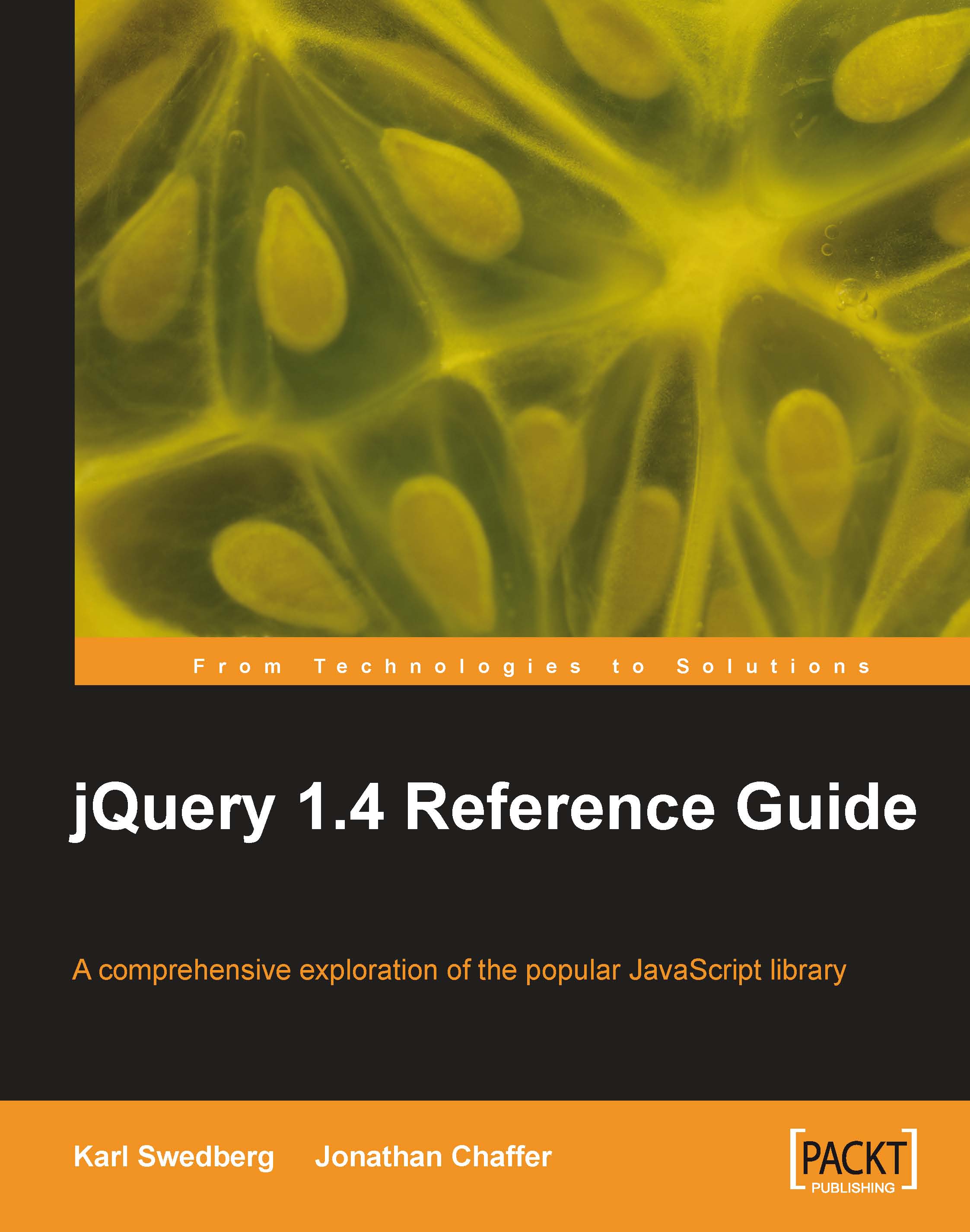
jQuery 1.4 Reference Guide

jQuery 1.4 Reference Guide: This book and eBook is a comprehensive exploration of the popular JavaScript library

eBook
$23.39 $25.99
Paperback
$43.99
Subscription
Free Trial
Renews at $19.99p/m

What do you get with Print?

Product feature icon Instant access to your digital copy whilst your Print order is Shipped
Product feature icon Paperback book shipped to your preferred address
Product feature icon Redeem a companion digital copy on all Print orders
Product feature icon Access this title in our online reader with advanced features
Product feature icon DRM FREE - Read whenever, wherever and however you want
Modal Close icon
Payment Processing...
tick Completed

Shipping Address

Billing Address

Shipping Methods
Table of content icon View table of contents Preview book icon Preview Book

jQuery 1.4 Reference Guide

Chapter 2. Selector Expressions

Each action we perform with jQuery requires a target. For example, in order to hide or show an element on the page, first we must find that element. To do so, we rely on jQuery's selector expressions.

Borrowing from CSS 1–3 and then adding its own, jQuery offers a powerful set of tools for matching a set of elements in a document. In this chapter, we'll examine every selector expression that jQuery makes available in turn.

CSS selectors


The following selectors are based on the Cascading Style Sheet specifications (1–3), as outlined by the W3C. For more information about the specifications, visit http://www.w3.org/Style/CSS/#specs.

Element (T)

Select all elements that have a tag name of T.

Examples

  • $('div') selects all elements with a tag name of div in the document

  • $('em') selects all elements with a tag name of em in the document

Description

JavaScript's getElementsByTagName() function is called to return the appropriate elements when this expression is used.

ID (#myid)

Select the unique element with an ID equal to myid.

Examples

  • $('#myid') selects the unique element with id="myid"

  • $('p#myid') selects a single paragraph with an ID of myid; in other words, the unique element <p id="myid">

Description

Each ID value must be used only once within a document. If more than one element has been assigned the same ID, queries that use that ID will only select the first matched element in the DOM. However, this...

Attribute selectors


The CSS specification also allows elements to be identified by their attributes. While not widely supported by browsers for the purpose of styling documents, these attribute selectors are highly useful and jQuery allows us to employ them regardless of the browser being used.

When using any of the following attribute selectors, we should account for attributes that have multiple, space-separated values. As these selectors see attribute values as a single string, $('a[rel=nofollow]'); for example, will select <a rel="nofollow" href="example.html">Some text</a> but not <a rel="nofollow self" href="example.html">Some text</a>.

Attribute values in selector expressions can be written as bare words or surrounded by quotation marks. Therefore, the following variations are equally correct:

  • Bare words: $('a[rel=nofollow self]')

  • Double quotes inside single quotes: $('a[rel="nofollow self"]')

  • Single quotes inside double quotes: $("a[rel='nofollow self']")

  • Escaped...

Form selectors


The following selectors can be used to access form elements in a variety of states. When using any of the form selectors other than :input, providing a tag name as well is recommended (for example, input:text rather than :text).

  • Form element (:input): Select all form elements (<input> (all types), <select>, <textarea>, <button>)

  • Text field (:text): Select all text fields (<input type="text">)

  • Password field (:password): Select all password fields (<input type="password">)

  • Radio button (:radio): Select all radio button fields (<input type="radio">)

  • Checkbox (:checkbox): Select all checkbox fields (<input type="checkbox">)

  • Submit button (:submit): Select all submit inputs and button elements (<input type="submit">, <button>)

  • Image button (:image): Select all image inputs (<input type="image">)

  • Reset button (:reset): Select all reset buttons (<input type="reset">)

  • Standard button (:button): Select all button...

Custom selectors


The following selectors were added to the jQuery library in an attempt to address common DOM traversal needs not met by the CSS specification.

Element at index (:eq(n))

Select the element at index n within the matched set.

Examples

  • $('li:eq(2)') selects the third <li> element

  • $('.myclass:eq(1)') selects the second element with the class myclass

Description

The selector :nth(n) exists as a synonym of this selector.

The index-related selector expressions (including this selector and the others that follow) filter the set of elements that have matched the expressions that precede them. They narrow the set down based on the order of the elements within this matched set. For example, if elements are first selected with a class selector (.myclass) and four elements are returned, these elements are given indices 0 through 3 for the purposes of these selectors.

Note that since JavaScript arrays use 0-based indexing, these selectors reflect that fact. This is why $('.myclass:eq...

Left arrow icon Right arrow icon

Key benefits

  • Quickly look up features of the jQuery library
  • Step through each function, method, and selector expression in the jQuery library with an easy-to-follow approach
  • Understand the anatomy of a jQuery script
  • Write your own plug-ins using jQuery's powerful plug-in architecture
  • Written by the creators oflearningquery.com
  • Check out the new Learning jQuery Third Edition

Description

If you are looking for a comprehensive reference guide to this popular JavaScript library, this book and eBook is for you. To make optimal use of jQuery, it's good to keep in mind the breadth of capabilities it provides. You can add dynamic, interactive elements to your sites with reduced development time using jQuery.Revised and updated for version 1.4 of jQuery, this book offers an organized menu of every jQuery method, function, and selector. Each method and function is introduced with a summary of its syntax and a list of its parameters and return value, followed by a discussion, with examples where applicable, to assist in getting the most out of jQuery and avoiding the pitfalls commonly associated with JavaScript and other client-side languages.In this book you will be provided information about the latest features of jQuery that include Sizzle Selector, Native event delegation, Event triggering, DOM manipulation, and many more. You won't be confined to built-in functionality, you'll be able to examine jQuery's plug-in architecture and we discuss both how to use plug-ins and how to write your own. If you're already familiar with JavaScript programming, this book will help you dive right into advanced jQuery concepts. You'll be able to experiment on your own, trusting the pages of this book to provide information on the intricacies of the library, where and when you need it.This book is a companion to Learning jQuery 1.3. Learning jQuery 1.3 begins with a tutorial to jQuery, where the authors share their knowledge, experience, and enthusiasm about jQuery to help you get the most from the library and to make your web applications shine.jQuery 1.4 Reference Guide digs deeper into the library, taking you through the syntax specifications and following up with detailed discussions. You'll discover the untapped possibilities that jQuery 1.4 makes available, and polish your skills as you return to this guide time and again.

Who is this book for?

This book is for you if you are a web developer who wants a broad, organized view of all that jQuery library has to offer or a quick reference on their desk to refer to for particular details. Basic knowledge of HTML and CSS is required. You should be comfortable with the syntax of JavaScript, but no knowledge of jQuery is assumed.This is a reference guide, not an introductory title and if you are looking to get started with jQuery (or JavaScript libraries in general) then you are looking for the companion title Learning jQuery 1.3.

What you will learn

  • Explore the impressive jQuery JavaScript library and its capabilities with a real-world example
  • Investigate jQuery s plug-in architecture, using a variety of approaches to extend the library s capabilities
  • Pull information from the server without refreshing a page using the AJAX capabilities of jQuery
  • Build a small script that dynamically extracts the headings from an HTML document and assembles them into a table of contents for the page
  • Discover the Form plug-in for combining AJAX techniques with HTML forms
  • Explore the Dimensions plug-in for getting the size and position of any element on the page—even the document and browser window
  • Determine whether an element is visible by testing its current width and height using a :visible selector
  • Inspect the browser environment and individual jQuery objects using the properties of jQuery
  • Create an extremely powerful jQuery toolset using a combined set of a selector expression and a corresponding DOM traversal method
  • Get complete and functional jQuery-powered scripts in this example-packed book
Estimated delivery fee Deliver to United States

Economy delivery 10 - 13 business days

Free $6.95

Premium delivery 6 - 9 business days

$21.95
(Includes tracking information)

Product Details

Country selected
Publication date, Length, Edition, Language, ISBN-13
Publication date : Jan 27, 2010
Length: 336 pages
Edition : 1st
Language : English
ISBN-13 : 9781849510042
Vendor :
jQuery
Languages :
Tools :

What do you get with Print?

Product feature icon Instant access to your digital copy whilst your Print order is Shipped
Product feature icon Paperback book shipped to your preferred address
Product feature icon Redeem a companion digital copy on all Print orders
Product feature icon Access this title in our online reader with advanced features
Product feature icon DRM FREE - Read whenever, wherever and however you want
Modal Close icon
Payment Processing...
tick Completed

Shipping Address

Billing Address

Shipping Methods
Estimated delivery fee Deliver to United States

Economy delivery 10 - 13 business days

Free $6.95

Premium delivery 6 - 9 business days

$21.95
(Includes tracking information)

Product Details

Publication date : Jan 27, 2010
Length: 336 pages
Edition : 1st
Language : English
ISBN-13 : 9781849510042
Vendor :
jQuery
Languages :
Tools :

Packt Subscriptions

See our plans and pricing
Modal Close icon
$19.99 billed monthly
Feature tick icon Unlimited access to Packt's library of 7,000+ practical books and videos
Feature tick icon Constantly refreshed with 50+ new titles a month
Feature tick icon Exclusive Early access to books as they're written
Feature tick icon Solve problems while you work with advanced search and reference features
Feature tick icon Offline reading on the mobile app
Feature tick icon Simple pricing, no contract
$199.99 billed annually
Feature tick icon Unlimited access to Packt's library of 7,000+ practical books and videos
Feature tick icon Constantly refreshed with 50+ new titles a month
Feature tick icon Exclusive Early access to books as they're written
Feature tick icon Solve problems while you work with advanced search and reference features
Feature tick icon Offline reading on the mobile app
Feature tick icon Choose a DRM-free eBook or Video every month to keep
Feature tick icon PLUS own as many other DRM-free eBooks or Videos as you like for just $5 each
Feature tick icon Exclusive print discounts
$279.99 billed in 18 months
Feature tick icon Unlimited access to Packt's library of 7,000+ practical books and videos
Feature tick icon Constantly refreshed with 50+ new titles a month
Feature tick icon Exclusive Early access to books as they're written
Feature tick icon Solve problems while you work with advanced search and reference features
Feature tick icon Offline reading on the mobile app
Feature tick icon Choose a DRM-free eBook or Video every month to keep
Feature tick icon PLUS own as many other DRM-free eBooks or Videos as you like for just $5 each
Feature tick icon Exclusive print discounts

Frequently bought together


Stars icon
Total $ 142.97
jQuery 1.4 Reference Guide
$43.99
Learning jQuery, Third Edition
$43.99
Microsoft Dynamics CRM 2011 Scripting Cookbook
$54.99
Total $ 142.97 Stars icon

Table of Contents

11 Chapters
Anatomy of a jQuery Script Chevron down icon Chevron up icon
Selector Expressions Chevron down icon Chevron up icon
DOM Traversal Methods Chevron down icon Chevron up icon
DOM Manipulation Methods Chevron down icon Chevron up icon
Event Methods Chevron down icon Chevron up icon
Effect Methods Chevron down icon Chevron up icon
AJAX Methods Chevron down icon Chevron up icon
Miscellaneous Methods Chevron down icon Chevron up icon
jQuery Properties Chevron down icon Chevron up icon
The Plug-in API Chevron down icon Chevron up icon
Alphabetical Quick Reference Chevron down icon Chevron up icon

Customer reviews

Top Reviews
Rating distribution
Full star icon Full star icon Full star icon Full star icon Half star icon 4.3
(8 Ratings)
5 star 50%
4 star 37.5%
3 star 0%
2 star 12.5%
1 star 0%
Filter icon Filter
Top Reviews

Filter reviews by


Juho Vepsäläinen Sep 12, 2010
Full star icon Full star icon Full star icon Full star icon Full star icon 5
Disclaimer: I received a digital review copy of this book from the publisher, Packt Publishing.I can't figure out anything negative to say about jQuery 1.4 Reference Guide. It probably serves best those already familiar with jQuery. Its explanations are clear and terse. Just the way I like it.In addition to reference material there's some nice information about anatomy of a jQuery script (first chapter) and plugins (last chapter). Despite this I believe that beginners will probably be served better by some other book, such as "Learning jQuery 1.3" or "jQuery in Action".If you need something quickly to refer to while developing using jQuery this is the book to pick. There's no way around that.
Amazon Verified review Amazon
J. Mccollum Mar 17, 2010
Full star icon Full star icon Full star icon Full star icon Full star icon 5
The jQuery 1.4 Reference Guide came out hot on the heels of jQuery 1.4, a landmark release for the project.jQuery 1.4 brought many new features and performance improvements, and this book does a great job of documenting them. As other reviewers have pointed out, there are 11 chapters into which all of the jQuery 1.4 methods are organised. The chapters include AJAX, animation, selectors, DOM traversal and manipulation among others. In addition, there is an excellent chapter on the jQuery plugin API - one of the highlights of the book for me. This chapter really demonstrated how easy it is to create plugins (of various types), encouraging code re-use and easier maintenance.The other highlight for me was a chapter at the beginning of the book - regarding selectors. Selectors are perhaps one of the first things you learn when you first begin to work with jQuery, but it was great to revisit this topic - the selector engine is much more powerful and flexible than I had realised.In addition, there are a couple of useful appendixes which provide a wealth of further information.The writing style is on the terse side, but for a book of this sort, that's a positive for me. There is very little 'fluff' here - the emphasis is on providing the necessary information quickly, with a minimal code sample to demonstrate the method.Consequently, this isn't a book for beginners, or for a reader looking for tutorials. For that, consider Learning jQuery 1.3 instead. However, if you're an intermediate to advanced jQuery developer looking to further your knowledge, this book is excellent.To top it all off, the publishers donate a portion of the profits from this book to the jQuery project, so in buying this book, you are indirectly helping to fund the project. 5 stars from me!
Amazon Verified review Amazon
Dan Wellman Mar 16, 2010
Full star icon Full star icon Full star icon Full star icon Full star icon 5
I recently read through the newest revision of Karl and Jonathon's amazing jQuery reference manual, which has just been updated for the latest release of the jQuery library itself. Even though it's a reference manual used to refer to specific methods or properties of the library rather than a teaching book that takes the reader on a journey through the API I still wanted to read through it in its entirety in order to give it a balanced review and to see how much additional information it provided. I'm already fairly competent in using jQuery so I wanted to see if there was anything new it could show me. It did - there were subtle aspects to a number of methods that I had never used before, and with the new additions to the guide added for jQuery 1.4, there was actually a lot I took away from this book.The first chapter served as a very good general introduction to jQuery and what the library is capable of. The whole chapter is dedicated to an interactive example that uses a wide variety of different jQuery methods and functionality, and the accompanying text gradually picks apart all of the code to show what it does. The example is excellent for those new to jQuery and was a very good way to start the book.After the initial example-based chapter the book switches tone to more of a reference style guide; chapter 2 is a very detailed, quite lengthy chapter that covers all of the different types of selectors that can be used to select elements from the DOM. Many different selectors, including advanced ones like the different types of attribute selectors are covered.Remaining chapters look at the different types of methods that are exposed by the library; there is a chapter dedicated to DOM traversal methods, another that looks at AJAX-related methods, etc. Helpfully, the book is structured similarly to the online documentation so readers should be able to easily find the method they require information about without too much difficulty.Towards the end of the book there are chapters that look at the miscellaneous methods such as .grep(), .unique(), etc which don't fit neatly into any of the other categories, and the different properties of the jQuery object that can give us extra information about the environment that the library is executing in such as the .browser properties. These last chapters will be of huge importance to many developers that are familiar with some of the more common methods, but less familiar with some of these lesser-used methods and properties.There is also a chapter dedicated to the construction of jQuery plugins; the authors didn't have to include an entire chapter on this topic as it is sometimes seen as beyond the scope of general jQuery usage. They could have just included some basic information under the miscellaneous chapter perhaps, but they didn't, they provided a whole chapter to it because the topic deserves a whole chapter. It's a relatively short chapter, and the example plugins are very light, but it covers all of the essentials for plugin development such as the standard conventions, the object method and global functions, so this chapter adds a lot of value.The book also features some potentially very useful appendices including lists of useful tools for JS developers such as code minifiers and browser development tools, information about where to find useful JavaScript, (X)HTML and CSS references as well as a complete alphabetical listing of every jQuery method and property.Overall, I found this an excellent reference book for developers of all levels and would recommend it to anyone that was serious about jQuery development. Bear in mind that it is a reference manual opposed to a recipe-style example-based book, so the style is very concise and sometimes dry. Personally I think this was a good thing as it allowed the book to remain focused on the core topics without going off on a tangent about implementational specifics that the reader may never encounter. It's highly accessible, very information-heavy and literally covers every single method and property found in the library. This book will stay on my desktop (my real, actual desk) for some time to come and will remain my first point of contact from now on when looking up any method of the library.My one complaint is that some of the appendix items from previous versions of the book seem to have been removed; for example, there is an information box in one chapter which states `An in-depth discussion of closures can be found in Appendix C of the book Learning jQuery 1.3. I'm sure many people buying the 1.4 version of the book won't already have the previous edition so this is not helpful in any way. Leaving this non-essential but related information in the book would have been far better. Sometimes however, due to the limits that are placed on page count by publishers, old, less-related information has to be removed. It's not a massive complaint, and I can understand why the authors may have had to remove these extras to make room for information relating to all the cool new functionality of jQuery, but I think the book would have benefited from retaining this information if at all possible.
Amazon Verified review Amazon
Boston Software Guy Feb 10, 2014
Full star icon Full star icon Full star icon Full star icon Full star icon 5
Although this book can serve as a learning book, it is also a solid reference book that along with the on-lineJQuery help is all you need. I keep a copy of this book nearby whenever I am developing.
Amazon Verified review Amazon
Ben Nadel Feb 15, 2010
Full star icon Full star icon Full star icon Full star icon Empty star icon 4
If you're a web developer, chances are good that you are building your web applications using the jQuery Javascript library. And, if you're doing that, chances are, you're loving it; jQuery's appeal comes from, in no small part, that fact that it provides a tremendous amount of power with a very small, very manageable API. And, while this is obviously a good thing, jQuery's ease of use can quickly allow us to become complacent in our learning. The jQuery development team is constantly making improvements to the library and it is important that we try to keep up with all the advancements such that we can leverage them to our benefit. Unfortunately, sometimes that means we have to Read The Manual (RTM).Luckily, with books like the jQuery 1.4 Reference Guide by Karl Swedberg and Jonathan Chaffer, reading the manual is not a bad thing. I had the opportunity to read this book over the weekend and it does a great job of outlining the entire jQuery API. I'm a slow reader and I was able to make it through this book in about 6 to 7 hours. But, make no mistake about it - it's a reference guide, not a learning manual; it does have code samples, but they go only slightly farther than what is required to demonstrate the given API method. For a more real-world, task-oriented exploration, you might want to check out Karl and Jonathan's other book, Learning jQuery 1.3.
Amazon Verified review Amazon
Get free access to Packt library with over 7500+ books and video courses for 7 days!
Start Free Trial

FAQs

What is the digital copy I get with my Print order? Chevron down icon Chevron up icon

When you buy any Print edition of our Books, you can redeem (for free) the eBook edition of the Print Book you’ve purchased. This gives you instant access to your book when you make an order via PDF, EPUB or our online Reader experience.

What is the delivery time and cost of print book? Chevron down icon Chevron up icon

Shipping Details

USA:

'

Economy: Delivery to most addresses in the US within 10-15 business days

Premium: Trackable Delivery to most addresses in the US within 3-8 business days

UK:

Economy: Delivery to most addresses in the U.K. within 7-9 business days.
Shipments are not trackable

Premium: Trackable delivery to most addresses in the U.K. within 3-4 business days!
Add one extra business day for deliveries to Northern Ireland and Scottish Highlands and islands

EU:

Premium: Trackable delivery to most EU destinations within 4-9 business days.

Australia:

Economy: Can deliver to P. O. Boxes and private residences.
Trackable service with delivery to addresses in Australia only.
Delivery time ranges from 7-9 business days for VIC and 8-10 business days for Interstate metro
Delivery time is up to 15 business days for remote areas of WA, NT & QLD.

Premium: Delivery to addresses in Australia only
Trackable delivery to most P. O. Boxes and private residences in Australia within 4-5 days based on the distance to a destination following dispatch.

India:

Premium: Delivery to most Indian addresses within 5-6 business days

Rest of the World:

Premium: Countries in the American continent: Trackable delivery to most countries within 4-7 business days

Asia:

Premium: Delivery to most Asian addresses within 5-9 business days

Disclaimer:
All orders received before 5 PM U.K time would start printing from the next business day. So the estimated delivery times start from the next day as well. Orders received after 5 PM U.K time (in our internal systems) on a business day or anytime on the weekend will begin printing the second to next business day. For example, an order placed at 11 AM today will begin printing tomorrow, whereas an order placed at 9 PM tonight will begin printing the day after tomorrow.


Unfortunately, due to several restrictions, we are unable to ship to the following countries:

  1. Afghanistan
  2. American Samoa
  3. Belarus
  4. Brunei Darussalam
  5. Central African Republic
  6. The Democratic Republic of Congo
  7. Eritrea
  8. Guinea-bissau
  9. Iran
  10. Lebanon
  11. Libiya Arab Jamahriya
  12. Somalia
  13. Sudan
  14. Russian Federation
  15. Syrian Arab Republic
  16. Ukraine
  17. Venezuela
What is custom duty/charge? Chevron down icon Chevron up icon

Customs duty are charges levied on goods when they cross international borders. It is a tax that is imposed on imported goods. These duties are charged by special authorities and bodies created by local governments and are meant to protect local industries, economies, and businesses.

Do I have to pay customs charges for the print book order? Chevron down icon Chevron up icon

The orders shipped to the countries that are listed under EU27 will not bear custom charges. They are paid by Packt as part of the order.

List of EU27 countries: www.gov.uk/eu-eea:

A custom duty or localized taxes may be applicable on the shipment and would be charged by the recipient country outside of the EU27 which should be paid by the customer and these duties are not included in the shipping charges been charged on the order.

How do I know my custom duty charges? Chevron down icon Chevron up icon

The amount of duty payable varies greatly depending on the imported goods, the country of origin and several other factors like the total invoice amount or dimensions like weight, and other such criteria applicable in your country.

For example:

  • If you live in Mexico, and the declared value of your ordered items is over $ 50, for you to receive a package, you will have to pay additional import tax of 19% which will be $ 9.50 to the courier service.
  • Whereas if you live in Turkey, and the declared value of your ordered items is over € 22, for you to receive a package, you will have to pay additional import tax of 18% which will be € 3.96 to the courier service.
How can I cancel my order? Chevron down icon Chevron up icon

Cancellation Policy for Published Printed Books:

You can cancel any order within 1 hour of placing the order. Simply contact customercare@packt.com with your order details or payment transaction id. If your order has already started the shipment process, we will do our best to stop it. However, if it is already on the way to you then when you receive it, you can contact us at customercare@packt.com using the returns and refund process.

Please understand that Packt Publishing cannot provide refunds or cancel any order except for the cases described in our Return Policy (i.e. Packt Publishing agrees to replace your printed book because it arrives damaged or material defect in book), Packt Publishing will not accept returns.

What is your returns and refunds policy? Chevron down icon Chevron up icon

Return Policy:

We want you to be happy with your purchase from Packtpub.com. We will not hassle you with returning print books to us. If the print book you receive from us is incorrect, damaged, doesn't work or is unacceptably late, please contact Customer Relations Team on customercare@packt.com with the order number and issue details as explained below:

  1. If you ordered (eBook, Video or Print Book) incorrectly or accidentally, please contact Customer Relations Team on customercare@packt.com within one hour of placing the order and we will replace/refund you the item cost.
  2. Sadly, if your eBook or Video file is faulty or a fault occurs during the eBook or Video being made available to you, i.e. during download then you should contact Customer Relations Team within 14 days of purchase on customercare@packt.com who will be able to resolve this issue for you.
  3. You will have a choice of replacement or refund of the problem items.(damaged, defective or incorrect)
  4. Once Customer Care Team confirms that you will be refunded, you should receive the refund within 10 to 12 working days.
  5. If you are only requesting a refund of one book from a multiple order, then we will refund you the appropriate single item.
  6. Where the items were shipped under a free shipping offer, there will be no shipping costs to refund.

On the off chance your printed book arrives damaged, with book material defect, contact our Customer Relation Team on customercare@packt.com within 14 days of receipt of the book with appropriate evidence of damage and we will work with you to secure a replacement copy, if necessary. Please note that each printed book you order from us is individually made by Packt's professional book-printing partner which is on a print-on-demand basis.

What tax is charged? Chevron down icon Chevron up icon

Currently, no tax is charged on the purchase of any print book (subject to change based on the laws and regulations). A localized VAT fee is charged only to our European and UK customers on eBooks, Video and subscriptions that they buy. GST is charged to Indian customers for eBooks and video purchases.

What payment methods can I use? Chevron down icon Chevron up icon

You can pay with the following card types:

  1. Visa Debit
  2. Visa Credit
  3. MasterCard
  4. PayPal
What is the delivery time and cost of print books? Chevron down icon Chevron up icon

Shipping Details

USA:

'

Economy: Delivery to most addresses in the US within 10-15 business days

Premium: Trackable Delivery to most addresses in the US within 3-8 business days

UK:

Economy: Delivery to most addresses in the U.K. within 7-9 business days.
Shipments are not trackable

Premium: Trackable delivery to most addresses in the U.K. within 3-4 business days!
Add one extra business day for deliveries to Northern Ireland and Scottish Highlands and islands

EU:

Premium: Trackable delivery to most EU destinations within 4-9 business days.

Australia:

Economy: Can deliver to P. O. Boxes and private residences.
Trackable service with delivery to addresses in Australia only.
Delivery time ranges from 7-9 business days for VIC and 8-10 business days for Interstate metro
Delivery time is up to 15 business days for remote areas of WA, NT & QLD.

Premium: Delivery to addresses in Australia only
Trackable delivery to most P. O. Boxes and private residences in Australia within 4-5 days based on the distance to a destination following dispatch.

India:

Premium: Delivery to most Indian addresses within 5-6 business days

Rest of the World:

Premium: Countries in the American continent: Trackable delivery to most countries within 4-7 business days

Asia:

Premium: Delivery to most Asian addresses within 5-9 business days

Disclaimer:
All orders received before 5 PM U.K time would start printing from the next business day. So the estimated delivery times start from the next day as well. Orders received after 5 PM U.K time (in our internal systems) on a business day or anytime on the weekend will begin printing the second to next business day. For example, an order placed at 11 AM today will begin printing tomorrow, whereas an order placed at 9 PM tonight will begin printing the day after tomorrow.


Unfortunately, due to several restrictions, we are unable to ship to the following countries:

  1. Afghanistan
  2. American Samoa
  3. Belarus
  4. Brunei Darussalam
  5. Central African Republic
  6. The Democratic Republic of Congo
  7. Eritrea
  8. Guinea-bissau
  9. Iran
  10. Lebanon
  11. Libiya Arab Jamahriya
  12. Somalia
  13. Sudan
  14. Russian Federation
  15. Syrian Arab Republic
  16. Ukraine
  17. Venezuela
Modal Close icon
Modal Close icon