Search icon CANCEL
Subscription
0
Cart icon
Your Cart (0 item)
Close icon
You have no products in your basket yet
Save more on your purchases! discount-offer-chevron-icon
Savings automatically calculated. No voucher code required.
Arrow left icon
Explore Products
Best Sellers
New Releases
Books
Videos
Audiobooks
Learning Hub
Newsletter Hub
Free Learning
Arrow right icon
timer SALE ENDS IN
0 Days
:
00 Hours
:
00 Minutes
:
00 Seconds
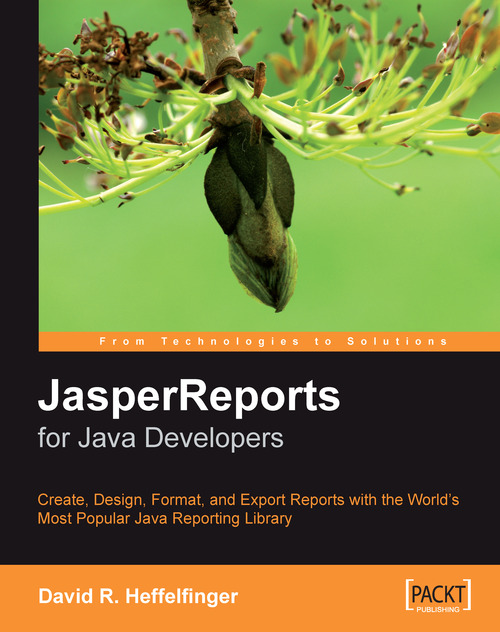
JasperReports for Java Developers

JasperReports for Java Developers:

eBook
$9.99 $28.99
Paperback
$48.99
Subscription
Free Trial
Renews at $19.99p/m

What do you get with Print?

Product feature icon Instant access to your digital copy whilst your Print order is Shipped
Product feature icon Paperback book shipped to your preferred address
Product feature icon Redeem a companion digital copy on all Print orders
Product feature icon Access this title in our online reader with advanced features
Product feature icon DRM FREE - Read whenever, wherever and however you want
Modal Close icon
Payment Processing...
tick Completed

Shipping Address

Billing Address

Shipping Methods
Table of content icon View table of contents Preview book icon Preview Book

JasperReports for Java Developers

Chapter 1. An Overview of JasperReports

This chapter presents an overview of JasperReports and explains its capabilities and features. Here is a brief outline of the topics covered in this chapter:

  • A brief history of JasperReports
  • What JasperReports is, and what it can do for us
  • A brief discussion of the JasperReports open-source license
  • The features of JasperReports
  • JasperReports' class library dependencies
  • A brief overview of the steps required to generate reports with JasperReports
  • Where to get support for JasperReports

Brief History of JasperReports

JasperReports was started by Teodor Danciu, in 2001, when he was faced with the task of evaluating reporting tools for a project he was working on. The existing solutions that he found were too expensive for his project's budget. Therefore, he decided to write his own reporting tool. The project for which he was evaluating reporting tools got canceled; but, nevertheless, he started working on JasperReports in his spare time. He registered the project on http://sourceforge.net in September, 2001. Shortly after, he started getting emails from interested potential users even though he had not yet released any code.

JasperReports version 0.1.5 was released in November, 2001. Since then, JasperReports has become immensely popular, and is currently one of the most popular (if not the most popular) Java reporting tools available. As a testament to JasperReports' enormous popularity, a Google search for java reporting tool returns the JasperReports website as its first result.

Until recently, JasperReports was basically a one-man project, with Teodor working on it in his spare time. In April 2005, a company called JasperSoft was formally launched at the MySQL User Conference in California. JasperSoft sponsors JasperReports' development, allowing Teodor and other JasperSoft developers to work full-time on JasperReports. JasperSoft also provides commercial support and services for JasperReports and related products, including the iReport Visual Designer for JasperReports. In addition to providing support for JasperReports and iReport, JasperSoft sells commercial applications incorporating JasperReports.

JasperSoft has raised over 8 million dollars in venture capital funding, no small feat in these post-dotcom days. This investment is a clear indication that venture capitalists have confidence in the success of JasperSoft, and, by extension, in the success of JasperReports. According to JasperSoft, JasperReports has been downloaded over 300,000 times, and gets over 20,000 downloads a month. It has been deployed in over 10,000 companies and Independent Software Vendors (ISVs).

What is JasperReports?

JasperReports is an open-source Java class library designed to aid developers with the task of adding reporting capabilities to Java applications. Since it is not a standalone tool, it cannot be installed on its own. Instead, it is embedded into Java applications by including its library in the application's CLASSPATH. JasperReports is a Java class library, and is not meant for end users, but rather is targeted towards Java developers who need to add reporting capabilities to their applications.

Although JasperReports is primarily used to add reporting capabilities to web-based applications via the Servlet API, it has absolutely no dependencies on the Servlet API or any other Java EE library. It is, therefore, by no means limited to web applications. There is nothing stopping us from creating standalone desktop or command-line Java applications to generate reports with JasperReports. After all, JasperReports is nothing but a Java class library providing an API to facilitate the ability to generate reports from any kind of Java application.

JasperReports requires a Java Development Kit (JDK) 1.3 or newer in order to successfully compile applications incorporating the JasperReports Java class library, and a Java Runtime Environment 1.3 or newer to successfully execute these applications. Older versions of JasperReports required a JDK to successfully execute JasperReports applications (strictly speaking, JasperReports required tools.jar to be in the CLASSPATH, and tools.jar is included in the JDK, not the JRE). However, from version 0.6.4, JasperReports is bundled with the Eclipse Java Development Tools (JDT) compiler, and no longer needs a JDK to execute deployed applications. Examples in this book are developed using JDK 1.5, but should compile and execute successfully with any JDK or JRE supported by JasperReports.

The JasperReports Open-Source License

JasperReports is licensed under the Lesser GNU Public License (LGPL). This license was chosen for JasperReports since, unlike the GPL, it allows JasperReports to be used in both open-source and closed-source applications. Applications linking to the JasperReports Java class library do not need to be open-source. However, if you consider making modifications to the existing JasperReports source code, then your modifications will have to be released under the LGPL. See http://jasperreports.sourceforge.net/license.html for the complete license.

Features of JasperReports

In addition to textual data, JasperReports is capable of generating professional reports including images, charts, and graphs. Some of the major JasperReports features include:

  • It has flexible report layout.
  • It is capable of presenting data textually or graphically.
  • It allows developers to supply data in multiple ways.
  • It can accept data from multiple datasources.
  • It can generate watermarks.
  • It can generate subreports.
  • It is capable of exporting reports to a variety of formats.

Each of these features is briefly described in the next few sections.

Flexible Report Layout

JasperReports allows us to separate data into optional report sections. These sections include:

  • The report title, which will appear once at the top of the report.
  • A page header, which will appear at the top of every page.
  • A detail section, which typically contains the primary report data.
  • A page footer, which will appear at the bottom of every page.
  • A summary section, which will appear at the end of the report.

All of these and other report sections are discussed in detail in Chapter 6. In addition to allowing us to define report sections, JasperReports allows the creation of elaborate dynamic layouts based on the contents of the report. For example, depending on the value of a report field, data can be hidden or displayed in a report, or data can be grouped into logical sections. Say, we are creating a report about cars. JasperReports allows us to group the data by make, model, year, or a combination of these or any other piece of data displayed on the report. Data grouping allows us to better control the layout of the report. Data-group definitions can also be used to calculate subtotal values based on a subset of the report data. Groups are also used to define datasets for charts and graphs. Data grouping is discussed in detail in Chapter 6.

Multiple Ways to Present Data

JasperReports provides the ability to display report data textually or graphically via charts. JasperReports allows us to use report expressions to generate reports that display dynamic data. That is, data that is not directly passed to the report or stored anywhere, but is calculated from the data contained in the datasource and/or report parameters.

Multiple Ways to Supply Data

JasperReports allows developers to pass data to a report by passing it report parameters. Report parameters can be instances of any Java class.

Data can also be passed to a report by using special classes called datasources. Report parameters and datasources can be combined for maximum flexibility.

Multiple Datasources

JasperReports can generate reports using any relational database system supported by JDBC. However, it is not limited to database reports only. It can generate reports from a number of datasources, including XML files, Plain Old Java Objects (POJOs), any class implementing the java.util.Map interface, and any class implementing the javax.swing.TableModel interface.

JasperReports also supports empty datasources, which are used for simple reports that have no dynamic data displayed. If we need to create a report from a datasource, not directly supported by JasperReports, it allows us to create our own custom datasources. JDBC datasources are discussed in detail in Chapter 4. Other datasource types, including custom datasources, are discussed in detail in Chapter 5.

Watermarks

JasperReports is capable of generating background images or text on the reports it generates. These background images can serve as a sort of 'watermark' for the report. A watermark is like a secondary image that is laid over the primary image.

Watermarks can be used for branding reports and for security purposes, since they make it difficult to forge reports. All report pages have the same watermark, which gives them a consistent look and feel.

Subreports

Another feature of JasperReports is that it allows us to create subreports, or reports within reports. Subreports simplify report design significantly by allowing us to extract complex report sections into a separate report, and incorporating that separate report into a master report.

Exporting Capabilities

Reports generated with JasperReports can be exported to a number of formats, including PDF (Portable Document Format), XLS (Excel), RTF (Rich Text Format, a format readable and editable by most word processors, including, but certainly not limited to, Microsoft Word, OpenOffice.org Writer, StarOffice Writer, and WordPerfect), HTML (HyperText Markup Language), XML (Extensible Markup Language), CSV (Comma-separated Values), and plain text. Exporting reports to these formats is discussed in detail in Chapter 9. There is also a third-party library to export JasperReports' reports to the OpenDocument Format (ODF). The OpenDocument Format is a standard XML-based file format specification for office applications developed by the Organization for the Advancement of Structured Information Standards (OASIS). OpenOffice.org version 2.0 uses ODF as its default format.

Note

The JasperReports OpenDocument Format exporter was developed in the summer of 2005, as a part of Google's Summer of Code program. More information about the JasperReports OpenDocument Format exporter can be found at http://netmoc.cpe.ucf.edu/Projects/jasper.html.

The screenshot overleaf demonstrates some of the features of JasperReports, including data grouping, adding images and watermarks to a report, and exporting to a PDF:

Exporting Capabilities

When creating the report given in the screenshot, we took advantage of the data-grouping capabilities of JasperReports to group data by country, state, and city. This grouping allowed us to display the data in a logical, easy-to-follow way. We also took advantage of JasperReports' ability to display images and added a watermark and a logo in the report heading. The report font was modified in the header section to display it in a bigger font and in bold. Text was laid out in an easy-to-follow format.

In the screenshot, the freely available Evince document viewer was used to display the PDF report. Of course, reports exported to PDF can be viewed with any PDF viewer, including Adobe Acrobat, Foxit, and xPDF.

Class Library Dependencies

JasperReports leverages other open-source Java libraries to implement some of their functionality. Some of the libraries JasperReports builds on include:

  • iText: iText is a PDF generation and manipulation library. It also has the ability to generate and manupulate RTF, XML, and HTML documents. JasperReports takes advantage of iText for exporting reports to PDF and RTF. More information about iText can be found at http://www.lowagie.com/iText/.
  • JFreeChart: JFreeChart is a Java library for producing various charts, including pie charts, bar charts, line and area charts, and the like. JasperReports takes advantage of JFreeChart to implement its built-in charting functionality. More information about JFreeChart can be found at http://www.jfree.org/jfreechart/index.php.
  • Jakarta POI: Jakarta POI is a Java class library to create and manipulate various Microsoft Office formats based on Microsoft's OLE 2 Compound Document format. JasperReports takes advantage of Jakarta POI for exporting reports to XLS (Microsoft Excel) format. More information about Jakarta POI can be found at http://jakarta.apache.org/poi/.
  • JAXP: JAXP refers to the Java API for parsing and transforming XML documents. It is used by JasperReports to parse XML files and is included in Java SE 5.0. It has to be downloaded separately when using earlier versions of Java SE. More information about JAXP can be found at http://java.sun.com/webservices/jaxp/index.jsp.
  • Jakarta Commons: Jakarta Commons is a collection of Java libraries providing a large number of reusable components. JasperReports takes advantage of the Digester, BeanUtils, and Logging components of Jakarta Commons to complement JAXP for XML parsing. More information about Jakarta Commons can be found at http://jakarta.apache.org/commons/.

Note

URLs are provided for informational purposes only. The JasperReports class library already includes the required JAR files listed here. There is no need for us to download them to take advantage of their functionality within JasperReports.

Typical Workflow

The flow chart overleaf illustrates the typical workflow while creating reports with JasperReports:

Typical Workflow

When working with JasperReports, the first step is to create a report template as an XML file. XML report templates can be hand-coded or generated by a graphical report designer. Even though JasperReports' report templates are XML files, template filenames are given an extension of .jrxml. JasperReports XML templates are commonly referred to as JRXML files, which is the term we will use for them in this book.

Here is what a typical JRXML file looks like. We will discuss JRXML files in detail in Chapter 4.

<?xml version="1.0" encoding="UTF-8"?>
<!DOCTYPE jasperReport PUBLIC "//JasperReports//DTD Report Design//EN" "http://jasperreports.sourceforge.net/dtds/jasperreport.dtd">
<jasperReport name="simple_template">
<title>
<band height="50">
</band>
</title>
<pageHeader>
<band height="50">
</band>
</pageHeader>
<columnHeader>
<band height="30">
</band>
</columnHeader>
<detail>
<band height="100">
</band>
</detail>
<columnFooter>
<band height="30">
</band>
</columnFooter>
<pageFooter>
<band height="50">
</band>
</pageFooter>
<lastPageFooter>
<band height="50">
</band>
</lastPageFooter>
<summary>
<band height="50">
</band>
</summary>
</jasperReport>

The JRXML file here mostly illustrates the main elements of a JRXML file. All elements in the file are optional except for the root<jasperReport> element. The above JRXML file, when compiled and filled, will generate an empty report; not very useful in its own right, but it can be used as a template for creating more useful reports. As can be seen in the above example, each main element of the JRXML file contains a<band> element as its only child element. Bands contain the data that is displayed in the report. In the above example, all bands are empty. In real JRXML files, bands contain child elements that are used to position, format, and display the actual report data, both textual and graphical. There are commercial and open-source visual design tools that can aid in the development of JRXML files. iReport, the official JasperReports graphical report designer, is covered in detail in Chapter 10.

JRXML files are compiled into a JasperReports native binary template, either programmatically by calling the appropriate methods on the JasperReports class library (compileReportToFile()), or by using a custom ANT task (used to compile multiple XML report design files in a single operation, by specifying the root directory that contains those files or by selecting them using file patterns) provided by JasperReports. The resulting compiled template is commonly known as the Jasper file, and is typically saved to disk with a .jasper extension. The Jasper file is then used to generate the final report, by providing it with its required data. This process is known as filling the report. A JRXML file has to be compiled only once. The generated Jasper file can be filled as many times as necessary to create and display reports.

Filled reports can be saved to disk in a JasperReports native format. Reports saved in this format are known as JasperPrint files. JasperPrint file names have a .jrprint extension. JasperPrint files can only be viewed with a JasperReports-specific viewer. JasperPrint files can be exported to other formats so that they can be opened with commonly available tools like PDF viewers and word processors. Exporting to other formats is discussed in detail in Chapter 9.

Where to Get Help?

JasperReports has official online forums and a mailing list where questions can be asked. Both the forums and the mailing list archives can be found at the JasperReports site at http://sourceforge.net/projects/jasperreports.

The JasperReports website contains tips, tricks, JavaDoc API documentation, and a quick reference for JRXML elements. We won't repeat this information in this book, since it is readily available online. The JasperReports website can be found at http://jasperreports.sourceforge.net.

Commercial support and training is offered by JasperSoft and other third-party companies.

Summary

In this chapter we were introduced to JasperReports. We discussed the evolution of JasperReports from a small one-man project to a project backed and funded by a company that has raised millions of dollars in venture capital. We also had an overview of JasperReports, where we discussed that JasperReports is not a standalone reporting solution. Instead, it is a Java library that allows us to add reporting capabilities to our applications.

Next on the line was the JasperReports' open-source license (LGPL). The chapter provided us with a brief explanation of the features of JasperReports, including flexibility in report layout, the ability to display report data textually or graphically, and the ability to group report data. The JasperReports' class library dependencies were also discussed along with the typical workflow followed when designing reports. The chapter also provided us with the official online forums and mailing lists from where we can seek help.

Left arrow icon Right arrow icon

Key benefits

  • Get started with JasperReports, and develop the skills to get the most from it
  • Create, design, format, and export reports
  • Generate report data from a wide range of datasources
  • Integrate Jasper Reports with Spring, Hibernate, Java Server Faces, or Struts

Description

JasperReports is the world's most popular embeddable Java open source reporting library, providing Java developers with the power to easily create rich print and web reports. This book shows you exactly how to get started, and develop the skills to get the most from JasperReports. The book steers you through each point of report setup, to creating, designing, formatting, and exporting reports with data from a wide range of datasources, and integrating JasperReports with other Java frameworks. Starting with the basics of adding reporting capabilities to your application, and creating report templates you will first see how to produce your reports through the use of JRXML files, custom ANT targets, and then see preview them in both the browser and the native browser of JasperReports. Getting data into your reports is the next step, and you will see how to get data from a range of datasources, not only databases, but XML files, and Java Objects, among others. You will create better looking reports with formatting and grouping, as well as adding graphical elements to the report. You will export your reports to a range of different formats, including PDF and XML. Creating reports will be made even easier with a walkthrough of the iReport Designer visual designing tool. To round things off, you will see how to integrate your reports with other Java frameworks, using Spring or Hibernate to get data for the report, and Java Server Faces or Struts for presenting the report.

Who is this book for?

This book is for Java developers who want to create rich reports for either the web or print, and want to get started quickly with JasperReports to do this. No knowledge of JasperReports is presumed, although obviously familiarity with Java, SQL, and XML are assumed where they are required.

What you will learn

  • Overview of JasperReports, and what it can do for you
  • Adding reporting capabilities to your application
  • Creating and formatting reports
  • Report layout and design
  • Working with database datasources
  • Working with other types of datasource such as arrays, collections, TableModels and XML
  • Creating subreports
  • Adding charts and graphics to a report
  • Working with the iReport report designer
  • Exporting reports to PDF, Excel spreadsheet or Word document format
  • Integrating JasperReports with other Java frameworks like Spring, Java Server Faces, Struts, and Hibernate
Estimated delivery fee Deliver to United States

Economy delivery 10 - 13 business days

Free $6.95

Premium delivery 6 - 9 business days

$21.95
(Includes tracking information)

Product Details

Country selected
Publication date, Length, Edition, Language, ISBN-13
Publication date : Aug 04, 2006
Length: 344 pages
Edition : 1st
Language : English
ISBN-13 : 9781904811909
Vendor :
Oracle
Category :
Languages :

What do you get with Print?

Product feature icon Instant access to your digital copy whilst your Print order is Shipped
Product feature icon Paperback book shipped to your preferred address
Product feature icon Redeem a companion digital copy on all Print orders
Product feature icon Access this title in our online reader with advanced features
Product feature icon DRM FREE - Read whenever, wherever and however you want
Modal Close icon
Payment Processing...
tick Completed

Shipping Address

Billing Address

Shipping Methods
Estimated delivery fee Deliver to United States

Economy delivery 10 - 13 business days

Free $6.95

Premium delivery 6 - 9 business days

$21.95
(Includes tracking information)

Product Details

Publication date : Aug 04, 2006
Length: 344 pages
Edition : 1st
Language : English
ISBN-13 : 9781904811909
Vendor :
Oracle
Category :
Languages :

Packt Subscriptions

See our plans and pricing
Modal Close icon
$19.99 billed monthly
Feature tick icon Unlimited access to Packt's library of 7,000+ practical books and videos
Feature tick icon Constantly refreshed with 50+ new titles a month
Feature tick icon Exclusive Early access to books as they're written
Feature tick icon Solve problems while you work with advanced search and reference features
Feature tick icon Offline reading on the mobile app
Feature tick icon Simple pricing, no contract
$199.99 billed annually
Feature tick icon Unlimited access to Packt's library of 7,000+ practical books and videos
Feature tick icon Constantly refreshed with 50+ new titles a month
Feature tick icon Exclusive Early access to books as they're written
Feature tick icon Solve problems while you work with advanced search and reference features
Feature tick icon Offline reading on the mobile app
Feature tick icon Choose a DRM-free eBook or Video every month to keep
Feature tick icon PLUS own as many other DRM-free eBooks or Videos as you like for just $5 each
Feature tick icon Exclusive print discounts
$279.99 billed in 18 months
Feature tick icon Unlimited access to Packt's library of 7,000+ practical books and videos
Feature tick icon Constantly refreshed with 50+ new titles a month
Feature tick icon Exclusive Early access to books as they're written
Feature tick icon Solve problems while you work with advanced search and reference features
Feature tick icon Offline reading on the mobile app
Feature tick icon Choose a DRM-free eBook or Video every month to keep
Feature tick icon PLUS own as many other DRM-free eBooks or Videos as you like for just $5 each
Feature tick icon Exclusive print discounts

Frequently bought together


Stars icon
Total $ 158.97
Object-Oriented JavaScript - Second Edition
$54.99
JasperReports for Java Developers
$48.99
Groovy 2 Cookbook
$54.99
Total $ 158.97 Stars icon

Table of Contents

12 Chapters
1. An Overview of JasperReports Chevron down icon Chevron up icon
2. Adding Reporting Capabilities to Java Applications Chevron down icon Chevron up icon
3. Creating Your First Report Chevron down icon Chevron up icon
4. Creating Dynamic Database Reports Chevron down icon Chevron up icon
5. Working with Other Datasources Chevron down icon Chevron up icon
6. Report Layout and Design Chevron down icon Chevron up icon
7. Adding Charts and Graphics to Reports Chevron down icon Chevron up icon
8. Other JasperReports Features Chevron down icon Chevron up icon
9. Exporting to Other Formats Chevron down icon Chevron up icon
10. Graphical Report Design with iReport Chevron down icon Chevron up icon
11. Integrating JasperReports with other Frameworks Chevron down icon Chevron up icon
Index Chevron down icon Chevron up icon

Customer reviews

Top Reviews
Rating distribution
Full star icon Full star icon Full star icon Half star icon Empty star icon 3.9
(7 Ratings)
5 star 42.9%
4 star 14.3%
3 star 28.6%
2 star 14.3%
1 star 0%
Filter icon Filter
Top Reviews

Filter reviews by


Jerry Smetzer Apr 22, 2007
Full star icon Full star icon Full star icon Full star icon Full star icon 5
Heffelfinger's book meets all my tests for excellence in technical manuals. First, it addresses a development problem I am having today; and it is the only book on the market - including books and articles published by the vendor - that does so. Other favorable attributes include these: the book is less than 3/4ths of an inch thick, weighs less than a pound; cost less than $50 bucks; and there is more white space than dense text.Some authors of technical books must think we buy their books in order to better understand and appreciate their verbose writing styles. I did that sort of thing in my literature courses. When I am under the gun to produce bullet-proof code I want the insight and keyboard sequences that get me to user acceptance with the shortest time, and the least grief.Finally, maybe most important, the book is full of brief, readable, complete, and relevant code. When compiled, the code actually works on my ratty old development machine with a minimum number of obscure error messages. There are many references to needed downloads and sources of information relevant to the topics discussed. The error messages can be resolved with some careful re-reading and re-thinking. Thus do we get through our learning curves. Unlike some technical books, the error messages generated by the code in this one are not black holes where hours of time disappear without ever regurgitating a solution to the problem that caused the error.My first programming opportunity in college had me using machine language techniques to write a five card inventory program on an IBM 1620 with 4K of magnetic core memory. I followed that up with a couple of years on a Displaywriter. In recent years I've had better equipment, and I've learned how to make Agile XP and use cases a part of my daily life, but youthful and sophisticated users who have grown up with the web want lots of tricky stuff on their pocket-size devices. The problem for old guys like me is that the tricky stuff and the devices themselves were never dreamed of in the late 20th century when I was trying to get my programmer chops, but today's users want the stuff, and they want it now.So, since I enjoy trying to make this stuff, I have been recently engaged in a massive struggle to figure out how to drag my decades of programming experience with Basic, Visual Basic, MS Access, and client-server architectures into the brave new 21st century world of n-tier, the web, java, open source, and mobile, disconnected data gathering.On page 25 David H told me, the reader, that I was required to use ANT in order to work the examples in his book. This was not an option. By doing so he has shined a light on the yellow brick road to the geek promised land, and this old geek is now going happily down that road. Five stars for "Jasper Reports for Java Developers."
Amazon Verified review Amazon
Sarah R. Aug 15, 2014
Full star icon Full star icon Full star icon Full star icon Full star icon 5
Fast service and book was exactly as described and shown.
Amazon Verified review Amazon
Mahesh Lavannis Jul 15, 2010
Full star icon Full star icon Full star icon Full star icon Full star icon 5
I knew nothing about JasperReports when I bought this book. And within a couple of days I have a great looking PDF report :) This book is very well laid out. It walks you step by step from your first "Hello World" report to dynamic tables to graphics. It is well worth its price, especially give the scarcity of good JasperReport doc. I am glad Heffelfinger took the time to write it - kudos! Note that I am using the 3.5 version of this book.
Amazon Verified review Amazon
R. Spears Dec 15, 2006
Full star icon Full star icon Full star icon Full star icon Empty star icon 4
There is such a dearth of documentation on JasperReports. This is a very nice explanation on how to use it, there a good set of examples.
Amazon Verified review Amazon
Sulalith Rajapakse Apr 11, 2007
Full star icon Full star icon Full star icon Empty star icon Empty star icon 3
I was looking for complex examples on crosstab reports but found only basic examples. I wish they had a chapter on Dynamic reports and a section describing the jasper report object model.Otherwise it is a good introduction into Jasper Reports as it goes through all the features (rather than searching through the jasper report forum).
Amazon Verified review Amazon
Get free access to Packt library with over 7500+ books and video courses for 7 days!
Start Free Trial

FAQs

What is the digital copy I get with my Print order? Chevron down icon Chevron up icon

When you buy any Print edition of our Books, you can redeem (for free) the eBook edition of the Print Book you’ve purchased. This gives you instant access to your book when you make an order via PDF, EPUB or our online Reader experience.

What is the delivery time and cost of print book? Chevron down icon Chevron up icon

Shipping Details

USA:

'

Economy: Delivery to most addresses in the US within 10-15 business days

Premium: Trackable Delivery to most addresses in the US within 3-8 business days

UK:

Economy: Delivery to most addresses in the U.K. within 7-9 business days.
Shipments are not trackable

Premium: Trackable delivery to most addresses in the U.K. within 3-4 business days!
Add one extra business day for deliveries to Northern Ireland and Scottish Highlands and islands

EU:

Premium: Trackable delivery to most EU destinations within 4-9 business days.

Australia:

Economy: Can deliver to P. O. Boxes and private residences.
Trackable service with delivery to addresses in Australia only.
Delivery time ranges from 7-9 business days for VIC and 8-10 business days for Interstate metro
Delivery time is up to 15 business days for remote areas of WA, NT & QLD.

Premium: Delivery to addresses in Australia only
Trackable delivery to most P. O. Boxes and private residences in Australia within 4-5 days based on the distance to a destination following dispatch.

India:

Premium: Delivery to most Indian addresses within 5-6 business days

Rest of the World:

Premium: Countries in the American continent: Trackable delivery to most countries within 4-7 business days

Asia:

Premium: Delivery to most Asian addresses within 5-9 business days

Disclaimer:
All orders received before 5 PM U.K time would start printing from the next business day. So the estimated delivery times start from the next day as well. Orders received after 5 PM U.K time (in our internal systems) on a business day or anytime on the weekend will begin printing the second to next business day. For example, an order placed at 11 AM today will begin printing tomorrow, whereas an order placed at 9 PM tonight will begin printing the day after tomorrow.


Unfortunately, due to several restrictions, we are unable to ship to the following countries:

  1. Afghanistan
  2. American Samoa
  3. Belarus
  4. Brunei Darussalam
  5. Central African Republic
  6. The Democratic Republic of Congo
  7. Eritrea
  8. Guinea-bissau
  9. Iran
  10. Lebanon
  11. Libiya Arab Jamahriya
  12. Somalia
  13. Sudan
  14. Russian Federation
  15. Syrian Arab Republic
  16. Ukraine
  17. Venezuela
What is custom duty/charge? Chevron down icon Chevron up icon

Customs duty are charges levied on goods when they cross international borders. It is a tax that is imposed on imported goods. These duties are charged by special authorities and bodies created by local governments and are meant to protect local industries, economies, and businesses.

Do I have to pay customs charges for the print book order? Chevron down icon Chevron up icon

The orders shipped to the countries that are listed under EU27 will not bear custom charges. They are paid by Packt as part of the order.

List of EU27 countries: www.gov.uk/eu-eea:

A custom duty or localized taxes may be applicable on the shipment and would be charged by the recipient country outside of the EU27 which should be paid by the customer and these duties are not included in the shipping charges been charged on the order.

How do I know my custom duty charges? Chevron down icon Chevron up icon

The amount of duty payable varies greatly depending on the imported goods, the country of origin and several other factors like the total invoice amount or dimensions like weight, and other such criteria applicable in your country.

For example:

  • If you live in Mexico, and the declared value of your ordered items is over $ 50, for you to receive a package, you will have to pay additional import tax of 19% which will be $ 9.50 to the courier service.
  • Whereas if you live in Turkey, and the declared value of your ordered items is over € 22, for you to receive a package, you will have to pay additional import tax of 18% which will be € 3.96 to the courier service.
How can I cancel my order? Chevron down icon Chevron up icon

Cancellation Policy for Published Printed Books:

You can cancel any order within 1 hour of placing the order. Simply contact customercare@packt.com with your order details or payment transaction id. If your order has already started the shipment process, we will do our best to stop it. However, if it is already on the way to you then when you receive it, you can contact us at customercare@packt.com using the returns and refund process.

Please understand that Packt Publishing cannot provide refunds or cancel any order except for the cases described in our Return Policy (i.e. Packt Publishing agrees to replace your printed book because it arrives damaged or material defect in book), Packt Publishing will not accept returns.

What is your returns and refunds policy? Chevron down icon Chevron up icon

Return Policy:

We want you to be happy with your purchase from Packtpub.com. We will not hassle you with returning print books to us. If the print book you receive from us is incorrect, damaged, doesn't work or is unacceptably late, please contact Customer Relations Team on customercare@packt.com with the order number and issue details as explained below:

  1. If you ordered (eBook, Video or Print Book) incorrectly or accidentally, please contact Customer Relations Team on customercare@packt.com within one hour of placing the order and we will replace/refund you the item cost.
  2. Sadly, if your eBook or Video file is faulty or a fault occurs during the eBook or Video being made available to you, i.e. during download then you should contact Customer Relations Team within 14 days of purchase on customercare@packt.com who will be able to resolve this issue for you.
  3. You will have a choice of replacement or refund of the problem items.(damaged, defective or incorrect)
  4. Once Customer Care Team confirms that you will be refunded, you should receive the refund within 10 to 12 working days.
  5. If you are only requesting a refund of one book from a multiple order, then we will refund you the appropriate single item.
  6. Where the items were shipped under a free shipping offer, there will be no shipping costs to refund.

On the off chance your printed book arrives damaged, with book material defect, contact our Customer Relation Team on customercare@packt.com within 14 days of receipt of the book with appropriate evidence of damage and we will work with you to secure a replacement copy, if necessary. Please note that each printed book you order from us is individually made by Packt's professional book-printing partner which is on a print-on-demand basis.

What tax is charged? Chevron down icon Chevron up icon

Currently, no tax is charged on the purchase of any print book (subject to change based on the laws and regulations). A localized VAT fee is charged only to our European and UK customers on eBooks, Video and subscriptions that they buy. GST is charged to Indian customers for eBooks and video purchases.

What payment methods can I use? Chevron down icon Chevron up icon

You can pay with the following card types:

  1. Visa Debit
  2. Visa Credit
  3. MasterCard
  4. PayPal
What is the delivery time and cost of print books? Chevron down icon Chevron up icon

Shipping Details

USA:

'

Economy: Delivery to most addresses in the US within 10-15 business days

Premium: Trackable Delivery to most addresses in the US within 3-8 business days

UK:

Economy: Delivery to most addresses in the U.K. within 7-9 business days.
Shipments are not trackable

Premium: Trackable delivery to most addresses in the U.K. within 3-4 business days!
Add one extra business day for deliveries to Northern Ireland and Scottish Highlands and islands

EU:

Premium: Trackable delivery to most EU destinations within 4-9 business days.

Australia:

Economy: Can deliver to P. O. Boxes and private residences.
Trackable service with delivery to addresses in Australia only.
Delivery time ranges from 7-9 business days for VIC and 8-10 business days for Interstate metro
Delivery time is up to 15 business days for remote areas of WA, NT & QLD.

Premium: Delivery to addresses in Australia only
Trackable delivery to most P. O. Boxes and private residences in Australia within 4-5 days based on the distance to a destination following dispatch.

India:

Premium: Delivery to most Indian addresses within 5-6 business days

Rest of the World:

Premium: Countries in the American continent: Trackable delivery to most countries within 4-7 business days

Asia:

Premium: Delivery to most Asian addresses within 5-9 business days

Disclaimer:
All orders received before 5 PM U.K time would start printing from the next business day. So the estimated delivery times start from the next day as well. Orders received after 5 PM U.K time (in our internal systems) on a business day or anytime on the weekend will begin printing the second to next business day. For example, an order placed at 11 AM today will begin printing tomorrow, whereas an order placed at 9 PM tonight will begin printing the day after tomorrow.


Unfortunately, due to several restrictions, we are unable to ship to the following countries:

  1. Afghanistan
  2. American Samoa
  3. Belarus
  4. Brunei Darussalam
  5. Central African Republic
  6. The Democratic Republic of Congo
  7. Eritrea
  8. Guinea-bissau
  9. Iran
  10. Lebanon
  11. Libiya Arab Jamahriya
  12. Somalia
  13. Sudan
  14. Russian Federation
  15. Syrian Arab Republic
  16. Ukraine
  17. Venezuela
Modal Close icon
Modal Close icon