Search icon CANCEL
Subscription
0
Cart icon
Your Cart (0 item)
Close icon
You have no products in your basket yet
Save more on your purchases! discount-offer-chevron-icon
Savings automatically calculated. No voucher code required.
Arrow left icon
Explore Products
Best Sellers
New Releases
Books
Videos
Audiobooks
Learning Hub
Newsletter Hub
Free Learning
Arrow right icon
timer SALE ENDS IN
0 Days
:
00 Hours
:
00 Minutes
:
00 Seconds
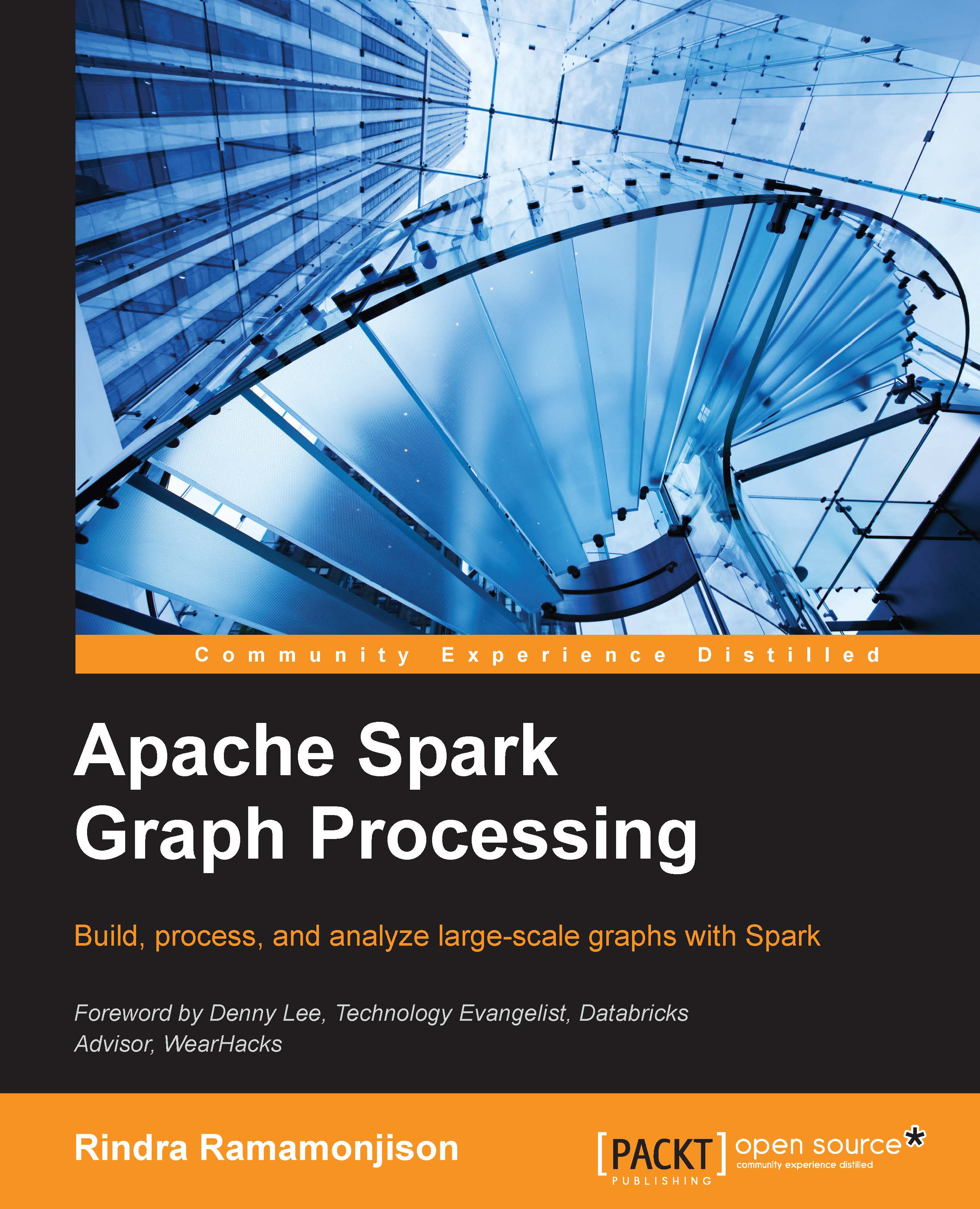
Apache Spark Graph Processing

Apache Spark Graph Processing: Build, process and analyze large-scale graph data effectively with Spark

eBook
$26.99 $29.99
Paperback
$38.99
Subscription
Free Trial
Renews at $19.99p/m

What do you get with Print?

Product feature icon Instant access to your digital copy whilst your Print order is Shipped
Product feature icon Paperback book shipped to your preferred address
Product feature icon Redeem a companion digital copy on all Print orders
Product feature icon Access this title in our online reader with advanced features
Product feature icon DRM FREE - Read whenever, wherever and however you want
Modal Close icon
Payment Processing...
tick Completed

Shipping Address

Billing Address

Shipping Methods
Table of content icon View table of contents Preview book icon Preview Book

Apache Spark Graph Processing

Chapter 2. Building and Exploring Graphs

This chapter aims to teach us how to represent various types of networks and complex systems as property graphs in Spark and GraphX. Before we can describe the behavior, and analyze the inner structure of these systems, we first need to map their components to vertices or nodes, and map the interactions between the individual components to edges or links. Building on what we learned in the previous chapter, we will delve into the details on how graphs are stored and represented in GraphX. In addition, this chapter introduces the language of graph theory, and the basic characteristics of graphs. Throughout this chapter, we will use real-world datasets that we will map to the different types of graphs. The examples include e-mail communication networks, food flavor network, and social ego networks. On completing this chapter, you will understand how to:

  • Load data and build Spark graphs in many ways
  • Use the join operator to mix external data...

Network datasets

In the previous chapter, we constructed a small social network as a toy example. From this chapter onwards, we are going to work with real-world datasets, drawn from various applications. In fact, graphs are used to represent any complex system as it describes the interactions between the components of the system. Despite the diversity in form, size, nature, and granularity of different systems, graph theory provides a common language, and a set of tools, for representing and analyzing complex systems.

Note

In brief, a graph consists of a set of vertices connected by a set of edges. Each edge represents the relationship between a pair of connected vertices. In this book, we will sometimes use the less technical terms network nodes to refer to vertices, and links to refer to edges. Note that Spark supports multigraphs, that is, it is permitted to have multiple edges between any pair of nodes.

Let's get a preview of the networks that we are going to build in this chapter...

Graph builders

In GraphX, there are four functions for building a property graph. Each of these functions requires that the data from which the graph is constructed should be structured in a specified manner.

The Graph factory method

The first one is the Graph factory method that we have already seen in the previous chapter. It is defined in the apply method of the companion object called Graph, which is as follows:

def apply[VD, ED](
      vertices: RDD[(VertexId, VD)],
      edges: RDD[Edge[ED]],
      defaultVertexAttr: VD = null)
    : Graph[VD, ED]

As we have seen before, this function takes two RDD collections: RDD[(VertexId, VD)] and RDD[Edge[ED]] as parameters for the vertices and edges respectively, to construct a Graph[VD, ED] parameter. The defaultVertexAttr attribute is used to assign the default attribute for the vertices that are present in the edge RDD but not in the vertex RDD. The Graph factory method is convenient when the RDD collections of edges and vertices are readily...

Building graphs

Let's now open our Spark shell and build three types of graphs: a directed email communication network, a bipartite graph of ingredient-compound connections, and a multigraph using the previous graph builders.

Note

Unless otherwise stated, we always assume that the Spark shell is launched from the $SPARKHOME directory. It then becomes the current directory for any relative file path used in this book.

Building directed graphs

The first graph that we will build is the Enron email communication network. If you have restarted your Spark shell, you need to again import the GraphX library. First, create a new folder called data inside $SPARKHOME and copy the dataset into it. This file contains the adjacency list of the email communications between the employees. Assuming that the current directory is $SPARKHOME, we can pass the file path to the GraphLoader.edgeListFile method:

scala> import org.apache.spark.graphx._
import org.apache.spark.graphx._

scala> import org.apache...

Computing the degrees of the network nodes

We are now going to explore the three graphs, and introduce an important property of a network node, which is the degree of the node.

The degree of a node represents the number of links it has to other nodes. In a directed graph, we can make a distinction between the incoming degree of a node or an in-degree, which is the number of its incoming links, and its outgoing degree or out-degree, which is the number of nodes that it points to. In the following sections, we will explore the degree distributions of the three example networks.

In-degree and out-degree of the Enron email network

For the Enron email network, we can confirm that there are roughly ten times more links than nodes:

scala> emailGraph.numEdges
res: Long = 367662

scala> emailGraph.numVertices
res: Long = 36692

Indeed, the in-degree and out-degree of the employees are exactly the same in this example as the email graph is bi-directed. This can be confirmed by looking at the average...

Summary

In this chapter, we have learned about the different ways to build graphs in Spark by working with concrete examples borrowed from online social networks, food science, and e-mail communications. We have seen that constructing a graph requires some data preparation and wrangling efforts. Nonetheless, GraphX offers various graph builder functions from which we can choose, depending on the graph representation that we need to create, and on the shape of the available datasets. Such usable functionalities are the advantages of GraphX against other similar graph-processing frameworks. Moreover, we looked at some basic statistics and properties of graphs, which are rather useful in characterizing their structure and in understanding their representation.

In the next chapter, we will go deeper into the analysis of graphs, using data visualization tools and new graph-theoretical concepts and algorithms, such as connectedness, triangle counting, and PageRank.

Left arrow icon Right arrow icon

Description

Apache Spark is the next standard of open-source cluster-computing engine for processing big data. Many practical computing problems concern large graphs, like the Web graph and various social networks. The scale of these graphs - in some cases billions of vertices, trillions of edges - poses challenges to their efficient processing. Apache Spark GraphX API combines the advantages of both data-parallel and graph-parallel systems by efficiently expressing graph computation within the Spark data-parallel framework. This book will teach the user to do graphical programming in Apache Spark, apart from an explanation of the entire process of graphical data analysis. You will journey through the creation of graphs, its uses, its exploration and analysis and finally will also cover the conversion of graph elements into graph structures. This book begins with an introduction of the Spark system, its libraries and the Scala Build Tool. Using a hands-on approach, this book will quickly teach you how to install and leverage Spark interactively on the command line and in a standalone Scala program. Then, it presents all the methods for building Spark graphs using illustrative network datasets. Next, it will walk you through the process of exploring, visualizing and analyzing different network characteristics. This book will also teach you how to transform raw datasets into a usable form. In addition, you will learn powerful operations that can be used to transform graph elements and graph structures. Furthermore, this book also teaches how to create custom graph operations that are tailored for specific needs with efficiency in mind. The later chapters of this book cover more advanced topics such as clustering graphs, implementing graph-parallel iterative algorithms and learning methods from graph data.

Who is this book for?

This book is for data scientists and big data developers who want to learn the processing and analyzing graph datasets at scale. Basic programming experience with Scala is assumed. Basic knowledge of Spark is assumed.

What you will learn

  • Write, build and deploy Spark applications with the Scala Build Tool.
  • Build and analyze largescale network datasets
  • Analyze and transform graphs using RDD and graphspecific operations
  • Implement new custom graph operations tailored to specific needs.
  • Develop iterative and efficient graph algorithms using message aggregation and Pregel abstraction
  • Extract subgraphs and use it to discover common clusters
  • Analyze graph data and solve various data science problems using realworld datasets.
Estimated delivery fee Deliver to United States

Economy delivery 10 - 13 business days

Free $6.95

Premium delivery 6 - 9 business days

$21.95
(Includes tracking information)

Product Details

Country selected
Publication date, Length, Edition, Language, ISBN-13
Publication date : Sep 10, 2015
Length: 148 pages
Edition : 1st
Language : English
ISBN-13 : 9781784391805
Category :

What do you get with Print?

Product feature icon Instant access to your digital copy whilst your Print order is Shipped
Product feature icon Paperback book shipped to your preferred address
Product feature icon Redeem a companion digital copy on all Print orders
Product feature icon Access this title in our online reader with advanced features
Product feature icon DRM FREE - Read whenever, wherever and however you want
Modal Close icon
Payment Processing...
tick Completed

Shipping Address

Billing Address

Shipping Methods
Estimated delivery fee Deliver to United States

Economy delivery 10 - 13 business days

Free $6.95

Premium delivery 6 - 9 business days

$21.95
(Includes tracking information)

Product Details

Publication date : Sep 10, 2015
Length: 148 pages
Edition : 1st
Language : English
ISBN-13 : 9781784391805
Category :

Packt Subscriptions

See our plans and pricing
Modal Close icon
$19.99 billed monthly
Feature tick icon Unlimited access to Packt's library of 7,000+ practical books and videos
Feature tick icon Constantly refreshed with 50+ new titles a month
Feature tick icon Exclusive Early access to books as they're written
Feature tick icon Solve problems while you work with advanced search and reference features
Feature tick icon Offline reading on the mobile app
Feature tick icon Simple pricing, no contract
$199.99 billed annually
Feature tick icon Unlimited access to Packt's library of 7,000+ practical books and videos
Feature tick icon Constantly refreshed with 50+ new titles a month
Feature tick icon Exclusive Early access to books as they're written
Feature tick icon Solve problems while you work with advanced search and reference features
Feature tick icon Offline reading on the mobile app
Feature tick icon Choose a DRM-free eBook or Video every month to keep
Feature tick icon PLUS own as many other DRM-free eBooks or Videos as you like for just $5 each
Feature tick icon Exclusive print discounts
$279.99 billed in 18 months
Feature tick icon Unlimited access to Packt's library of 7,000+ practical books and videos
Feature tick icon Constantly refreshed with 50+ new titles a month
Feature tick icon Exclusive Early access to books as they're written
Feature tick icon Solve problems while you work with advanced search and reference features
Feature tick icon Offline reading on the mobile app
Feature tick icon Choose a DRM-free eBook or Video every month to keep
Feature tick icon PLUS own as many other DRM-free eBooks or Videos as you like for just $5 each
Feature tick icon Exclusive print discounts

Frequently bought together


Stars icon
Total $ 87.98
Spark Cookbook
$48.99
Apache Spark Graph Processing
$38.99
Total $ 87.98 Stars icon

Table of Contents

9 Chapters
1. Getting Started with Spark and GraphX Chevron down icon Chevron up icon
2. Building and Exploring Graphs Chevron down icon Chevron up icon
3. Graph Analysis and Visualization Chevron down icon Chevron up icon
4. Transforming and Shaping Up Graphs to Your Needs Chevron down icon Chevron up icon
5. Creating Custom Graph Aggregation Operators Chevron down icon Chevron up icon
6. Iterative Graph-Parallel Processing with Pregel Chevron down icon Chevron up icon
7. Learning Graph Structures Chevron down icon Chevron up icon
A. References Chevron down icon Chevron up icon
Index Chevron down icon Chevron up icon

Customer reviews

Rating distribution
Full star icon Full star icon Full star icon Half star icon Empty star icon 3.5
(2 Ratings)
5 star 0%
4 star 50%
3 star 50%
2 star 0%
1 star 0%
nag Jun 18, 2016
Full star icon Full star icon Full star icon Full star icon Empty star icon 4
Reading it. will give full feedback later.
Amazon Verified review Amazon
MSastry Nov 01, 2015
Full star icon Full star icon Full star icon Empty star icon Empty star icon 3
This book is easy to read with a promise to provide step by step procedures to learn Apache Spark Graph Processing. To the most extent, Mr. Rindra Ramamonjison fulfills the promise. There are several errors in the book as such reader gets confused and can not be followed through the text. For example, spark-1.4.1-bin-hadoop2.6.tgz does not have the directories: core, graphx, mllib, sql, and streaming in SPARKHOME. Also, in the directory data, there are no files such as people.csv and links.csv.Apart from the above superficial errors, the book met my expectation to learn Graph Processing.
Amazon Verified review Amazon
Get free access to Packt library with over 7500+ books and video courses for 7 days!
Start Free Trial

FAQs

What is the digital copy I get with my Print order? Chevron down icon Chevron up icon

When you buy any Print edition of our Books, you can redeem (for free) the eBook edition of the Print Book you’ve purchased. This gives you instant access to your book when you make an order via PDF, EPUB or our online Reader experience.

What is the delivery time and cost of print book? Chevron down icon Chevron up icon

Shipping Details

USA:

'

Economy: Delivery to most addresses in the US within 10-15 business days

Premium: Trackable Delivery to most addresses in the US within 3-8 business days

UK:

Economy: Delivery to most addresses in the U.K. within 7-9 business days.
Shipments are not trackable

Premium: Trackable delivery to most addresses in the U.K. within 3-4 business days!
Add one extra business day for deliveries to Northern Ireland and Scottish Highlands and islands


EU:

Premium: Trackable delivery to most EU destinations within 4-9 business days.

Australia:

Economy: Can deliver to P. O. Boxes and private residences.

Trackable service with delivery to addresses in Australia only.
Delivery time ranges from 7-9 business days for VIC and 8-10 business days for Interstate metro
Delivery time is up to 15 business days for remote areas of WA, NT & QLD.

Premium: Delivery to addresses in Australia only
Trackable delivery to most P. O. Boxes and private residences in Australia within 4-5 days based on the distance to a destination following dispatch.

India:

Premium: Delivery to most Indian addresses within 5-6 business days

Rest of the World:

Premium: Countries in the American continent: Trackable delivery to most countries within 4-7 business days

Asia:

Premium: Delivery to most Asian addresses within 5-9 business days

Disclaimer:
All orders received before 5 PM U.K time would start printing from the next business day. So the estimated delivery times start from the next day as well. Orders received after 5 PM U.K time (in our internal systems) on a business day or anytime on the weekend will begin printing the second to next business day. For example, an order placed at 11 AM today will begin printing tomorrow, whereas an order placed at 9 PM tonight will begin printing the day after tomorrow.


Unfortunately, due to several restrictions, we are unable to ship to the following countries:

  1. Afghanistan
  2. American Samoa
  3. Belarus
  4. Brunei Darussalam
  5. Central African Republic
  6. The Democratic Republic of Congo
  7. Eritrea
  8. Guinea-bissau
  9. Iran
  10. Lebanon
  11. Libiya Arab Jamahriya
  12. Somalia
  13. Sudan
  14. Russian Federation
  15. Syrian Arab Republic
  16. Ukraine
  17. Venezuela
What is custom duty/charge? Chevron down icon Chevron up icon

Customs duty are charges levied on goods when they cross international borders. It is a tax that is imposed on imported goods. These duties are charged by special authorities and bodies created by local governments and are meant to protect local industries, economies, and businesses.

Do I have to pay customs charges for the print book order? Chevron down icon Chevron up icon

The orders shipped to the countries that are listed under EU27 will not bear custom charges. They are paid by Packt as part of the order.

List of EU27 countries: www.gov.uk/eu-eea:

A custom duty or localized taxes may be applicable on the shipment and would be charged by the recipient country outside of the EU27 which should be paid by the customer and these duties are not included in the shipping charges been charged on the order.

How do I know my custom duty charges? Chevron down icon Chevron up icon

The amount of duty payable varies greatly depending on the imported goods, the country of origin and several other factors like the total invoice amount or dimensions like weight, and other such criteria applicable in your country.

For example:

  • If you live in Mexico, and the declared value of your ordered items is over $ 50, for you to receive a package, you will have to pay additional import tax of 19% which will be $ 9.50 to the courier service.
  • Whereas if you live in Turkey, and the declared value of your ordered items is over € 22, for you to receive a package, you will have to pay additional import tax of 18% which will be € 3.96 to the courier service.
How can I cancel my order? Chevron down icon Chevron up icon

Cancellation Policy for Published Printed Books:

You can cancel any order within 1 hour of placing the order. Simply contact customercare@packt.com with your order details or payment transaction id. If your order has already started the shipment process, we will do our best to stop it. However, if it is already on the way to you then when you receive it, you can contact us at customercare@packt.com using the returns and refund process.

Please understand that Packt Publishing cannot provide refunds or cancel any order except for the cases described in our Return Policy (i.e. Packt Publishing agrees to replace your printed book because it arrives damaged or material defect in book), Packt Publishing will not accept returns.

What is your returns and refunds policy? Chevron down icon Chevron up icon

Return Policy:

We want you to be happy with your purchase from Packtpub.com. We will not hassle you with returning print books to us. If the print book you receive from us is incorrect, damaged, doesn't work or is unacceptably late, please contact Customer Relations Team on customercare@packt.com with the order number and issue details as explained below:

  1. If you ordered (eBook, Video or Print Book) incorrectly or accidentally, please contact Customer Relations Team on customercare@packt.com within one hour of placing the order and we will replace/refund you the item cost.
  2. Sadly, if your eBook or Video file is faulty or a fault occurs during the eBook or Video being made available to you, i.e. during download then you should contact Customer Relations Team within 14 days of purchase on customercare@packt.com who will be able to resolve this issue for you.
  3. You will have a choice of replacement or refund of the problem items.(damaged, defective or incorrect)
  4. Once Customer Care Team confirms that you will be refunded, you should receive the refund within 10 to 12 working days.
  5. If you are only requesting a refund of one book from a multiple order, then we will refund you the appropriate single item.
  6. Where the items were shipped under a free shipping offer, there will be no shipping costs to refund.

On the off chance your printed book arrives damaged, with book material defect, contact our Customer Relation Team on customercare@packt.com within 14 days of receipt of the book with appropriate evidence of damage and we will work with you to secure a replacement copy, if necessary. Please note that each printed book you order from us is individually made by Packt's professional book-printing partner which is on a print-on-demand basis.

What tax is charged? Chevron down icon Chevron up icon

Currently, no tax is charged on the purchase of any print book (subject to change based on the laws and regulations). A localized VAT fee is charged only to our European and UK customers on eBooks, Video and subscriptions that they buy. GST is charged to Indian customers for eBooks and video purchases.

What payment methods can I use? Chevron down icon Chevron up icon

You can pay with the following card types:

  1. Visa Debit
  2. Visa Credit
  3. MasterCard
  4. PayPal
What is the delivery time and cost of print books? Chevron down icon Chevron up icon

Shipping Details

USA:

'

Economy: Delivery to most addresses in the US within 10-15 business days

Premium: Trackable Delivery to most addresses in the US within 3-8 business days

UK:

Economy: Delivery to most addresses in the U.K. within 7-9 business days.
Shipments are not trackable

Premium: Trackable delivery to most addresses in the U.K. within 3-4 business days!
Add one extra business day for deliveries to Northern Ireland and Scottish Highlands and islands

EU:

Premium: Trackable delivery to most EU destinations within 4-9 business days.

Australia:

Economy: Can deliver to P. O. Boxes and private residences.
Trackable service with delivery to addresses in Australia only.
Delivery time ranges from 7-9 business days for VIC and 8-10 business days for Interstate metro
Delivery time is up to 15 business days for remote areas of WA, NT & QLD.

Premium: Delivery to addresses in Australia only
Trackable delivery to most P. O. Boxes and private residences in Australia within 4-5 days based on the distance to a destination following dispatch.

India:

Premium: Delivery to most Indian addresses within 5-6 business days

Rest of the World:

Premium: Countries in the American continent: Trackable delivery to most countries within 4-7 business days

Asia:

Premium: Delivery to most Asian addresses within 5-9 business days

Disclaimer:
All orders received before 5 PM U.K time would start printing from the next business day. So the estimated delivery times start from the next day as well. Orders received after 5 PM U.K time (in our internal systems) on a business day or anytime on the weekend will begin printing the second to next business day. For example, an order placed at 11 AM today will begin printing tomorrow, whereas an order placed at 9 PM tonight will begin printing the day after tomorrow.


Unfortunately, due to several restrictions, we are unable to ship to the following countries:

  1. Afghanistan
  2. American Samoa
  3. Belarus
  4. Brunei Darussalam
  5. Central African Republic
  6. The Democratic Republic of Congo
  7. Eritrea
  8. Guinea-bissau
  9. Iran
  10. Lebanon
  11. Libiya Arab Jamahriya
  12. Somalia
  13. Sudan
  14. Russian Federation
  15. Syrian Arab Republic
  16. Ukraine
  17. Venezuela
Modal Close icon
Modal Close icon