Search icon CANCEL
Subscription
0
Cart icon
Your Cart (0 item)
Close icon
You have no products in your basket yet
Arrow left icon
Explore Products
Best Sellers
New Releases
Books
Events
Videos
Audiobooks
Packt Hub
Free Learning
Arrow right icon
timer SALE ENDS IN
0 Days
:
00 Hours
:
00 Minutes
:
00 Seconds
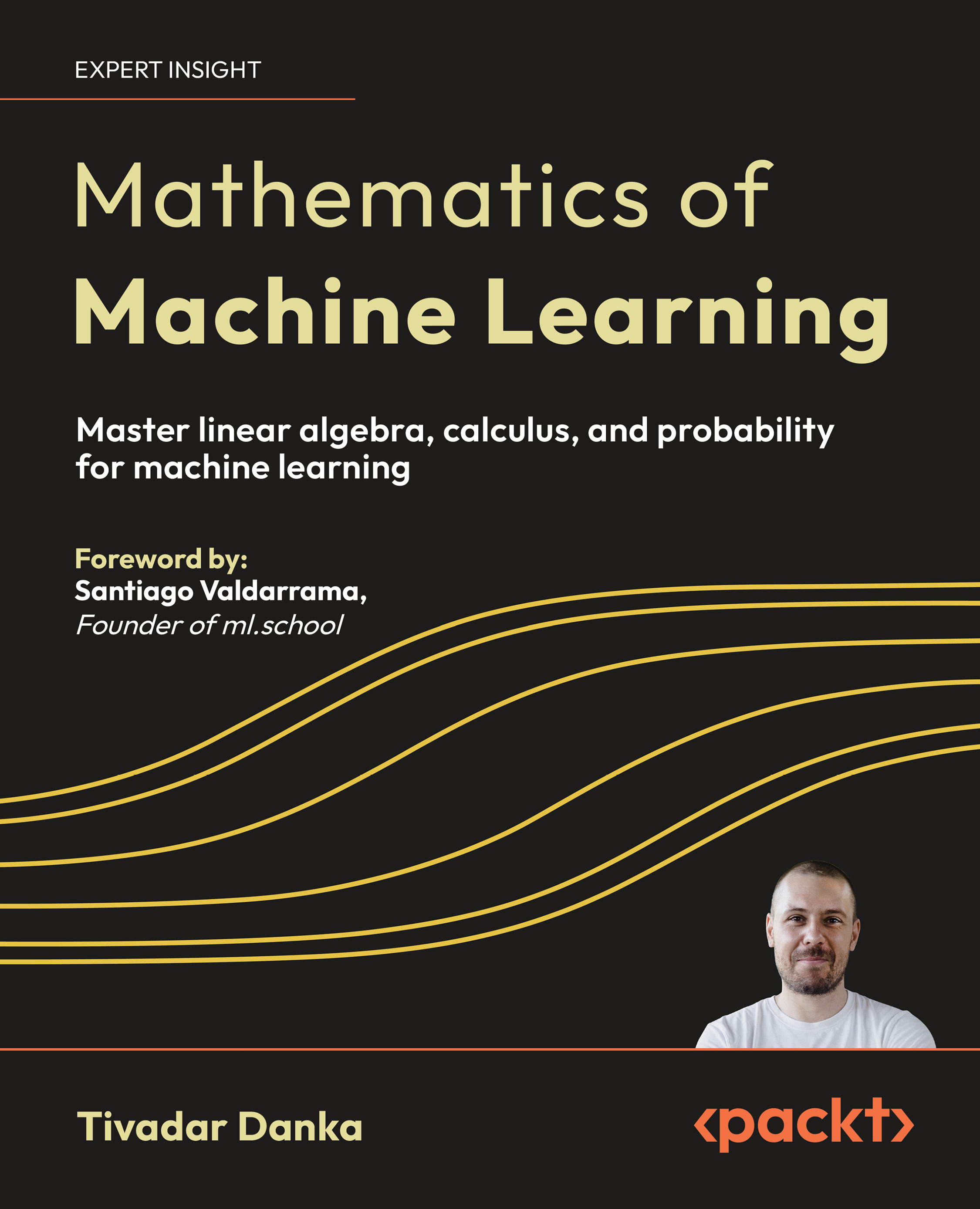
Mathematics of Machine Learning

Mathematics of Machine Learning: Master linear algebra, calculus, and probability for machine learning

Arrow left icon
Profile Icon Tivadar Danka
Arrow right icon
$59.99
Full star icon Full star icon Full star icon Empty star icon Empty star icon 3 (6 Ratings)
Paperback May 2025 730 pages 1st Edition
eBook
$43.19 $47.99
Paperback
$59.99
Arrow left icon
Profile Icon Tivadar Danka
Arrow right icon
$59.99
Full star icon Full star icon Full star icon Empty star icon Empty star icon 3 (6 Ratings)
Paperback May 2025 730 pages 1st Edition
eBook
$43.19 $47.99
Paperback
$59.99
eBook
$43.19 $47.99
Paperback
$59.99

What do you get with Print?

Product feature icon Instant access to your digital copy whilst your Print order is Shipped
Product feature icon Paperback book shipped to your preferred address
Product feature icon Redeem a companion digital copy on all Print orders
Product feature icon Access this title in our online reader with advanced features
Product feature icon DRM FREE - Read whenever, wherever and however you want
Product feature icon AI Assistant (beta) to help accelerate your learning
Modal Close icon
Payment Processing...
tick Completed

Shipping Address

Billing Address

Shipping Methods
Table of content icon View table of contents Preview book icon Preview Book

Mathematics of Machine Learning

Introduction

Why do I have to learn mathematics? - This is a question I am asked daily.

Well, you don’t have to. But you should!

On the surface, advanced mathematics doesn’t impact software engineering and machine learning in a production setting. You don’t have to calculate gradients, solve linear equations, or find eigenvalues by hand. Basic and advanced algorithms are abstracted away into libraries and APIs, performing all the hard work for you.

Nowadays, implementing a state-of-the-art deep neural network is almost equivalent to instantiating an object in PyTorch, loading the pre-trained weights, and letting the data blaze through the model. Just like all technological advances, this is a double-edged sword. On the one hand, frameworks that accelerate prototyping and development enable machine learning in practice. Without them, we wouldn’t have seen the explosion in deep learning that we witnessed in the last decade.

On the other hand, high-level abstractions are barriers between us and the underlying technology. User-level knowledge is only sufficient when one is treading on familiar paths. (Or until something breaks.)

If you are not convinced, let’s do a thought experiment! Imagine moving to a new country without speaking the language and knowing the way of life. However, you have a smartphone and a reliable internet connection.

How do you start exploring?

With Google Maps and a credit card, you can do many awesome things there: explore the city, eat in excellent restaurants, and have a good time. You can do the groceries every day without speaking a word: just put the stuff in your basket and swipe your card at the cashier.

After a few months, you’ll also start to pick up some language – simple things like saying greetings or introducing yourself. You are off to a good start!

There are built-in solutions for everyday tasks that just work – food ordering services, public transportation, etc. However, at some point, they will break down. For instance, you need to call the delivery person who dropped off your package at the wrong door. You need to call help if your rental car breaks down.

You may also want to do more. Get a job, or perhaps even start your own business. For that, you need to communicate with others effectively.

Learning the language when you plan to live somewhere for a few months is unnecessary. However, if you want to stay there for the rest of your life, it is one of the best investments you can make.

Now, replace the country with machine learning and the language with mathematics.

The fact is that algorithms are written in the language of mathematics. To get proficient with algorithms, you have to speak it.

What is this book about?

”There is a similarity between knowing one’s way about a town and mastering a field of knowledge; from any given point one should be able to reach any other point. One is even better informed if one can immediately take the most convenient and quickest path from one point to the other.”

— George Pólya and Gábor Szegő, in the introduction of the legendary book Problems and Theorems in Analysis

The above quote is one of my all-time favorites. For me, it says that knowledge rests on many pillars. Like a chair has four legs, a well-rounded machine learning engineer also has a broad skill set that enables them to be effective in their job. Each of us focus on a balanced constellation of skills, and mathematics is a great addition for many. You can start machine learning without advanced mathematics, but at some point in your career, getting familiar with the mathematical background of machine learning can help you bring your skills to the next level.

There are two paths to mastery in deep learning. One starts from the practical parts and the other starts from theory. Both are perfectly viable, and eventually, they intertwine. This book is for those who started on the practical, application-oriented path, like data scientists, machine learning engineers, or even software developers interested in the topic.

This book is not a 100% pure mathematical treatise. At points, I will make some shortcuts to balance between clarity and mathematical correctness. My goal is to give you the “Eureka!” moments and help you understand the bigger picture instead of preparing you for a PhD in mathematics.

Most machine learning books I have read fall into one of two categories.

  1. Focus on practical applications, but unclear and imprecise with mathematical concepts.
  2. Focus on theory, involving heavy mathematics with almost no real applications.

I want this book to offer the best of both approaches: a sound introduction of basic and advanced mathematical concepts, keeping machine learning in sight at all times.

My goal is not only to cover the bare fundamentals but to give a breadth of knowledge. In my experience, to master a subject, one needs to go both deep and wide. Covering only the very essentials of mathematics would be like a tightrope walk. Instead of performing a balancing act every time you encounter a mathematical subject in the future, I want you to gain a stable footing. Such confidence can bring you very far and set you apart from others.

During our journey, we are going to follow a roadmap that takes us through

  1. linear algebra,
  2. calculus,
  3. multivariable calculus,
  4. and probability theory.

We are going to begin our journey with linear algebra. In machine learning, data is represented by vectors. Training a learning algorithm is the same as finding more descriptive representations of data through a series of transformations.

Linear algebra is the study of vector spaces and their transformations.

Simply put, a neural network is just a function that maps the data to a high-level representation. Linear transformations are the fundamental building blocks of these. Developing a good understanding of them will go a long way, as they are everywhere in machine learning.

While linear algebra shows how to describe predictive models, calculus has the tools to fit them to the data. When you train a neural network, you are almost certainly using gradient descent, a technique rooted in calculus and the study of differentiation.

Besides differentiation, its “inverse” is also a central part of calculus: integration. Integrals express essential quantities such as expected value, entropy, mean squared error, etc. They provide the foundations for probability and statistics.

However, when doing machine learning, we deal with functions with millions of variables. In higher dimensions, things work differently. This is where multivariable calculus comes in, where differentiation and integration are adapted to these spaces.

With linear algebra and calculus under our belt, we are ready to describe and train neural networks. However, we lack the understanding of extracting patterns from data. How do we draw conclusions from experiments and observations? How do we describe and discover patterns in them? These are answered by probability theory and statistics, the logic of scientific thinking. In the final chapter, we extend the classical binary logic and learn to deal with uncertainty in our predictions.

How to read this book

Mathematics follows a definition-theorem-proof structure that might be difficult to follow at first. If you are unfamiliar with such a flow, don’t worry. I’ll give a gentle introduction right now.

In essence, mathematics is the study of abstract objects (such as functions) through their fundamental properties. Instead of empirical observations, mathematics is based on logic, making it universal. If we want to use the powerful tool of logic, the mathematical objects need to be precisely defined. Definitions are presented in boxes like this below.

Definition 1. (An example definition)

Definitions appear like this.

Given a definition, results are formulated as if A, then B statements, where A is the premise, and B is the conclusion. Such results are called theorems. For instance, if a function is differentiable, then it is also continuous. If a function is convex, then it has global minima. If we have a function, then we can approximate it with arbitrary precision using a single-layer neural network. You get the pattern. Theorems are the core of mathematics.

We must provide a sound logical argument to accept the validity of a proposition, one that deduces the conclusion from the premise. This is called a proof, responsible for the steep learning curve of mathematics. Contrary to other scientific disciplines, proofs in mathematics are indisputable statements, set in stone forever. On a practical note, look out for these boxes.

Theorem 1. (An example theorem)

Let x be a fancy mathematical object. The following two statements hold.

(a If A, then B.

(b) If C and D, then E.

Proof. This is where the proof goes.

To enhance the learning experience, I’ll often make good-to-know but not absolutely essential information into remarks.

Remark 1. (An exciting remark)

Mathematics is awesome. You’ll be a better engineer because of it.

The most effective way of learning is building things and putting theory into practice. In mathematics, this is the only way to learn. What this means is that you need to read through the text carefully. Don’t take anything for granted just because it is written down. Think through every sentence. Take every argument and calculation apart. Try to prove theorems by yourself before reading the proofs.

With that in mind, let’s get to it! Buckle up for the ride; the road is long and full of twists and turns.

Conventions used

There are a number of text conventions used throughout this book. CodeInText indicates code words in text, database table names, folder names, filenames, file extensions, pathnames, or URLs. For example: “Slicing works by specifying the first and last elements with an optional step size, using the syntax object[first:last:step].”

A block of code is set as follows:

from sklearn.datasets import load_iris 
data = load_iris() 
x, y = data["data"], data["target"] 
x[:10]

Any command-line input or output is written as follows:

(3.5, -2.71, 'a string')

Italics indicate new concepts or emphasis. For instance, words in menus or dialog boxes appear in the text like this. For example: "This is our first example of a non-differentiable function."

What this book covers

Chapter 1, Vectors and vector spaces covers what vectors are and how to work with them. We’ll travel from concrete examples through precise mathematical definitions to implementations, understanding vector spaces and NumPy arrays, which are used to represent vectors efficiently. Besides the fundamentals, we’ll learn

Chapter 2, The geometric structure of vector spaces moves forward by studying the concept of norms, distances, inner products, angles, and orthogonality, enhancing the algebraic definition of vector spaces with some much-needed geometric structure. These are not just tools for visualization; they play a crucial role in machine learning. We’ll also encounter our first algorithm, the Gram-Schmidt orthogonalization method, turning any set of vectors into an orthonormal basis.

In Chapter 3, Linear algebra in practice, we break out NumPy once more, and implement everything that we’ve learned so far. Here, we learn how to work with the high-performance NumPy arrays in practice: operations, broadcasting, functions, culminating in the from-scratch implementation of the Gram-Schmidt algorithm. This is also the first time we encounter matrices, the workhorses of linear algebra.

Chapter 4, Linear transformations is about the true nature of matrices; that is, structure-preserving transformations between vector spaces. This way, seemingly arcane things – such as the definition of matrix multiplication – suddenly make sense. Once more, we take the leap from algebraic structures to geometric ones, allowing us to study matrices as transformations that distort their underlying space. We’ll also look at one of the most important descriptors of matrices: the determinants, describing how the underlying linear transformations affect the volume of the spaces.

Chapter 5, Matrices and equations presents the third (and for us, the final) face of matrices as systems of linear equations. In this chapter, we first learn how to solve systems of linear equations by hand using the Gaussian elimination, then supercharge it via our newfound knowledge of linear algebra, obtaining the mighty LU decomposition. With the help of the LU decomposition, we go hard and achieve a roughly 70000 × speedup on computing determinants.

Chapter 6 introduces two of the most important descriptors of matrices: eigenvalues and eigenvectors. Why do we need them?

Because in Chapter 7, Matrix factorizations, we are able to reach the pinnacle of linear algebra with their help. First, we show that real and symmetric matrices can be written in diagonal form by constructing a basis from their eigenvectors, known as the spectral decomposition theorem. In turn, a clever application of the spectral decomposition leads to the singular value decomposition, the single most important result of linear algebra.

Chapter 8, Matrices and graphs closes the linear algebra part of the book by studying the fruitful connection between linear algebra and graph theory. By representing matrices as graphs, we are able to show deep results such as the Frobenius normal form, or even talk about the eigenvalues and eigenvectors of graphs.

In Chapter 9, Functions, we take a detailed look at functions, a concept that we have used intuitively so far. This time, we make the intuition mathematically precise, learning that functions are essentially arrows between dots.

Chapter 10, Numbers, sequences, and series continues down the rabbit hole, looking at the concept of numbers. Each step from natural numbers towards real numbers represents a conceptual jump, peaking at the study of sequences and series.

With Chapter 11, Topology, limits, and continuity, we are almost at the really interesting parts. However, in calculus, the objects, concepts, and tools are most often described in terms of limits and continuous functions. So, we take a detailed look at what they are.

Chapter 12 is about the single most important concept in calculus: Differentiation. In this chapter, we learn that the derivative of a function describes 1) the slope of the tangent line, and 2) the best local linear approximation to a function. From a practical side, we also look at how derivatives behave with respect to operations, most importantly the function composition, yielding the essential chain rule, the bread and butter of backpropagation.

After all the setup, Chapter 13, Optimization introduces the algorithm that is used to train virtually every neural network: gradient descent. For that, we learn how the derivative describes the monotonicity of functions and how local extrema can be characterized with the first and second order derivatives.

Chapter 14, Integration wraps our study of univariate functions. Intuitively speaking, integration describes the (signed) area under the functions’ graph, but upon closer inspection, it also turns out to be the inverse of differentiation. In machine learning (and throughout all of mathematics, really), integrals describe various probabilities, expected values, and other essential quantities.

Now that we understand how calculus is done in single variables, Chapter 15 leads us to the world of Multivariable functions, where machine learning is done. There, we have an entire zoo of functions: scalar-vector, vector-scalar, and vector-vector ones.

In Chapter 16, Derivatives and gradients, we continue our journey, overcoming the difficulties of generalizing differentiation to multivariable functions. Here, we have three kinds of derivatives: partial, total, and directional; resulting in the gradient vector and the Jacobian and Hessian matrices.

As expected, optimization is also slightly more complicated in multiple variables. This issue is cleared up by Chapter 17, Optimization in multiple variables, where we learn the analogue of the univariate second-derivative test, and implement the almighty gradient descent in its final form, concluding our study of calculus.

Now that we have a mechanistic understanding of machine learning, Chapter 18, What is probability? shows us how to reason and model under uncertainty. In mathematical terms, probability spaces are defined by the Kolmogorov axioms, and we’ll also learn the tools that allow us to work with probabilistic models.

Chapter 19 introduces Random variables and distributions, allowing us not only to bring the tools of calculus into probability theory, but to compact probabilistic models into sequences or functions.

Finally, in Chapter 20, we learn the concept of The expected value, quantifying probabilistic models and distributions with averages, variances, covariances, and entropy.

To get the most out of this book

The code for this book is provided in the form of Jupyter notebooks, hosted on GitHub at https://github.com/cosmic-cortex/mathematics-of-machine-learning-book. To run the notebooks, you’ll need to install the required packages.

The easiest way to install them is using Conda. Conda is a great package manager for Python. If you don’t have Conda installed on your system, the installation instructions can be found here: https://bit.ly/InstallConda.

Note that Conda’s license might have some restrictions for commercial use. After installing Conda, follow the environment installation instructions in the book’s repository README.md.

Download the example code files

The code bundle for the book is hosted on GitHub at https://github.com/cosmic-cortex/mathematics-of-machine-learning-book. We also have other code bundles from our rich catalog of books and videos available at https://github.com/PacktPublishing/. Check them out!

Download the color images

We also provide a PDF file that has color images of the screenshots/diagrams used in this book. You can download it here: https://packt.link/gbp/9781837027873.

Get in touch

Feedback from our readers is always welcome. General feedback: Email feedback@packtpub.com and mention the book’s title in the subject of your message. If you have questions about any aspect of this book, please email us at questions@packtpub.com. Errata: Although we have taken every care to ensure the accuracy of our content, mistakes do happen. If you have found a mistake in this book, we would be grateful if you reported this to us. Please visit http://www.packtpub.com/submit-errata, click Submit Errata, and fill in the form. Piracy: If you come across any illegal copies of our works in any form on the internet, we would be grateful if you would provide us with the location address or website name. Please contact us at copyright@packtpub.com with a link to the material. If you are interested in becoming an author: If there is a topic that you have expertise in and you are interested in either writing or contributing to a book, please visit http://authors.packtpub.com.

Share your thoughts

Once you’ve read Mathematics of Machine Learning, we’d love to hear your thoughts! Click here to go straight to the Amazon review page for this book and share your feedback.

Your review is important to us and the tech community and will help us make sure we’re delivering excellent quality content.

Download a free PDF copy of this book

Thanks for purchasing this book!

Do you like to read on the go but are unable to carry your print books everywhere? Is your eBook purchase not compatible with the device of your choice?

Don’t worry; with every Packt book, you now get a DRM-free PDF version of that book at no cost.

Read anywhere, on any device. Search, copy, and paste code from your favorite technical books directly into your application.

The perks don’t stop there! You can get exclusive access to discounts, newsletters, and great free content in your inbox daily.

Follow these simple steps to get the benefits:

  1. Scan the QR code or visit the link below:

    PIC

  2. Submit your proof of purchase.
  3. That’s it! We’ll send your free PDF and other benefits to your email address directly.
Left arrow icon Right arrow icon
Download code icon Download Code

Key benefits

  • Master linear algebra, calculus, and probability theory for ML
  • Bridge the gap between theory and real-world applications
  • Learn Python implementations of core mathematical concepts

Description

Mathematics of Machine Learning provides a rigorous yet accessible introduction to the mathematical underpinnings of machine learning, designed for engineers, developers, and data scientists ready to elevate their technical expertise. With this book, you’ll explore the core disciplines of linear algebra, calculus, and probability theory essential for mastering advanced machine learning concepts. PhD mathematician turned ML engineer Tivadar Danka—known for his intuitive teaching style that has attracted 100k+ followers—guides you through complex concepts with clarity, providing the structured guidance you need to deepen your theoretical knowledge and enhance your ability to solve complex machine learning problems. Balancing theory with application, this book offers clear explanations of mathematical constructs and their direct relevance to machine learning tasks. Through practical Python examples, you’ll learn to implement and use these ideas in real-world scenarios, such as training machine learning models with gradient descent or working with vectors, matrices, and tensors. By the end of this book, you’ll have gained the confidence to engage with advanced machine learning literature and tailor algorithms to meet specific project requirements. *Email sign-up and proof of purchase required

Who is this book for?

This book is for aspiring machine learning engineers, data scientists, software developers, and researchers who want to gain a deeper understanding of the mathematics that drives machine learning. A foundational understanding of algebra and Python, and basic familiarity with machine learning tools are recommended.

What you will learn

  • Understand core concepts of linear algebra, including matrices, eigenvalues, and decompositions
  • Grasp fundamental principles of calculus, including differentiation and integration
  • Explore advanced topics in multivariable calculus for optimization in high dimensions
  • Master essential probability concepts like distributions, Bayes' theorem, and entropy
  • Bring mathematical ideas to life through Python-based implementations
Estimated delivery fee Deliver to United States

Economy delivery 10 - 13 business days

Free $6.95

Premium delivery 6 - 9 business days

$21.95
(Includes tracking information)

Product Details

Country selected
Publication date, Length, Edition, Language, ISBN-13
Publication date : May 30, 2025
Length: 730 pages
Edition : 1st
Language : English
ISBN-13 : 9781837027873
Category :

What do you get with Print?

Product feature icon Instant access to your digital copy whilst your Print order is Shipped
Product feature icon Paperback book shipped to your preferred address
Product feature icon Redeem a companion digital copy on all Print orders
Product feature icon Access this title in our online reader with advanced features
Product feature icon DRM FREE - Read whenever, wherever and however you want
Product feature icon AI Assistant (beta) to help accelerate your learning
Modal Close icon
Payment Processing...
tick Completed

Shipping Address

Billing Address

Shipping Methods
Estimated delivery fee Deliver to United States

Economy delivery 10 - 13 business days

Free $6.95

Premium delivery 6 - 9 business days

$21.95
(Includes tracking information)

Product Details

Publication date : May 30, 2025
Length: 730 pages
Edition : 1st
Language : English
ISBN-13 : 9781837027873
Category :

Packt Subscriptions

See our plans and pricing
Modal Close icon
$19.99 billed monthly
Feature tick icon Unlimited access to Packt's library of 7,000+ practical books and videos
Feature tick icon Constantly refreshed with 50+ new titles a month
Feature tick icon Exclusive Early access to books as they're written
Feature tick icon Solve problems while you work with advanced search and reference features
Feature tick icon Offline reading on the mobile app
Feature tick icon Simple pricing, no contract
$199.99 billed annually
Feature tick icon Unlimited access to Packt's library of 7,000+ practical books and videos
Feature tick icon Constantly refreshed with 50+ new titles a month
Feature tick icon Exclusive Early access to books as they're written
Feature tick icon Solve problems while you work with advanced search and reference features
Feature tick icon Offline reading on the mobile app
Feature tick icon Choose a DRM-free eBook or Video every month to keep
Feature tick icon PLUS own as many other DRM-free eBooks or Videos as you like for just $5 each
Feature tick icon Exclusive print discounts
$279.99 billed in 18 months
Feature tick icon Unlimited access to Packt's library of 7,000+ practical books and videos
Feature tick icon Constantly refreshed with 50+ new titles a month
Feature tick icon Exclusive Early access to books as they're written
Feature tick icon Solve problems while you work with advanced search and reference features
Feature tick icon Offline reading on the mobile app
Feature tick icon Choose a DRM-free eBook or Video every month to keep
Feature tick icon PLUS own as many other DRM-free eBooks or Videos as you like for just $5 each
Feature tick icon Exclusive print discounts

Table of Contents

32 Chapters
Introduction Chevron down icon Chevron up icon
Part 1: Linear Algebra Chevron down icon Chevron up icon
1 Vectors and Vector Spaces Chevron down icon Chevron up icon
2 The Geometric Structure of Vector Spaces Chevron down icon Chevron up icon
3 Linear Algebra in Practice Chevron down icon Chevron up icon
4 Linear Transformations Chevron down icon Chevron up icon
5 Matrices and Equations Chevron down icon Chevron up icon
6 Eigenvalues and Eigenvectors Chevron down icon Chevron up icon
7 Matrix Factorizations Chevron down icon Chevron up icon
8 Matrices and Graphs Chevron down icon Chevron up icon
References Chevron down icon Chevron up icon
Part 2: Calculus Chevron down icon Chevron up icon
9 Functions Chevron down icon Chevron up icon
10 Numbers, Sequences, and Series Chevron down icon Chevron up icon
11 Topology, Limits, and Continuity Chevron down icon Chevron up icon
12 Differentiation Chevron down icon Chevron up icon
13 Optimization Chevron down icon Chevron up icon
14 Integration Chevron down icon Chevron up icon
References Chevron down icon Chevron up icon
Part 3: Multivariable Calculus Chevron down icon Chevron up icon
15 Multivariable Functions Chevron down icon Chevron up icon
16 Derivatives and Gradients Chevron down icon Chevron up icon
17 Optimization in Multiple Variables Chevron down icon Chevron up icon
References Chevron down icon Chevron up icon
Part 4: Probability Theory Chevron down icon Chevron up icon
18 What is Probability? Chevron down icon Chevron up icon
19 Random Variables and Distributions Chevron down icon Chevron up icon
20 The Expected Value Chevron down icon Chevron up icon
References Chevron down icon Chevron up icon
Part 5: Appendix Chevron down icon Chevron up icon
Other Books You May Enjoy Chevron down icon Chevron up icon
Index Chevron down icon Chevron up icon

Customer reviews

Top Reviews
Rating distribution
Full star icon Full star icon Full star icon Empty star icon Empty star icon 3
(6 Ratings)
5 star 33.3%
4 star 16.7%
3 star 0%
2 star 16.7%
1 star 33.3%
Filter icon Filter
Top Reviews

Filter reviews by


Kiran Nevaskar Jan 27, 2026
Full star icon Full star icon Full star icon Full star icon Full star icon 5
Feefo Verified review Feefo
Dominique Coladon Mar 25, 2026
Full star icon Full star icon Full star icon Full star icon Full star icon 5
great book
Feefo Verified review Feefo
N/A Apr 10, 2026
Full star icon Full star icon Full star icon Full star icon Empty star icon 4
I'm working my way through this now.
Feefo Verified review Feefo
N/A May 20, 2026
Full star icon Full star icon Empty star icon Empty star icon Empty star icon 2
Common, after paying so much, pictures are not colored. All images, 3D images, pictures are black and white. For the subject, which required so many images to understand the concept, seeing black and white pictures made me disappointed.
Feefo Verified review Feefo
N/A Feb 07, 2026
Full star icon Empty star icon Empty star icon Empty star icon Empty star icon 1
The text-to-speech is awfull, it's so robotic. Every company has good ones. listen to Mannings they are great. I won't buy another Packet untill you upgrade
Feefo Verified review Feefo
Get free access to Packt library with over 7500+ books and video courses for 7 days!
Start Free Trial

FAQs

What is the digital copy I get with my Print order? Chevron down icon Chevron up icon

When you buy any Print edition of our Books, you can redeem (for free) the eBook edition of the Print Book you’ve purchased. This gives you instant access to your book when you make an order via PDF, EPUB or our online Reader experience.

What is the delivery time and cost of print book? Chevron down icon Chevron up icon

Shipping Details

USA:

'

Economy: Delivery to most addresses in the US within 10-15 business days

Premium: Trackable Delivery to most addresses in the US within 3-8 business days

UK:

Economy: Delivery to most addresses in the U.K. within 7-9 business days.
Shipments are not trackable

Premium: Trackable delivery to most addresses in the U.K. within 3-4 business days!
Add one extra business day for deliveries to Northern Ireland and Scottish Highlands and islands

EU:

Premium: Trackable delivery to most EU destinations within 4-9 business days.

Australia:

Economy: Can deliver to P. O. Boxes and private residences.
Trackable service with delivery to addresses in Australia only.
Delivery time ranges from 7-9 business days for VIC and 8-10 business days for Interstate metro
Delivery time is up to 15 business days for remote areas of WA, NT & QLD.

Premium: Delivery to addresses in Australia only
Trackable delivery to most P. O. Boxes and private residences in Australia within 4-5 days based on the distance to a destination following dispatch.

India:

Premium: Delivery to most Indian addresses within 5-6 business days

Rest of the World:

Premium: Countries in the American continent: Trackable delivery to most countries within 4-7 business days

Asia:

Premium: Delivery to most Asian addresses within 5-9 business days

Disclaimer:
All orders received before 5 PM U.K time would start printing from the next business day. So the estimated delivery times start from the next day as well. Orders received after 5 PM U.K time (in our internal systems) on a business day or anytime on the weekend will begin printing the second to next business day. For example, an order placed at 11 AM today will begin printing tomorrow, whereas an order placed at 9 PM tonight will begin printing the day after tomorrow.


Unfortunately, due to several restrictions, we are unable to ship to the following countries:

  1. Afghanistan
  2. American Samoa
  3. Belarus
  4. Brunei Darussalam
  5. Central African Republic
  6. The Democratic Republic of Congo
  7. Eritrea
  8. Guinea-bissau
  9. Iran
  10. Lebanon
  11. Libiya Arab Jamahriya
  12. Somalia
  13. Sudan
  14. Russian Federation
  15. Syrian Arab Republic
  16. Ukraine
  17. Venezuela
What is custom duty/charge? Chevron down icon Chevron up icon

Customs duty are charges levied on goods when they cross international borders. It is a tax that is imposed on imported goods. These duties are charged by special authorities and bodies created by local governments and are meant to protect local industries, economies, and businesses.

Do I have to pay customs charges for the print book order? Chevron down icon Chevron up icon

The orders shipped to the countries that are listed under EU27 will not bear custom charges. They are paid by Packt as part of the order.

List of EU27 countries: www.gov.uk/eu-eea:

A custom duty or localized taxes may be applicable on the shipment and would be charged by the recipient country outside of the EU27 which should be paid by the customer and these duties are not included in the shipping charges been charged on the order.

How do I know my custom duty charges? Chevron down icon Chevron up icon

The amount of duty payable varies greatly depending on the imported goods, the country of origin and several other factors like the total invoice amount or dimensions like weight, and other such criteria applicable in your country.

For example:

  • If you live in Mexico, and the declared value of your ordered items is over $ 50, for you to receive a package, you will have to pay additional import tax of 19% which will be $ 9.50 to the courier service.
  • Whereas if you live in Turkey, and the declared value of your ordered items is over € 22, for you to receive a package, you will have to pay additional import tax of 18% which will be € 3.96 to the courier service.
How can I cancel my order? Chevron down icon Chevron up icon

Cancellation Policy for Published Printed Books:

You can cancel any order within 1 hour of placing the order. Simply contact customercare@packt.com with your order details or payment transaction id. If your order has already started the shipment process, we will do our best to stop it. However, if it is already on the way to you then when you receive it, you can contact us at customercare@packt.com using the returns and refund process.

Please understand that Packt Publishing cannot provide refunds or cancel any order except for the cases described in our Return Policy (i.e. Packt Publishing agrees to replace your printed book because it arrives damaged or material defect in book), Packt Publishing will not accept returns.

What is your returns and refunds policy? Chevron down icon Chevron up icon

Return Policy:

We want you to be happy with your purchase from Packtpub.com. We will not hassle you with returning print books to us. If the print book you receive from us is incorrect, damaged, doesn't work or is unacceptably late, please contact Customer Relations Team on customercare@packt.com with the order number and issue details as explained below:

  1. If you ordered (eBook, Video or Print Book) incorrectly or accidentally, please contact Customer Relations Team on customercare@packt.com within one hour of placing the order and we will replace/refund you the item cost.
  2. Sadly, if your eBook or Video file is faulty or a fault occurs during the eBook or Video being made available to you, i.e. during download then you should contact Customer Relations Team within 14 days of purchase on customercare@packt.com who will be able to resolve this issue for you.
  3. You will have a choice of replacement or refund of the problem items.(damaged, defective or incorrect)
  4. Once Customer Care Team confirms that you will be refunded, you should receive the refund within 10 to 12 working days.
  5. If you are only requesting a refund of one book from a multiple order, then we will refund you the appropriate single item.
  6. Where the items were shipped under a free shipping offer, there will be no shipping costs to refund.

On the off chance your printed book arrives damaged, with book material defect, contact our Customer Relation Team on customercare@packt.com within 14 days of receipt of the book with appropriate evidence of damage and we will work with you to secure a replacement copy, if necessary. Please note that each printed book you order from us is individually made by Packt's professional book-printing partner which is on a print-on-demand basis.

What tax is charged? Chevron down icon Chevron up icon

Currently, no tax is charged on the purchase of any print book (subject to change based on the laws and regulations). A localized VAT fee is charged only to our European and UK customers on eBooks, Video and subscriptions that they buy. GST is charged to Indian customers for eBooks and video purchases.

What payment methods can I use? Chevron down icon Chevron up icon

You can pay with the following card types:

  1. Visa Debit
  2. Visa Credit
  3. MasterCard
  4. PayPal
What is the delivery time and cost of print books? Chevron down icon Chevron up icon

Shipping Details

USA:

'

Economy: Delivery to most addresses in the US within 10-15 business days

Premium: Trackable Delivery to most addresses in the US within 3-8 business days

UK:

Economy: Delivery to most addresses in the U.K. within 7-9 business days.
Shipments are not trackable

Premium: Trackable delivery to most addresses in the U.K. within 3-4 business days!
Add one extra business day for deliveries to Northern Ireland and Scottish Highlands and islands

EU:

Premium: Trackable delivery to most EU destinations within 4-9 business days.

Australia:

Economy: Can deliver to P. O. Boxes and private residences.
Trackable service with delivery to addresses in Australia only.
Delivery time ranges from 7-9 business days for VIC and 8-10 business days for Interstate metro
Delivery time is up to 15 business days for remote areas of WA, NT & QLD.

Premium: Delivery to addresses in Australia only
Trackable delivery to most P. O. Boxes and private residences in Australia within 4-5 days based on the distance to a destination following dispatch.

India:

Premium: Delivery to most Indian addresses within 5-6 business days

Rest of the World:

Premium: Countries in the American continent: Trackable delivery to most countries within 4-7 business days

Asia:

Premium: Delivery to most Asian addresses within 5-9 business days

Disclaimer:
All orders received before 5 PM U.K time would start printing from the next business day. So the estimated delivery times start from the next day as well. Orders received after 5 PM U.K time (in our internal systems) on a business day or anytime on the weekend will begin printing the second to next business day. For example, an order placed at 11 AM today will begin printing tomorrow, whereas an order placed at 9 PM tonight will begin printing the day after tomorrow.


Unfortunately, due to several restrictions, we are unable to ship to the following countries:

  1. Afghanistan
  2. American Samoa
  3. Belarus
  4. Brunei Darussalam
  5. Central African Republic
  6. The Democratic Republic of Congo
  7. Eritrea
  8. Guinea-bissau
  9. Iran
  10. Lebanon
  11. Libiya Arab Jamahriya
  12. Somalia
  13. Sudan
  14. Russian Federation
  15. Syrian Arab Republic
  16. Ukraine
  17. Venezuela
Modal Close icon
Modal Close icon