Search icon CANCEL
Subscription
0
Cart icon
Your Cart (0 item)
Close icon
You have no products in your basket yet
Save more on your purchases! discount-offer-chevron-icon
Savings automatically calculated. No voucher code required.
Arrow left icon
Explore Products
Best Sellers
New Releases
Books
Videos
Audiobooks
Learning Hub
Newsletter Hub
Free Learning
Arrow right icon
timer SALE ENDS IN
0 Days
:
00 Hours
:
00 Minutes
:
00 Seconds
Arrow up icon
GO TO TOP
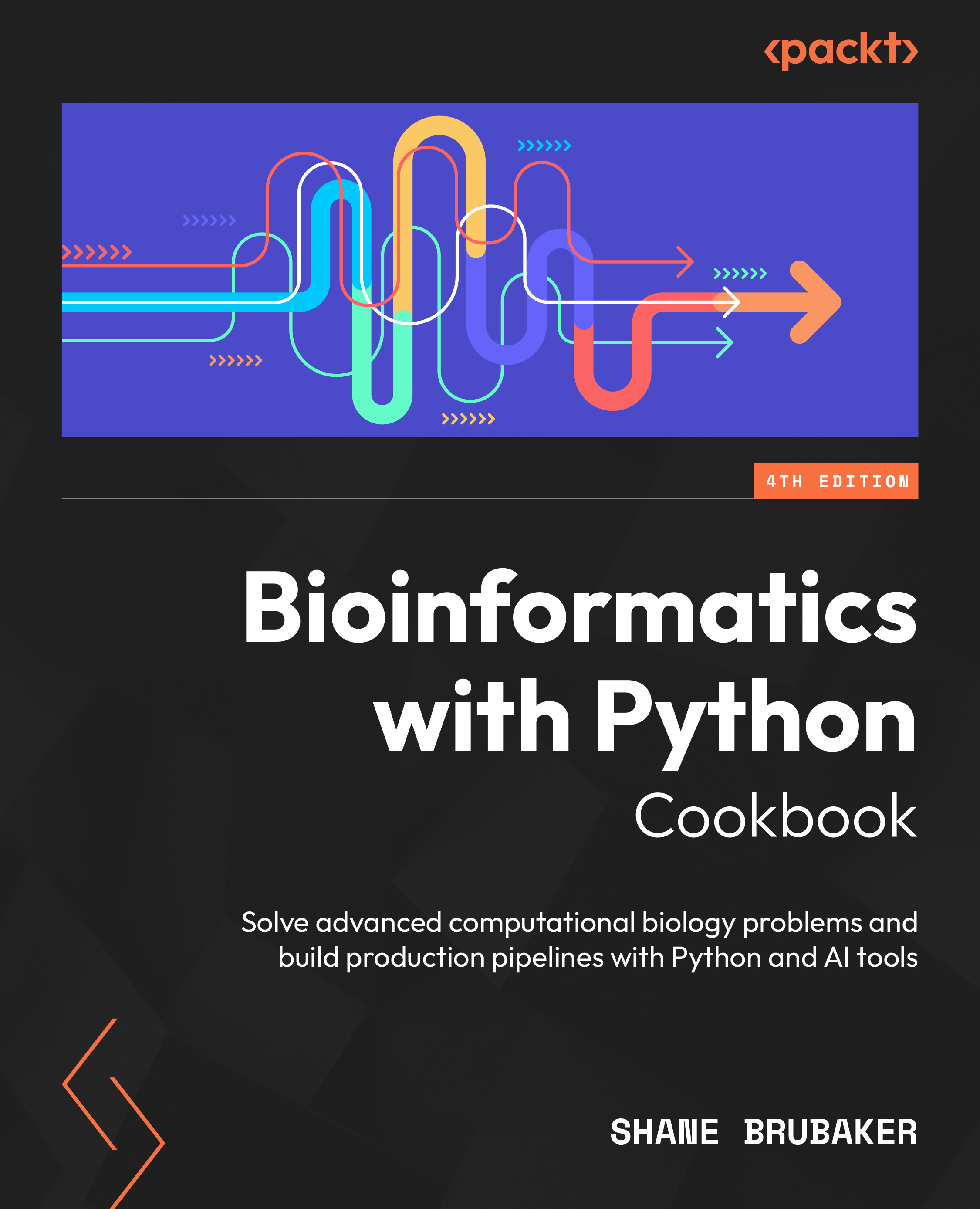
Bioinformatics with Python Cookbook

You're reading from   Bioinformatics with Python Cookbook Solve advanced computational biology problems and build production pipelines with Python and AI tools

Arrow left icon
Product type Paperback
Published in Dec 2025
Publisher Packt
ISBN-13 9781836642756
Length 618 pages
Edition 4th Edition
Languages
Tools
Arrow right icon
Author (1):
Arrow left icon
Shane Brubaker Shane Brubaker
Author Profile Icon Shane Brubaker
Shane Brubaker
Arrow right icon
View More author details
Toc

Table of Contents (22) Chapters Close

Preface 1. Chapter 1: Computer Specifications and Python Setup 2. Chapter 2: Basics of Data Manipulation FREE CHAPTER 3. Chapter 3: Modern Coding Practices and AI-Generated Coding 4. Chapter 4: Data Science and Graphing 5. Chapter 5: Alignment and Variant Calling 6. Chapter 6: Annotation and Biological Interpretation 7. Chapter 7: Genomes and Genome Assembly 8. Chapter 8: Accessing Public Databases 9. Chapter 9: Protein Structure and Proteomics 10. Chapter 10: Phylogenetics 11. Chapter 11: Population Genetics 12. Chapter 12: Metabolic Modeling and Other Applications 13. Chapter 13: Genome Editing 14. Chapter 14: Cloud Basics 15. Chapter 15: Workflow Systems 16. Chapter 16: More Workflow Systems 17. Chapter 17: Deep Learning and LLMs for Nucleic Acid and Protein Design 18. Chapter 18: Single-Cell Technology and Imaging 19. Chapter 19: Unlock Your Exclusive Benefits 20. Index 21. Other Books You May Enjoy

Computing molecular distances on a PDB file

Here, we will find atoms closer to three zincs in the 1TUP model. We will consider several distances to these zincs. We will take this opportunity to discuss the performance of algorithms.In this recipe, we will use the Biopython PDB module to parse and interact with the structure of a protein. We’ll learn how to define a simple distance function to see how close various atoms in the model are from key points in the structure. Finally, we’ll dive into some compute optimization and see how we can make our calculations faster!Knowing how to calculate the molecular distances between various atoms in the protein structure model is important and can be useful for several reasons. First off, it can be used to check various constraints to validate the accuracy of the model. It can be especially important in Protein Engineering when we need to try and find what residues might be close to the Active Site. It can also be used to help understand...

lock icon The rest of the chapter is locked
CONTINUE READING
83
Tech Concepts
36
Programming languages
73
Tech Tools
Icon Unlimited access to the largest independent learning library in tech of over 8,000 expert-authored tech books and videos.
Icon Innovative learning tools, including AI book assistants, code context explainers, and text-to-speech.
Icon 50+ new titles added per month and exclusive early access to books as they are being written.
Bioinformatics with Python Cookbook
Register for a free Packt account to unlock a world of extra content!
A free Packt account unlocks extra newsletters, articles, discounted offers, and much more. Start advancing your knowledge today.
Unlock this book and the full library FREE for 7 days
Get unlimited access to 7000+ expert-authored eBooks and videos courses covering every tech area you can think of
Renews at $19.99/month. Cancel anytime
Modal Close icon
Modal Close icon