Search icon CANCEL
Subscription
0
Cart icon
Your Cart (0 item)
Close icon
You have no products in your basket yet
Save more on your purchases! discount-offer-chevron-icon
Savings automatically calculated. No voucher code required.
Arrow left icon
Explore Products
Best Sellers
New Releases
Books
Videos
Audiobooks
Learning Hub
Newsletter Hub
Free Learning
Arrow right icon
timer SALE ENDS IN
0 Days
:
00 Hours
:
00 Minutes
:
00 Seconds
Arrow up icon
GO TO TOP
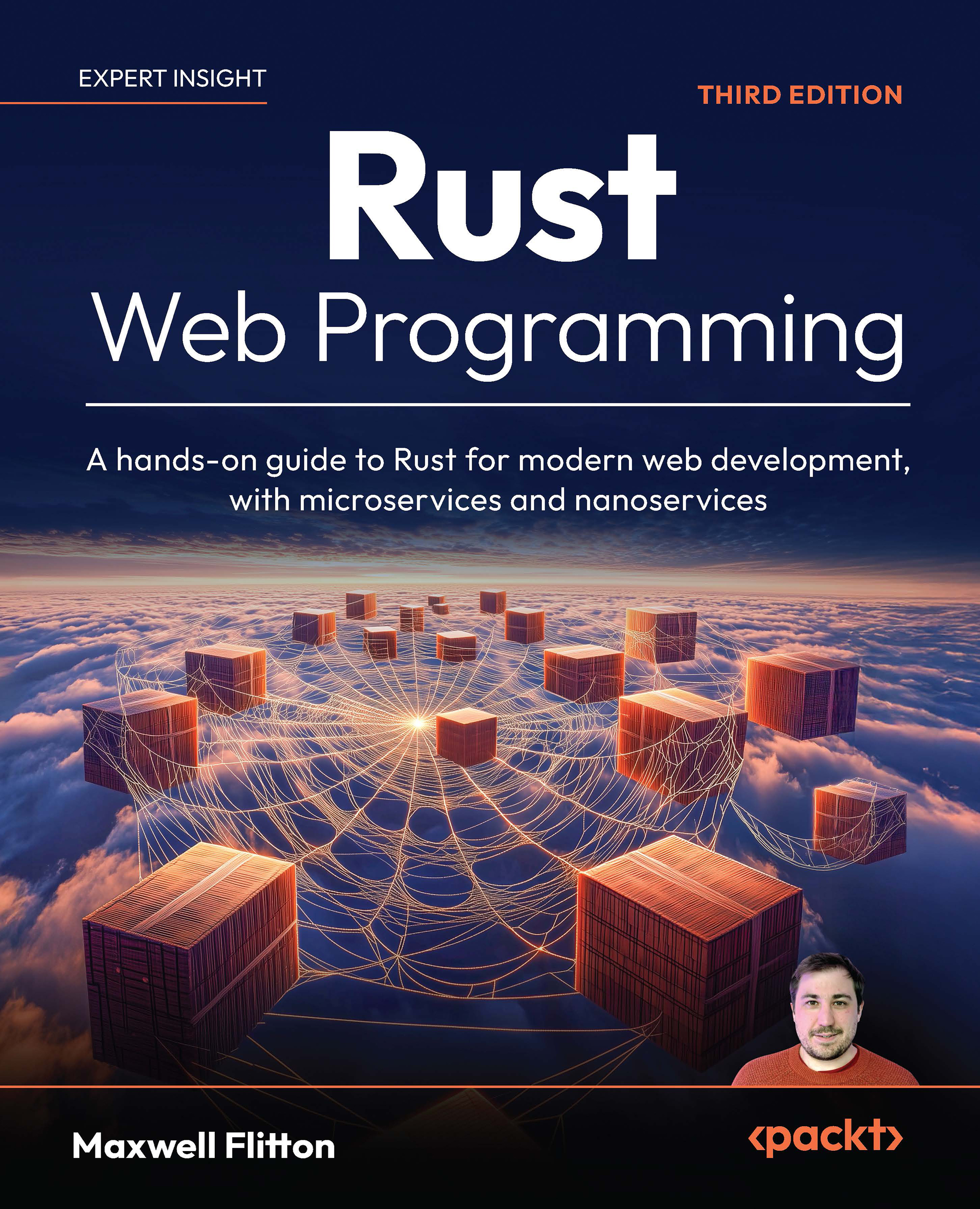
Rust Web Programming

You're reading from   Rust Web Programming A hands-on guide to Rust for modern web development, with microservices and nanoservices

Arrow left icon
Product type Paperback
Published in Jan 2026
Publisher Packt
ISBN-13 9781835887769
Length 674 pages
Edition 3rd Edition
Languages
Arrow right icon
Author (1):
Arrow left icon
Maxwell Flitton Maxwell Flitton
Author Profile Icon Maxwell Flitton
Maxwell Flitton
Arrow right icon
View More author details
Toc

Table of Contents (24) Chapters Close

Preface 1. A Quick Introduction to Rust 2. Useful Rust Patterns for Web Programming FREE CHAPTER 3. Designing Your Web Application in Rust 4. Async Rust 5. Handling HTTP Requests 6. Processing HTTP Requests 7. Displaying Content in the Browser 8. Injecting Rust in the Frontend with WebAssembly 9. Data Persistence with PostgreSQL 10. Managing User Sessions 11. Communicating Between Servers 12. Caching Auth Sessions 13. Observability Through Logging 14. Unit Testing 15. End-to-End Testing 16. Deploying Our Application on AWS 17. Configuring HTTPS with NGINX on AWS 18. Practicalities of Using Microservices and Nanoservices 19. Low-Level Networking 20. Distributed Computing 21. Unlock Your Exclusive Benefits 22. Other Books You May Enjoy
23. Index

What is HTTPS?

So far, our frontend and backend applications have been running through HTTP. However, this is not secure and has some drawbacks. To secure the traffic between our browser and our NGINX server, we are going to have to ensure that our application is using the HTTP/2 protocol. The HTTP/2 protocol has the following differences from the standard HTTP/1 protocol:

  • Binary protocol: HTTP uses a text-based protocol, whereas HTTP/2 uses a binary protocol. A binary protocol uses bytes to transmit data as opposed to human-readable characters, which are encoded using the American Standard Code for Information Interchange (ASCII). Using bytes reduces the number of possible errors and the size needed to transfer data. It will also enable us to encrypt our data stream, which is the basis of HTTPS.
  • Compressed headers: HTTP/2 compresses headers when sending requests. Compressing headers has similar benefits to the binary protocol, which results in a smaller size of data...
lock icon The rest of the chapter is locked
CONTINUE READING
83
Tech Concepts
36
Programming languages
73
Tech Tools
Icon Unlimited access to the largest independent learning library in tech of over 8,000 expert-authored tech books and videos.
Icon Innovative learning tools, including AI book assistants, code context explainers, and text-to-speech.
Icon 50+ new titles added per month and exclusive early access to books as they are being written.
Rust Web Programming
Register for a free Packt account to unlock a world of extra content!
A free Packt account unlocks extra newsletters, articles, discounted offers, and much more. Start advancing your knowledge today.
Unlock this book and the full library FREE for 7 days
Get unlimited access to 7000+ expert-authored eBooks and videos courses covering every tech area you can think of
Renews at $19.99/month. Cancel anytime
Modal Close icon
Modal Close icon