Search icon CANCEL
Subscription
0
Cart icon
Your Cart (0 item)
Close icon
You have no products in your basket yet
Save more on your purchases! discount-offer-chevron-icon
Savings automatically calculated. No voucher code required.
Arrow left icon
Explore Products
Best Sellers
New Releases
Books
Events
Videos
Audiobooks
Packt Hub
Free Learning
Arrow right icon
timer SALE ENDS IN
0 Days
:
00 Hours
:
00 Minutes
:
00 Seconds
Arrow up icon
GO TO TOP
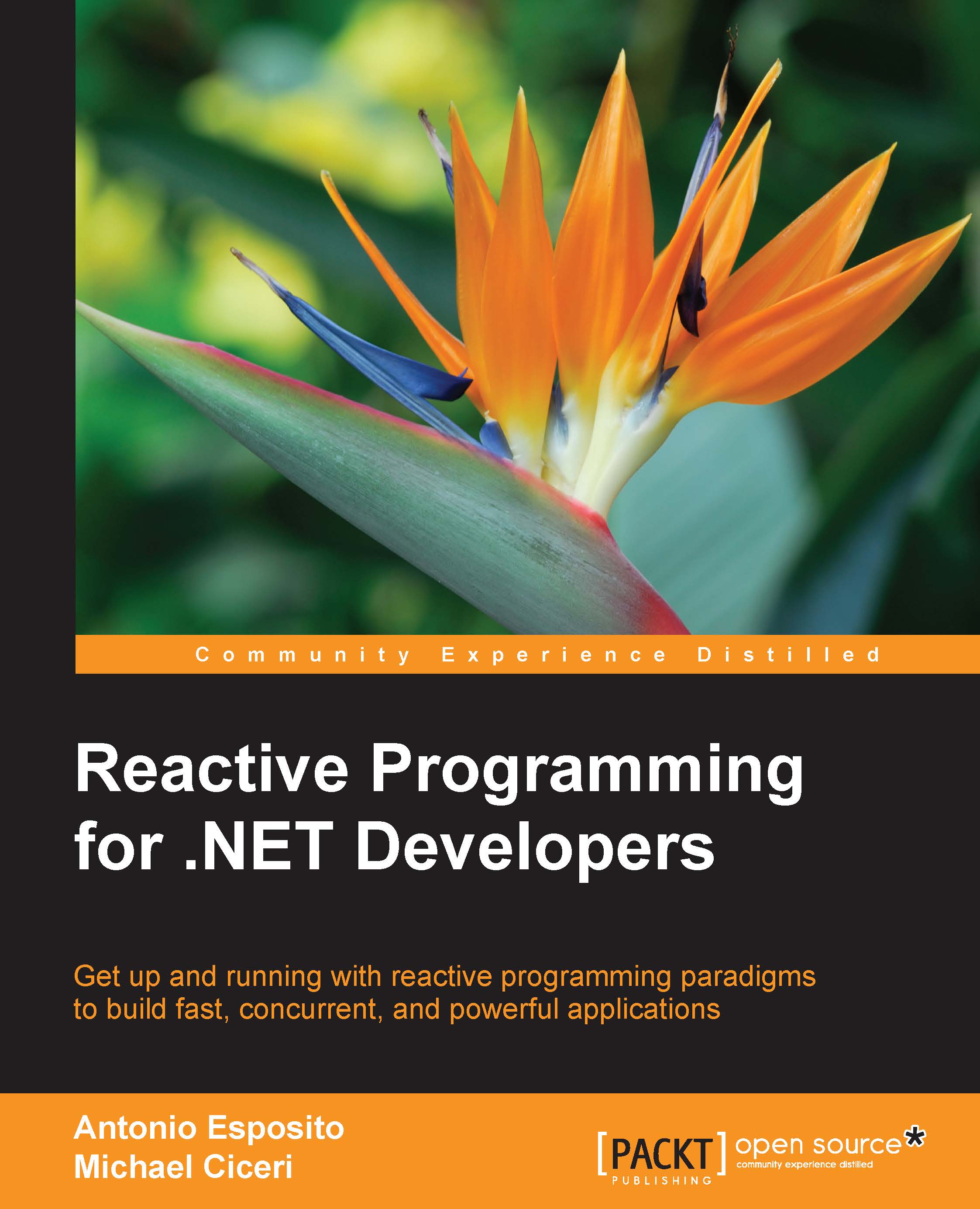
Reactive Programming for .NET Developers

You're reading from   Reactive Programming for .NET Developers Get up and running with reactive programming paradigms to build fast, concurrent, and powerful applications

Arrow left icon
Product type Paperback
Published in Jul 2016
Publisher Packt
ISBN-13 9781785882883
Length 276 pages
Edition 1st Edition
Languages
Tools
Arrow right icon
Authors (2):
Arrow left icon
Antonio Esposito Antonio Esposito
Author Profile Icon Antonio Esposito
Antonio Esposito
 Ciceri Ciceri
Author Profile Icon Ciceri
Ciceri
Arrow right icon
View More author details
Toc

Table of Contents (10) Chapters Close

Preface 1. First Steps Toward Reactive Programming 2. Reactive Programming with C# FREE CHAPTER 3. Reactive Extension Programming 4. Observable Sequence Programming 5. Debugging Reactive Extensions 6. CLR Integration and Scheduling 7. Advanced Techniques 8. F# and Functional Reactive Programming 9. Advanced FRP and Best Practices

Sequence partitioning


Partitioning is the ability to split data into multiple strips.

When dealing with reactive sequences, partitioning means splitting a sourcing sequence into multiple subsequences. The goal may be to maintain message flow consistency when dealing with multiple parallel sequences. In this case, although we may prefer working with data from all the sourcing sequences in a single sequence chain for simplicity and maintainability, at a time, we will need to split the messages from their original flow by grouping them by one (or more) properties.

In reactive programming, we never partition for performance needs (such as parallelizing processing) because this is achieved by default using the reactive framework itself if we use the proper overall design (refer to Chapter 6, CLR Integration and Scheduling, for a more in-depth the argument).

GroupBy

The king of the partitioning functions is the GroupBy one. This is the same within Rx, thus we have the GroupBy extension method that...

lock icon The rest of the chapter is locked
CONTINUE READING
83
Tech Concepts
36
Programming languages
73
Tech Tools
Icon Unlimited access to the largest independent learning library in tech of over 8,000 expert-authored tech books and videos.
Icon Innovative learning tools, including AI book assistants, code context explainers, and text-to-speech.
Icon 50+ new titles added per month and exclusive early access to books as they are being written.
Reactive Programming for .NET Developers
Register for a free Packt account to unlock a world of extra content!
A free Packt account unlocks extra newsletters, articles, discounted offers, and much more. Start advancing your knowledge today.
Unlock this book and the full library FREE for 7 days
Get unlimited access to 7000+ expert-authored eBooks and videos courses covering every tech area you can think of
Renews at £16.99/month. Cancel anytime
Modal Close icon
Modal Close icon