Search icon CANCEL
Subscription
0
Cart icon
Your Cart (0 item)
Close icon
You have no products in your basket yet
Save more on your purchases! discount-offer-chevron-icon
Savings automatically calculated. No voucher code required.
Arrow left icon
Explore Products
Best Sellers
New Releases
Books
Videos
Audiobooks
Learning Hub
Newsletter Hub
Free Learning
Arrow right icon
timer SALE ENDS IN
0 Days
:
00 Hours
:
00 Minutes
:
00 Seconds
Software Architecture with Kotlin

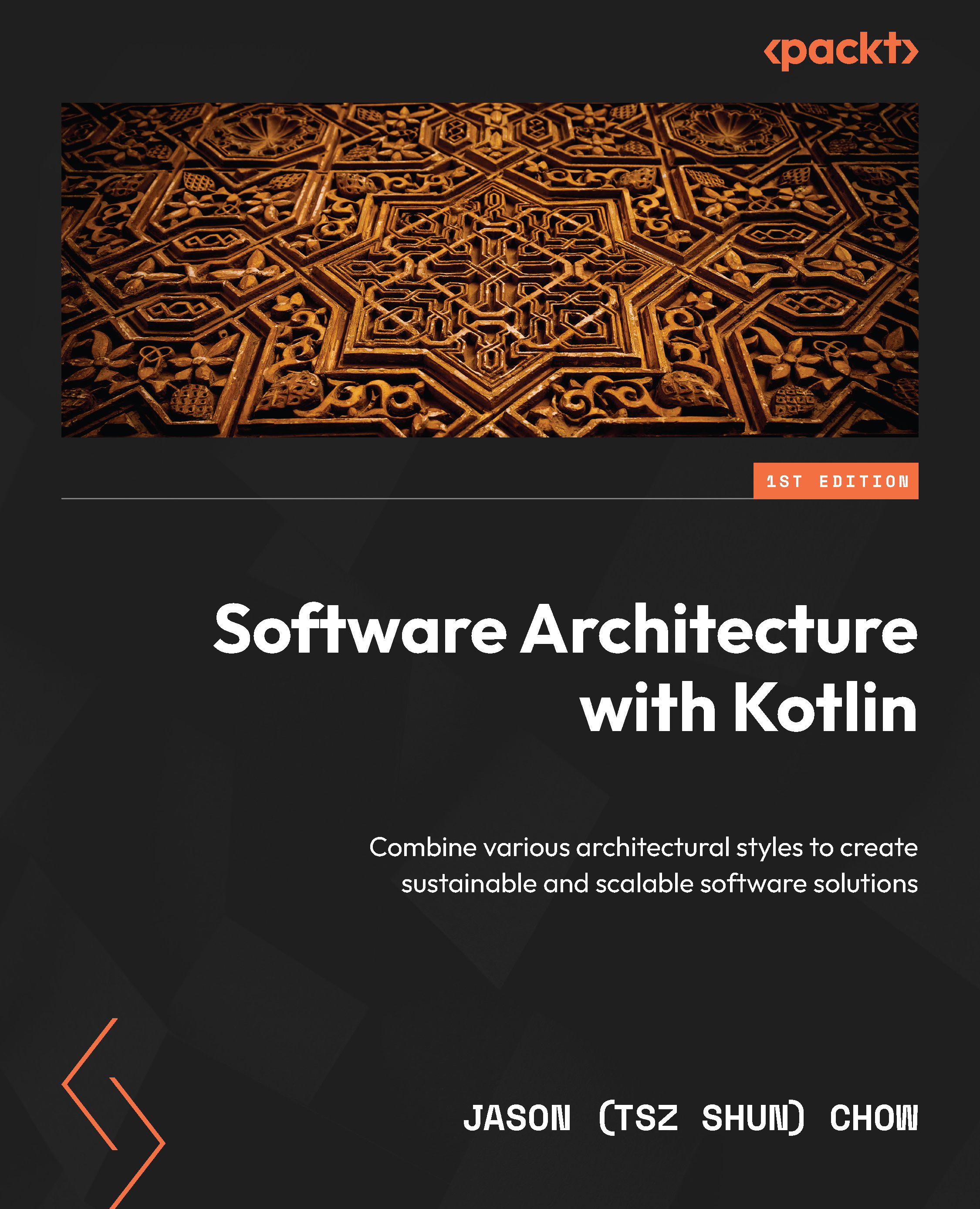
Software Architecture with Kotlin: Combine various architectural styles to create sustainable and scalable software solutions

eBook
€8.98 €23.99
Paperback
€29.99
Subscription
Free Trial
Renews at €18.99p/m

What do you get with Print?

Product feature icon Instant access to your digital copy whilst your Print order is Shipped
Product feature icon Paperback book shipped to your preferred address
Product feature icon Redeem a companion digital copy on all Print orders
Product feature icon Access this title in our online reader with advanced features
Product feature icon DRM FREE - Read whenever, wherever and however you want
Product feature icon AI Assistant (beta) to help accelerate your learning
Modal Close icon
Payment Processing...
tick Completed

Shipping Address

Billing Address

Shipping Methods
Table of content icon View table of contents Preview book icon Preview Book

Software Architecture with Kotlin

Principles of Software Architecture

In this chapter, we are going to cover the fundamental principles of software architecture. They are vitally important to every part of software architecture. We should constantly remind ourselves of these, just like professional pianists practice scales every day.

We’ll go through different ways to describe and view software architecture first. Then we’ll cover a few important principles that will be referenced in later chapters. It is intended that you might go back to this chapter anytime and contemplate again some of these key concepts.

  • Perspectives, dimensions, and qualities
  • Separation of concerns, cohesiveness, and coupling
  • SOLID principles
  • YAGNI and future-proof architecture
  • The Law of Demeter

Technical requirements

You can find all the code files used in this chapter on GitHub: https://github.com/Packt Publishing/Software-Architecture-with-Kotlin/tree/main/chapter-2

Perspectives, dimensions, and qualities

Software systems are not physical objects that we can easily see or touch. At their roots, they are instructions that are interpreted by a machine. So, we will need to visualize software systems in other ways.

The major purpose of visualizing software systems is to demonstrate how stakeholder concerns are addressed. There is usually a lengthy list of concerns. Each stakeholder usually has multiple concerns at various levels of abstraction. It is not possible to address all concerns from all angles in one visual representation.

The concept of View was introduced in the 1970s to describe software architecture. Since then, there have been numerous efforts to codify and standardize methods in describing software architecture. ISO/IEC/IEEE 42010:2022 is the current standard in specifying software architecture, by which the architectural concepts, structure, and language are defined.

In a View, only selected perspectives of software architecture...

Separation of concerns, cohesiveness, and coupling

A system is composed of many components and the interconnections among them. The ability to group and separate elements in the system has become a crucial factor in ensuring it is maintainable, reusable, and extendable. We are going to cover three fundamental concepts that will help us group and separate elements appropriately, namely separation of concerns, cohesiveness, and coupling.

Separation of concerns

Separation of concerns is a fundamental principle that we should apply in every corner of the system. It is a principle that advocates segregating the system into independent components and having each component address a specific concern. Separation of concerns aims at creating a system that is easier to maintain, reason, and update, and which can adapt to changes in requirements over time.

Let us take the following scenario as an example: the submission of a draft service exchange contract from a household’s browser...

SOLID principles

The SOLID principles are a set of five software architecture principles that advocate for creating maintainable, understandable, flexible, and modular software. Though they were originally targeted at object-oriented software, the concepts behind them are useful and can be applied to systems other than object orientation.

These concepts were first introduced by Robert J. Martin in his Design Principles and Design Patterns paper in 2000. However, the SOLID acronym was introduced later by Michael Feathers.

The acronym SOLID stands for the following:

  • Single Responsibility Principle (SRP)
  • Open-Closed Principle (OCP)
  • Liskov Substitution Principle (LSP)
  • Interface Segregation Principle (ISP)
  • Dependency Inversion Principle (DIP)

We will walk through each of them and use the concepts that we have covered for discussion.

SRP

The SRP states that a class should have one responsibility or concern, and only one. There is only one reason...

The Law of Demeter

The Law of Demeter, or the principle of least knowledge, states that a software component should have limited knowledge about the inner details of other components. More specifically, a component should not know about the internal details of another component.

Let us say there is a function that returns the city in the address of a person:

class Person(val name: String, val address: Address) {
    fun getAddressCity(): String {
        return address.city
    }
}
class Address(val city: String)

The Person class directly accesses the city property inside the Address class. The Person class should not have this knowledge, as this is a violation of the Law of Demeter.

This creates a coupling between Person and Address. The coupling dictates that if the city property changes its data type, then both classes will need to change. It also means that the code change is bigger than...

YAGNI and future-proof architecture

You Ain’t Gonna Need It (YAGNI) is a principle that states that functionalities should not be implemented until they are needed. This principle came from Extreme Programming (XP) as an approach to improve software quality and respond to changing business requirements.

This principle is also related to the idea of minimalism in software development, which states that we should avoid unnecessary code and complexity in exchange for clean, easy-to-understand, and extensible software.

Another way to describe YAGNI is as the imperative to do the simplest thing that works. This is by no means an incomplete design or unfulfilled user requirement. It still promotes complete and functional software that satisfies user requirements with the simplest design available.

YAGNI aims at a few practices:

  • Simple and lean code base: By implementing only what is necessary now, a lot of complexity can be avoided. As a result, the code base is simple...

Summary

We have covered the 4+1 architecture view model, as well as system quality attributes, separation of concerns, cohesiveness, coupling, the SOLID principles, and the Law of Demeter. We have demonstrated them with code examples. These demonstrated that adhering to these principles lets the code become modular, flexible, maintainable, extensible, and easy to understand.

We have also discussed the conflicting concepts of the YAGNI principle and future-proof architecture. We clarified what future-proofing is and how it is different from capacity planning.

In the next chapter, we will explore polymorphism and its alternative approaches.

Left arrow icon Right arrow icon
Download code icon Download Code

Key benefits

  • Learn how to analyze and dissect various architectural styles into building blocks
  • Combine existing ideas with your own to create custom solutions
  • Make informed decisions by navigating trade-offs and compromises
  • Purchase of the print or Kindle book includes a free PDF eBook

Description

Software Architecture with Kotlin explores the various styles of software architecture with a focus on using the Kotlin programming language. The author draws on their 20+ years of industry experience in developing large-scale enterprise distributed systems to help you grasp the principles, practices, and patterns that shape the architectural landscape of modern software systems. The book establishes a strong foundation in software architecture, explaining key concepts such as architectural qualities and principles, before teaching you how architectural decisions impact the quality of a system, such as scalability, reliability, and extendability. The chapters address modern architecture topics such as microservices, serverless, and event-driven architectures, providing insights into the challenges and trade-offs involved in adopting these architectural styles. You’ll also discover practical tools that’ll help you make informed decisions and mitigate risks. All architectural patterns in this book are demonstrated using Kotlin. By the end of this book, you’ll have gained practical expertise by using real-world examples, along with a solid understanding of Kotlin, to become a more proficient and impactful software architect.

Who is this book for?

This book is for developers with basic Kotlin knowledge seeking a deeper understanding of architecture, Kotlin Android developers who are starting to get involved in backend development, and Java developers transitioning to Kotlin. It's also ideal for software architects who are less experienced in Kotlin and want to enhance their skills, as well as those who enjoy discussing and exploring unique architectural concepts.

What you will learn

  • Master the fundamental principles of architecture and design
  • Explore common architectural styles and their applicable scenarios
  • Analyze, break down, compare, and design architectural styles to solve practical problems
  • Reason, negotiate, and make difficult choices in the absence of ideal solutions
  • Mitigate risks when making compromises and trade-offs
  • Create scalable, sustainable, maintainable, and extendable software systems
  • Use the Kotlin programming language to achieve your architectural goals
Estimated delivery fee Deliver to Finland

Premium delivery 7 - 10 business days

€17.95
(Includes tracking information)

Product Details

Country selected
Publication date, Length, Edition, Language, ISBN-13
Publication date : Dec 31, 2024
Length: 462 pages
Edition : 1st
Language : English
ISBN-13 : 9781835461860
Category :
Languages :

What do you get with Print?

Product feature icon Instant access to your digital copy whilst your Print order is Shipped
Product feature icon Paperback book shipped to your preferred address
Product feature icon Redeem a companion digital copy on all Print orders
Product feature icon Access this title in our online reader with advanced features
Product feature icon DRM FREE - Read whenever, wherever and however you want
Product feature icon AI Assistant (beta) to help accelerate your learning
Modal Close icon
Payment Processing...
tick Completed

Shipping Address

Billing Address

Shipping Methods
Estimated delivery fee Deliver to Finland

Premium delivery 7 - 10 business days

€17.95
(Includes tracking information)

Product Details

Publication date : Dec 31, 2024
Length: 462 pages
Edition : 1st
Language : English
ISBN-13 : 9781835461860
Category :
Languages :

Packt Subscriptions

See our plans and pricing
Modal Close icon
€18.99 billed monthly
Feature tick icon Unlimited access to Packt's library of 7,000+ practical books and videos
Feature tick icon Constantly refreshed with 50+ new titles a month
Feature tick icon Exclusive Early access to books as they're written
Feature tick icon Solve problems while you work with advanced search and reference features
Feature tick icon Offline reading on the mobile app
Feature tick icon Simple pricing, no contract
€189.99 billed annually
Feature tick icon Unlimited access to Packt's library of 7,000+ practical books and videos
Feature tick icon Constantly refreshed with 50+ new titles a month
Feature tick icon Exclusive Early access to books as they're written
Feature tick icon Solve problems while you work with advanced search and reference features
Feature tick icon Offline reading on the mobile app
Feature tick icon Choose a DRM-free eBook or Video every month to keep
Feature tick icon PLUS own as many other DRM-free eBooks or Videos as you like for just €5 each
Feature tick icon Exclusive print discounts
€264.99 billed in 18 months
Feature tick icon Unlimited access to Packt's library of 7,000+ practical books and videos
Feature tick icon Constantly refreshed with 50+ new titles a month
Feature tick icon Exclusive Early access to books as they're written
Feature tick icon Solve problems while you work with advanced search and reference features
Feature tick icon Offline reading on the mobile app
Feature tick icon Choose a DRM-free eBook or Video every month to keep
Feature tick icon PLUS own as many other DRM-free eBooks or Videos as you like for just €5 each
Feature tick icon Exclusive print discounts

Table of Contents

17 Chapters
Chapter 1: The Essence of Software Architecture Chevron down icon Chevron up icon
Chapter 2: Principles of Software Architecture Chevron down icon Chevron up icon
Chapter 3: Polymorphism and Alternatives Chevron down icon Chevron up icon
Chapter 4: Peer-to-Peer and Client-Server Architecture Chevron down icon Chevron up icon
Chapter 5: Exploring MVC, MVP, and MVVM Chevron down icon Chevron up icon
Chapter 6: Microservices, Serverless, and Microfrontends Chevron down icon Chevron up icon
Chapter 7: Modular and Layered Architectures Chevron down icon Chevron up icon
Chapter 8: Domain-Driven Design (DDD) Chevron down icon Chevron up icon
Chapter 9: Event Sourcing and CQRS Chevron down icon Chevron up icon
Chapter 10: Idempotency, Replication, and Recovery Models Chevron down icon Chevron up icon
Chapter 11: Auditing and Monitoring Models Chevron down icon Chevron up icon
Chapter 12: Performance and Scalability Chevron down icon Chevron up icon
Chapter 13: Testing Chevron down icon Chevron up icon
Chapter 14: Security Chevron down icon Chevron up icon
Chapter 15: Beyond Architecture Chevron down icon Chevron up icon
Index Chevron down icon Chevron up icon
Other Books You May Enjoy Chevron down icon Chevron up icon

Customer reviews

Rating distribution
Full star icon Full star icon Full star icon Full star icon Half star icon 4.3
(3 Ratings)
5 star 33.3%
4 star 66.7%
3 star 0%
2 star 0%
1 star 0%
Tiny Feb 05, 2025
Full star icon Full star icon Full star icon Full star icon Full star icon 5
The book provides an excellent overview of software architecture combined with Kotlin examples. If you currently use Kotlin, this can certainly help advance the case. In terms of software architecture explanations, it is probably one of the most comprehensive I've seen in a while. My one argument is there wasn't any comparison between Kotlin and other systems, some comparison would have been helpful. Overall, this makes an excellent reference for any software architecture questions working from the high level context all the way down to the code. Read more
Amazon Verified review Amazon
Om S Jan 24, 2025
Full star icon Full star icon Full star icon Full star icon Empty star icon 4
This book provides a solid introduction to software architecture, blending theory with practical examples using Kotlin. It covers a range of architectural styles, including microservices, event-driven design, and serverless, while highlighting the trade-offs and challenges involved in real-world applications. Read more
Amazon Verified review Amazon
David K. Lee Jan 20, 2025
Full star icon Full star icon Full star icon Full star icon Empty star icon 4
This book shows all the things in the software architecture in Kotlin. Proper code examples can help users understand the design concepts at hand. The one impressive thing is explaining sealed classes and delegation for Polymorphism. It should be helpful for my Android development in Kotlin. Read more
Amazon Verified review Amazon
Get free access to Packt library with over 7500+ books and video courses for 7 days!
Start Free Trial

FAQs

What is the digital copy I get with my Print order? Chevron down icon Chevron up icon

When you buy any Print edition of our Books, you can redeem (for free) the eBook edition of the Print Book you’ve purchased. This gives you instant access to your book when you make an order via PDF, EPUB or our online Reader experience.

What is the delivery time and cost of print book? Chevron down icon Chevron up icon

Shipping Details

USA:

'

Economy: Delivery to most addresses in the US within 10-15 business days

Premium: Trackable Delivery to most addresses in the US within 3-8 business days

UK:

Economy: Delivery to most addresses in the U.K. within 7-9 business days.
Shipments are not trackable

Premium: Trackable delivery to most addresses in the U.K. within 3-4 business days!
Add one extra business day for deliveries to Northern Ireland and Scottish Highlands and islands

EU:

Premium: Trackable delivery to most EU destinations within 4-9 business days.

Australia:

Economy: Can deliver to P. O. Boxes and private residences.
Trackable service with delivery to addresses in Australia only.
Delivery time ranges from 7-9 business days for VIC and 8-10 business days for Interstate metro
Delivery time is up to 15 business days for remote areas of WA, NT & QLD.

Premium: Delivery to addresses in Australia only
Trackable delivery to most P. O. Boxes and private residences in Australia within 4-5 days based on the distance to a destination following dispatch.

India:

Premium: Delivery to most Indian addresses within 5-6 business days

Rest of the World:

Premium: Countries in the American continent: Trackable delivery to most countries within 4-7 business days

Asia:

Premium: Delivery to most Asian addresses within 5-9 business days

Disclaimer:
All orders received before 5 PM U.K time would start printing from the next business day. So the estimated delivery times start from the next day as well. Orders received after 5 PM U.K time (in our internal systems) on a business day or anytime on the weekend will begin printing the second to next business day. For example, an order placed at 11 AM today will begin printing tomorrow, whereas an order placed at 9 PM tonight will begin printing the day after tomorrow.


Unfortunately, due to several restrictions, we are unable to ship to the following countries:

  1. Afghanistan
  2. American Samoa
  3. Belarus
  4. Brunei Darussalam
  5. Central African Republic
  6. The Democratic Republic of Congo
  7. Eritrea
  8. Guinea-bissau
  9. Iran
  10. Lebanon
  11. Libiya Arab Jamahriya
  12. Somalia
  13. Sudan
  14. Russian Federation
  15. Syrian Arab Republic
  16. Ukraine
  17. Venezuela
What is custom duty/charge? Chevron down icon Chevron up icon

Customs duty are charges levied on goods when they cross international borders. It is a tax that is imposed on imported goods. These duties are charged by special authorities and bodies created by local governments and are meant to protect local industries, economies, and businesses.

Do I have to pay customs charges for the print book order? Chevron down icon Chevron up icon

The orders shipped to the countries that are listed under EU27 will not bear custom charges. They are paid by Packt as part of the order.

List of EU27 countries: www.gov.uk/eu-eea:

A custom duty or localized taxes may be applicable on the shipment and would be charged by the recipient country outside of the EU27 which should be paid by the customer and these duties are not included in the shipping charges been charged on the order.

How do I know my custom duty charges? Chevron down icon Chevron up icon

The amount of duty payable varies greatly depending on the imported goods, the country of origin and several other factors like the total invoice amount or dimensions like weight, and other such criteria applicable in your country.

For example:

  • If you live in Mexico, and the declared value of your ordered items is over $ 50, for you to receive a package, you will have to pay additional import tax of 19% which will be $ 9.50 to the courier service.
  • Whereas if you live in Turkey, and the declared value of your ordered items is over € 22, for you to receive a package, you will have to pay additional import tax of 18% which will be € 3.96 to the courier service.
How can I cancel my order? Chevron down icon Chevron up icon

Cancellation Policy for Published Printed Books:

You can cancel any order within 1 hour of placing the order. Simply contact customercare@packt.com with your order details or payment transaction id. If your order has already started the shipment process, we will do our best to stop it. However, if it is already on the way to you then when you receive it, you can contact us at customercare@packt.com using the returns and refund process.

Please understand that Packt Publishing cannot provide refunds or cancel any order except for the cases described in our Return Policy (i.e. Packt Publishing agrees to replace your printed book because it arrives damaged or material defect in book), Packt Publishing will not accept returns.

What is your returns and refunds policy? Chevron down icon Chevron up icon

Return Policy:

We want you to be happy with your purchase from Packtpub.com. We will not hassle you with returning print books to us. If the print book you receive from us is incorrect, damaged, doesn't work or is unacceptably late, please contact Customer Relations Team on customercare@packt.com with the order number and issue details as explained below:

  1. If you ordered (eBook, Video or Print Book) incorrectly or accidentally, please contact Customer Relations Team on customercare@packt.com within one hour of placing the order and we will replace/refund you the item cost.
  2. Sadly, if your eBook or Video file is faulty or a fault occurs during the eBook or Video being made available to you, i.e. during download then you should contact Customer Relations Team within 14 days of purchase on customercare@packt.com who will be able to resolve this issue for you.
  3. You will have a choice of replacement or refund of the problem items.(damaged, defective or incorrect)
  4. Once Customer Care Team confirms that you will be refunded, you should receive the refund within 10 to 12 working days.
  5. If you are only requesting a refund of one book from a multiple order, then we will refund you the appropriate single item.
  6. Where the items were shipped under a free shipping offer, there will be no shipping costs to refund.

On the off chance your printed book arrives damaged, with book material defect, contact our Customer Relation Team on customercare@packt.com within 14 days of receipt of the book with appropriate evidence of damage and we will work with you to secure a replacement copy, if necessary. Please note that each printed book you order from us is individually made by Packt's professional book-printing partner which is on a print-on-demand basis.

What tax is charged? Chevron down icon Chevron up icon

Currently, no tax is charged on the purchase of any print book (subject to change based on the laws and regulations). A localized VAT fee is charged only to our European and UK customers on eBooks, Video and subscriptions that they buy. GST is charged to Indian customers for eBooks and video purchases.

What payment methods can I use? Chevron down icon Chevron up icon

You can pay with the following card types:

  1. Visa Debit
  2. Visa Credit
  3. MasterCard
  4. PayPal
What is the delivery time and cost of print books? Chevron down icon Chevron up icon

Shipping Details

USA:

'

Economy: Delivery to most addresses in the US within 10-15 business days

Premium: Trackable Delivery to most addresses in the US within 3-8 business days

UK:

Economy: Delivery to most addresses in the U.K. within 7-9 business days.
Shipments are not trackable

Premium: Trackable delivery to most addresses in the U.K. within 3-4 business days!
Add one extra business day for deliveries to Northern Ireland and Scottish Highlands and islands

EU:

Premium: Trackable delivery to most EU destinations within 4-9 business days.

Australia:

Economy: Can deliver to P. O. Boxes and private residences.
Trackable service with delivery to addresses in Australia only.
Delivery time ranges from 7-9 business days for VIC and 8-10 business days for Interstate metro
Delivery time is up to 15 business days for remote areas of WA, NT & QLD.

Premium: Delivery to addresses in Australia only
Trackable delivery to most P. O. Boxes and private residences in Australia within 4-5 days based on the distance to a destination following dispatch.

India:

Premium: Delivery to most Indian addresses within 5-6 business days

Rest of the World:

Premium: Countries in the American continent: Trackable delivery to most countries within 4-7 business days

Asia:

Premium: Delivery to most Asian addresses within 5-9 business days

Disclaimer:
All orders received before 5 PM U.K time would start printing from the next business day. So the estimated delivery times start from the next day as well. Orders received after 5 PM U.K time (in our internal systems) on a business day or anytime on the weekend will begin printing the second to next business day. For example, an order placed at 11 AM today will begin printing tomorrow, whereas an order placed at 9 PM tonight will begin printing the day after tomorrow.


Unfortunately, due to several restrictions, we are unable to ship to the following countries:

  1. Afghanistan
  2. American Samoa
  3. Belarus
  4. Brunei Darussalam
  5. Central African Republic
  6. The Democratic Republic of Congo
  7. Eritrea
  8. Guinea-bissau
  9. Iran
  10. Lebanon
  11. Libiya Arab Jamahriya
  12. Somalia
  13. Sudan
  14. Russian Federation
  15. Syrian Arab Republic
  16. Ukraine
  17. Venezuela
Modal Close icon
Modal Close icon