The future of GenAI isn’t about better prompts. It’s about building systems that can complete reliable, end-to-end workflows.
For the past two years, much of the conversation around GenAI has focused on prompting.
How do you write better prompts? Which model performs best? How can you make responses sound more intelligent?
Those questions matter, but they miss a larger shift that’s already happening.
The next generation of GenAI applications won’t be evaluated by how well they answer a single question. They’ll be evaluated by whether they can reliably complete an entire workflow from start to finish.
That is a fundamentally different engineering problem.
Register for the Workshop →Build Your Financial AI Analyst
From Answers to Actions
Consider a Financial AI Analyst.
A typical chatbot can answer questions about a company using what it already knows or by retrieving a few relevant document chunks. That might be enough for a demo.
It isn’t enough for a system someone can actually trust.
A production-ready financial assistant needs to do far more than generate text. It needs to gather evidence, perform calculations, validate results, and explain its reasoning before arriving at a conclusion.
A typical workflow might look like this:
◾Retrieve the latest annual report.
◾Identify the relevant financial statements.
◾Extract revenue, cash flow, margins, and debt figures.
◾Connect to a live market data API.
◾Calculate returns, volatility, valuation ratios, and trends using Python.
◾Compare results against previous reporting periods or competitors.
◾Generate a clear, source-backed explanation.
◾Each step depends on a different capability.
RAG retrieves relevant information from enterprise documents. APIs provide live external data. Python performs deterministic calculations that shouldn’t be delegated to an LLM. The language model orchestrates these components, deciding which tools to use, when additional information is required, and how to communicate the final result.
This is what modern AI engineering increasingly looks like.
AI Systems Are Becoming Workflow Engines
Rather than relying on one large prompt and hoping for the best, developers are designing AI applications as structured workflows.
These systems retrieve information, call tools, execute code, validate intermediate results, and adapt their next actions based on what they discover.
The LLM becomes one component within a larger orchestration layer rather than the entire application.
This shift is enabling developers to build AI assistants that are significantly more useful because they can interact with external systems, perform real computations, and produce grounded outputs instead of plausible-sounding guesses.
But it also introduces a new challenge.
Every Additional Step Creates New Failure Points
Unlock access to the largest independent learning library in Tech for FREE!
Get unlimited access to 7500+ expert-authored eBooks and video courses covering every tech area you can think of.
Renews at $19.99/month. Cancel anytime
The more capable an AI workflow becomes, the more opportunities there are for things to go wrong.
The system might retrieve the wrong document.
It could extract an incorrect financial value.
An API might return incomplete data.
A calculation could be performed using outdated inputs.
Or the model might confidently generate a conclusion that isn’t actually supported by the evidence it collected.
These aren’t isolated problems. They’re engineering challenges that emerge whenever multiple tools, data sources, and reasoning steps are combined into a single application.
That’s why modern AI workflows require more than good prompts.
They require evaluations, structured outputs, source verification, guardrails, prompt injection defenses, and mechanisms that make every step observable and testable.
Reliability isn’t something that’s added after deployment. It has to be designed into the workflow from the beginning.
Register for the Workshop →Build Your Financial AI Analyst
Building AI Systems You Can Trust
As enterprises move beyond experimentation, the definition of a successful GenAI application is changing.
It’s no longer enough for a model to produce an impressive answer.
The entire process behind that answer needs to be transparent, repeatable, and reliable enough to support real business decisions.
That’s where workflow-driven AI engineering is headed — and it’s rapidly becoming one of the most valuable skills for data scientists, ML engineers, and AI practitioners building production systems.
Build One Yourself
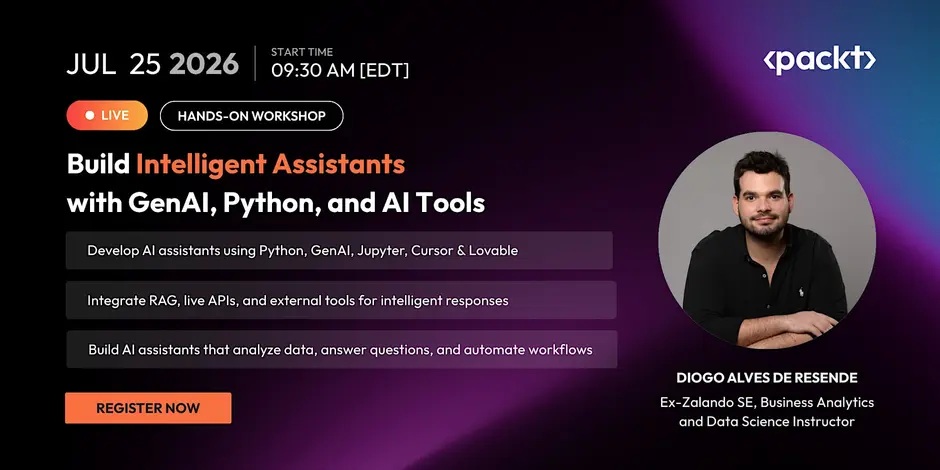
In my upcoming live workshop,Build Intelligent Assistants with GenAI, Python & AI Tools, we’ll move beyond theory and build a production-ready Financial AI Analyst from scratch.
Together, we’ll build an end-to-end workflow that combines:
◾GenAI and modern LLMs
◾Python for deterministic financial analysis
◾Retrieval-Augmented Generation (RAG)
◾Live market data APIs
◾Jupyter Notebook
◾Cursor
◾Lovable
Along the way, we’ll explore how to integrate retrieval, tool use, evaluations, guardrails, and prompt injection defenses into AI workflows that are designed for real-world reliability rather than simple demonstrations.
If you’re looking to move beyond chatbot prototypes and start building production-ready AI assistants, this workshop is designed to give you a practical architecture you can reuse across financial analysis, enterprise copilots, and intelligent business applications.
📅 Live Online Workshop
Build Intelligent Assistants with GenAI, Python & AI Tools
Saturday, July 25 | 7:00 PM–11:00 PM GMT+5
Join us to build a complete Financial AI Analyst and gain hands-on experience with the tools, workflows, and engineering practices powering the next generation of GenAI applications.
Register for the Workshop →Build Your Financial AI Analyst


 United States

 Great Britain
 India
India
 Germany
 France
 Canada
 Russia
 Spain
Spain
 Brazil
 Australia
 Singapore
 Canary Islands
 Hungary
 Ukraine
 Luxembourg
 Estonia
 Lithuania
 South Korea
 Turkey
 Switzerland
 Colombia
 Taiwan
 Chile
Chile
 Norway
 Ecuador
 Indonesia
 New Zealand
 Cyprus
 Denmark
 Finland
 Poland
 Malta
Malta
 Czechia
 Austria
 Sweden
 Italy
Italy
 Egypt
Egypt
 Belgium
 Portugal
 Slovenia
 Ireland
 Romania
 Greece
 Argentina
 Netherlands
 Bulgaria
 Latvia
 South Africa
 Malaysia
 Japan
Japan
 Slovakia
 Philippines
 Mexico
 Thailand