

Introducing this book and its siblings
Before we dive in, let’s set the context by understanding that this is one of four books about .NET 10 that I have written that cover almost everything a beginner to .NET needs to know.
This book is the second of a quartet of books that completes your learning journey through .NET 10:
- The first book, C# 14 and .NET 10 – Modern Cross-Platform Development Fundamentals, covers the fundamentals of the C# language, the .NET libraries, and using modern ASP.NET Core, Blazor, and Minimal API web services for web development. It is designed to be read linearly because skills and knowledge from earlier chapters build up and are needed to understand later chapters.
- The second book (the one you’re reading now), Real-World Web Development with .NET 10, covers mature and proven web development technologies like ASP.NET Core MVC and controller-based Web API web services, as well as OData, FastEndpoints, and Umbraco CMS for building real-world web projects on .NET 10. You will learn how to test your web services using xUnit and test the user interfaces of your websites using Playwright, and then how to containerize your projects ready for deployment.
- The third book, Apps and Services with .NET 10, covers data using SQL Server, Dapper, and EF Core, as well as more specialized .NET libraries like internationalization and popular third-party packages including Serilog and Noda Time. You will learn how to build native ahead-of-time (AOT)-compiled services with ASP.NET Core Minimal API web services and how to improve performance, scalability, and reliability using caching, queues, and background services. You will implement modern services using GraphQL, gRPC, and SignalR. Finally, you will learn how to build graphical user interfaces for websites, desktop, and mobile apps with .NET MAUI, Avalonia, and Blazor.
- The fourth book, Tools and Skills for .NET 10, covers important tools and skills that a professional .NET developer should have. These include design patterns and solution architecture, debugging, memory analysis, all the important types of testing, whether it be unit, integration, performance, or web user interface testing, and then topics for testing cloud-native solutions on your local computer, like containerization, Docker, and Aspire. Finally, we will look at how to prepare for an interview to get the .NET developer career that you want.
A summary of the .NET 10 quartet and their most important topics is shown in Figure 1.1:
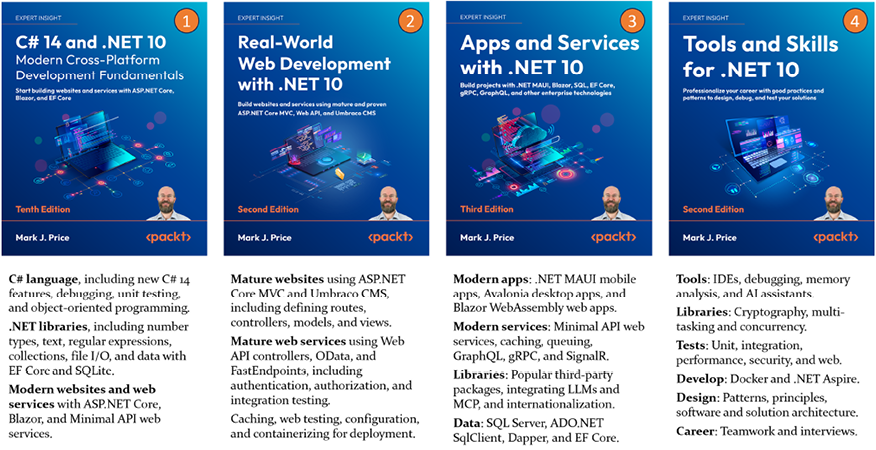
Figure 1.1: Companion books for learning .NET for beginner-to-intermediate readers
Now, let’s review some of the history of web development using .NET, which means learning about one of its most important platforms, ASP.NET Core.