Search icon CANCEL
Subscription
0
Cart icon
Your Cart (0 item)
Close icon
You have no products in your basket yet
Save more on your purchases! discount-offer-chevron-icon
Savings automatically calculated. No voucher code required.
Arrow left icon
Explore Products
Best Sellers
New Releases
Books
Videos
Audiobooks
Learning Hub
Newsletter Hub
Free Learning
Arrow right icon
timer SALE ENDS IN
0 Days
:
00 Hours
:
00 Minutes
:
00 Seconds
Arrow up icon
GO TO TOP
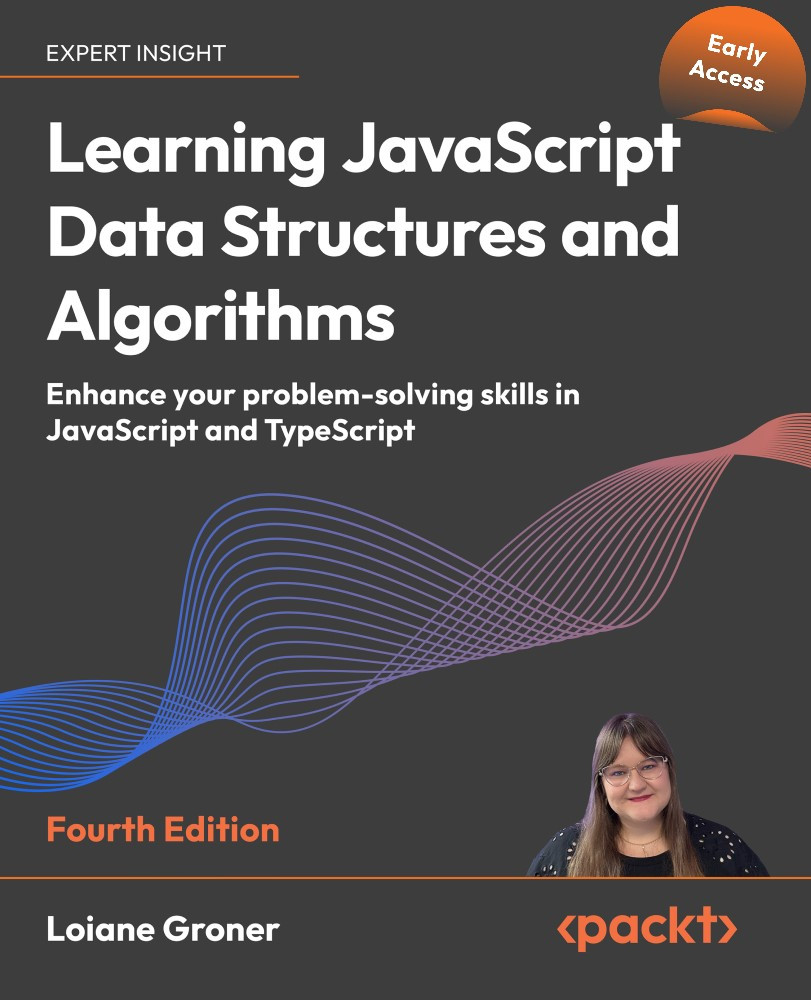
Learning JavaScript Data Structures and Algorithms

You're reading from   Learning JavaScript Data Structures and Algorithms Enhance your problem-solving skills in JavaScript and TypeScript

Arrow left icon
Product type Paperback
Published in Sep 2026
Publisher Packt
ISBN-13 9781836205395
Length 615 pages
Edition 4th Edition
Languages
Arrow right icon
Author (1):
Arrow left icon
Loiane Groner Loiane Groner
Author Profile Icon Loiane Groner
Loiane Groner
Arrow right icon
View More author details
Toc

Table of Contents (9) Chapters Close

Learning JavaScript Data Structures and Algorithms, Fourth Edition: Enhance your problem-solving skills in JavaScript and TypeScript
1 Introducing Data Structures and Algorithms in JavaScript FREE CHAPTER 2 Big O notation 3 Arrays 4 Stacks 5 Queues and Deques 6 Linked Lists 7 Sets 8 Dictionaries and Hashes

The linked list data structure

Arrays, a ubiquitous data structure found in nearly every programming language, offer a convenient way to store collections of elements. Their familiar bracket notation ([]) provides direct access to individual items. However, arrays come with a key limitation: their fixed size in most languages. This constraint makes inserting or removing elements from the beginning or middle a costly operation due to the need to shift remaining elements. While JavaScript provides methods to handle this, the underlying process still involves these shifts, impacting performance.

Linked lists, like arrays, maintain a sequential collection of elements. However, unlike arrays where elements occupy contiguous memory locations, linked lists store elements as nodes scattered throughout memory. Each node encapsulates the element's data (the information or value we want to store) along with a reference (also called a pointer or link) that directs you to the next node in the...

lock icon The rest of the chapter is locked

Subscribe to access the full title

Advance your knowledge in tech

A Packt subscription gives you instant online access to our library of over 8,000 practical eBooks and videos, constantly updated with the latest in tech
Register for a free Packt account to unlock a world of extra content!
A free Packt account unlocks extra newsletters, articles, discounted offers, and much more. Start advancing your knowledge today.
Unlock this book and the full library FREE for 7 days
Get unlimited access to 7000+ expert-authored eBooks and videos courses covering every tech area you can think of
Renews at $19.99/month. Cancel anytime
Modal Close icon
Modal Close icon